
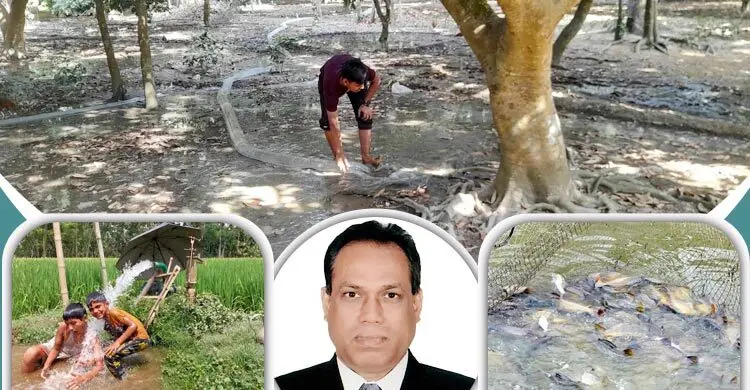
The sun's burning rays seem to be pouring down fire. Cities and villages, roads and highways, all are scorched by the sun; tarmac roads feel like blazing ovens, and lives driven by the need to earn a living are at breaking point. For the past few days mild to severe heatwaves across the country have left animals suffering too, and even the air feels like fire. The season's first heatwave has shattered all of this season's records.
Record heat in Chuadanga
For several days the mercury has soared in Chuadanga, which now records the highest temperatures in the country. The temperature in this border district has gone above 42 degrees Celsius, a very severe heatwave, and in places the tar on roads is melting. Other districts are also burning: a severe heatwave of 41 degrees is sweeping the south-west. Many people are fainting in the extreme heat, and various illnesses and health problems are appearing. Daily life is in disarray; no one leaves home unless they must, many go out with umbrellas, and working people are suffering most.
According to the Met Office, the heat may intensify further across the country. In Bangladesh, a maximum temperature of 36 degrees Celsius in a region is considered a mild heatwave, above 38 degrees a moderate heatwave, and above 40 degrees a severe heatwave. A severe heatwave is now under way in various parts of the country, including Dhaka, Chuadanga and Jashore.
Loss of green space
Our beloved Dhaka and the whole country now badly lack open green spaces. This does not happen abroad, where parks and open spaces are provided for in city planning. So if people are to survive, they must also save the trees and plants that were their neighbours in their earliest life. Scientists in every country are calling for a return to the green shade of trees to escape environmental pollution. That is why tree planting is needed.
Dhaka is a city of heritage. The 400-year-old city is described as one of South Asia's leading centres of education, culture and trade. On its 134 square miles live 1.41 crore people; the population is now much higher, thought to be close to 2 crore. With 1.15 lakh people per square mile, it can be called one of the most densely populated cities in the world. The World Bank says its population will reach 3.5 crore by 2035. As the population grows, canals, rivers and ponds are filled and trees cut down to build homes, businesses, roads, schools, colleges and other infrastructure, harming the environment and shrinking green cover.
Three researchers from Kyoto and Hokkaido universities in Japan who studied Dhaka's greenery found that the city's green area was 12 per cent in 1995 and 8 per cent in 2015, and is now no more than 6-7 per cent. Only a small share of the trees cut in Dhaka are replanted, and tree felling is raising Dhaka's temperature. The same picture holds everywhere in Bangladesh.
What is driving the heat
This fiery heatwave has been intensified by legal and illegal brick kilns across the country, and by the huge rise in air-conditioner use in mills, factories, shopping malls, shops, markets, hotels, motels and homes in towns and cities. Alongside this, unplanned legal and illegal battery-, CNG-, diesel- and petrol-powered vehicles, rickshaws, auto-rickshaws and other transport have multiplied, each adding to rising temperatures. The many electronic devices in our daily lives are also constantly giving off heat. Across the country there seems to be a frenzy of filling in rivers, canals, beels, ponds and ditches. All these activities are responsible for today's unwanted extreme heatwave. Without restraining our daily actions, solving this problem will be difficult and challenging, and tree planting alone will hardly improve the overall situation.
Climate change-related crises have also put the very existence of crops' beneficial insects under threat. The indiscriminate use of chemicals and pesticides in farming has made this problem worse: these unwanted pesticides mix into crop soils and increase the soil's carbon emissions, so that the earth's surface temperature keeps rising.
Threat to the farm sector
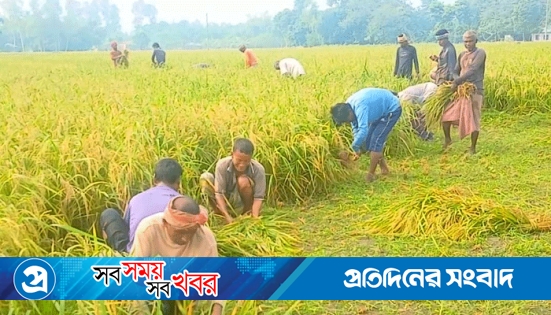
The country's agriculture is facing disaster from the extreme heatwave, with temperatures rising nationwide day by day. Temperatures above 35 degrees are intolerable for rice, and the country is seeing 42 degrees Celsius, a major obstacle to overall rice production and food security. Besides rice, mango, jackfruit, lychee, cotton and other crops are being damaged, and there are fears for maize and soybean production too.
Managing rice and fruit crops
If Boro rice is hit by heat shock or hot winds (35 degrees), the grain may become chaff. So 2-3 inches of water must be kept in the field from the panicle stage of rice to flowering. Mango, jackfruit and lychee trees must be irrigated adequately at the base every 7-10 days. If needed, water can be sprayed on the branches, or flood irrigation used. This will reduce fruit drop and raise yields. Mulching at the base of trees after irrigation can help keep moisture in the soil.
Managing vegetables
Fields of fruiting and leafy vegetables need two to three irrigations over the next week, depending on soil type. Organic fertiliser holds more water, so it should be applied. Mulching and irrigation must be ensured to protect fruit and vegetable seedlings from heat damage. Farmers should seek advice from the local agriculture department to reduce crop losses from the ongoing heatwave.
Managing livestock
To help livestock withstand heat stress, cattle and poultry sheds must be kept cool. Cattle should be bathed several times a day or sprayed with water. They should be given water mixed with extra salt, vitamin C and glucose. During the heatwave, cattle should not be kept shut in sheds but kept in the natural shade of trees. They should be fed tender green grass instead of dry straw, and feed should be reduced in extreme heat. Deworming, vaccination and transporting animals should be avoided in the hottest weather. If an unexpected situation arises, contact the local livestock officer.
Protecting fish
In relatively shallow ponds, new water should be added to bring the depth to at least 5 feet, so the lower water stays somewhat cooler and fish can shelter there. Shade can be provided by building a trellis over the water on the pond's south bank and growing gourd-type plants on it. Water hyacinth or coconut leaves can be kept in bamboo enclosures covering 10 per cent of the pond's area. During the sunniest part of the day, from noon to 3pm, water from a deep tube well should be supplied to keep the water depth at 5 feet or more. In the morning, 200-250 grams of salt or 100 grams of vet saline per decimal can be dissolved and sprinkled over the pond.
At night, an aerator, blower or machine (which makes the pond water spout or swirl, helping oxygen from the air mix quickly into the water) should be run to supply oxygen; otherwise oxygen tablets should be spread at 10 grams per decimal. Feeding should be reduced, or stopped temporarily if needed, until the water cools to normal, with small amounts given in the morning and after dusk. Vitamin C (7-8 grams per kg of feed) should be mixed into feed until temperatures return to normal. Moving fish or fingerlings during the day should be stopped at this time or done with great care.
A severe heatwave has been sweeping Bangladesh for the past few days. So let us all be careful and warn others too.
Source: Jagonews24. First published in Bengali on The Agro News.
Comments
(0)