
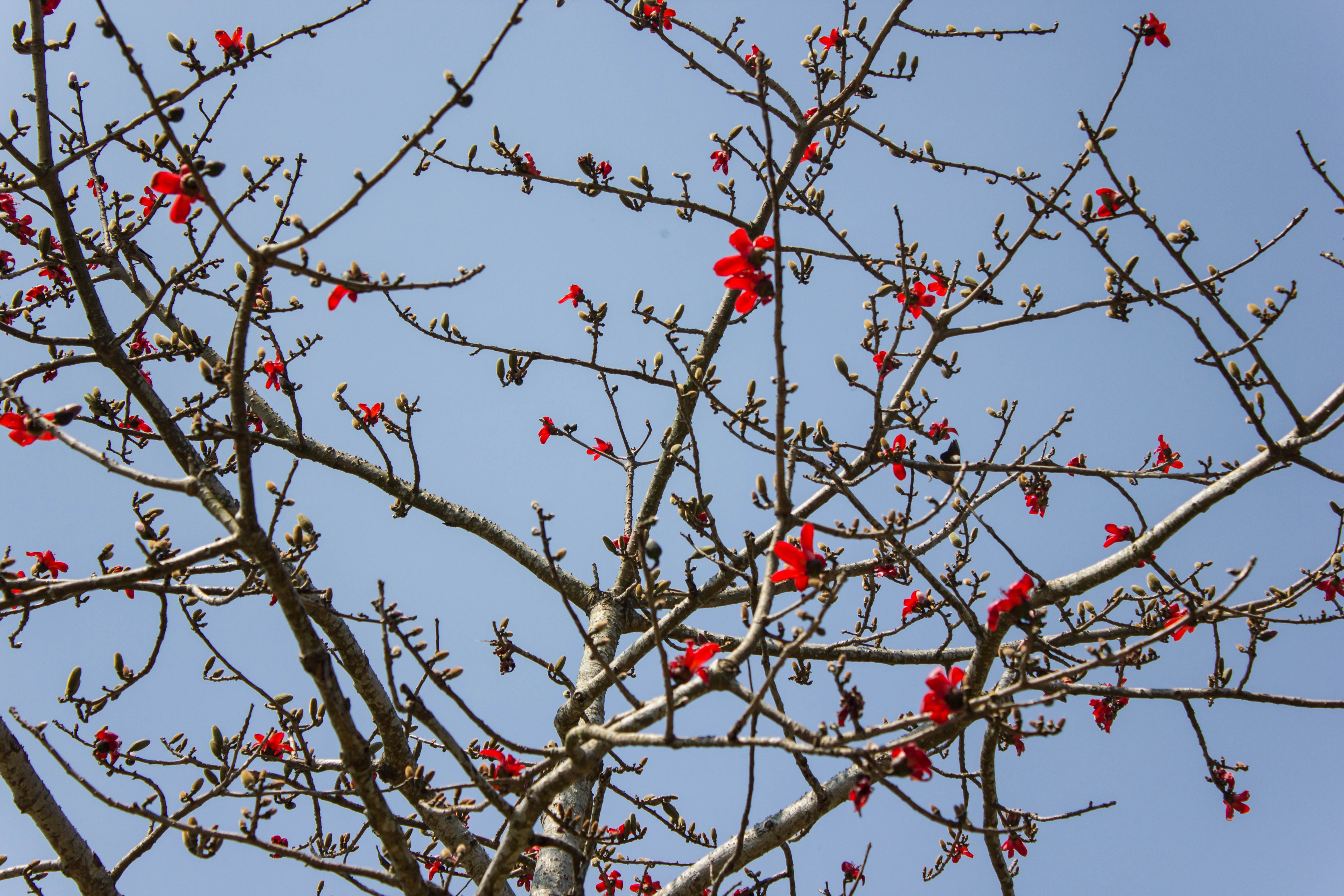
On 14 February 2026, the first day of Falgun and of spring in the Bangla calendar, Jagonews24 published a photo feature by Khairul Bashar Ashiq on the shimul (red silk-cotton) and palash (flame of the forest) trees in bloom at Hatirjheel in Dhaka. In the chess court park area next to the FDC, the feature reported, the arrival of spring had covered the branches with reddish flowers, as it does every year, giving one of the capital's busiest districts a burst of colour and drawing small birds to the blossoms in search of nectar.
Spring colour at Hatirjheel's chess court park
The feature described Hatirjheel as a quiet refuge of nature amid the bustle of the capital. In the green space by the chess court, it said, the red blossom both rests the eyes of city dwellers and draws birds close. Small birds perched on the branches looking for nectar, while light and shade played across the hanging clusters of flowers.
Red shimul flowers spread between bare branches against the open sky, a pattern the writer likened to fire. Dense clusters of orange-red flowers stood out along the boughs. The writer described a small bird sitting on a branch and searching a flower for nectar, and called the scene a living moment of urban nature that recalls how people and nature live side by side.
Up close, the photographs showed the arrangement of petals, pollen and green buds. Visitors and passers-by stopped and sat down to take in the sight. According to the feature, the trees at this spot bloom every spring in striking red, yellow and reddish-orange, and in the chess court area the fiery 'red palash' and the shimul together give the whole setting its spring atmosphere.
The writer gave the palash particular attention, calling it a silent poem of spring written in the colour of fire. When the bright red-orange petals burst out together from dry branches, the feature said, the bare surroundings suddenly come back to life: from a distance the trees seem to be ablaze, and up close a faint scent lies in the folds of the soft petals. Against the blue sky, the dusty paths and the patches of green, the palash colour made spring livelier still; the writer called the flower a crimson symbol of the season's joy, love and new hope.
Pohela Falgun, the first day of spring
The feature appeared on Pohela Falgun, the first day of the Bangla month of Falgun, which Bangladesh marks as the first day of spring. A Dhaka Tribune report published on the evening of 13 February 2026 said that Pohela Falgun would fall on Saturday 14 February that year and would again coincide with Valentine's Day, which is celebrated worldwide on that date.
The two occasions fall together because of the revised Bangla calendar. According to the same report, Pohela Falgun used to fall on 13 February under the earlier calendar. The revision, which the report attributed to the Bangla Academy, aligned the calendar with historically significant dates of 1971 so that national days keep the same Bangla dates every year. Under it, the months from Boishakh to Ashwin have 31 days each, Kartik to Magh have 30 days each, and Falgun has 29 days, or 30 in a Gregorian leap year.
The report noted that the Faculty of Fine Arts at the University of Dhaka had no official programme for the day in 2026 and that students planned to celebrate in their own way. The custom of students gathering and walking through the campus on the first day of spring began at the fine arts faculty and has since spread across the whole campus. For many city residents, the flowering trees in open spaces such as Hatirjheel are part of the same seasonal change the day celebrates.
Hatirjheel: a drainage channel turned city lake
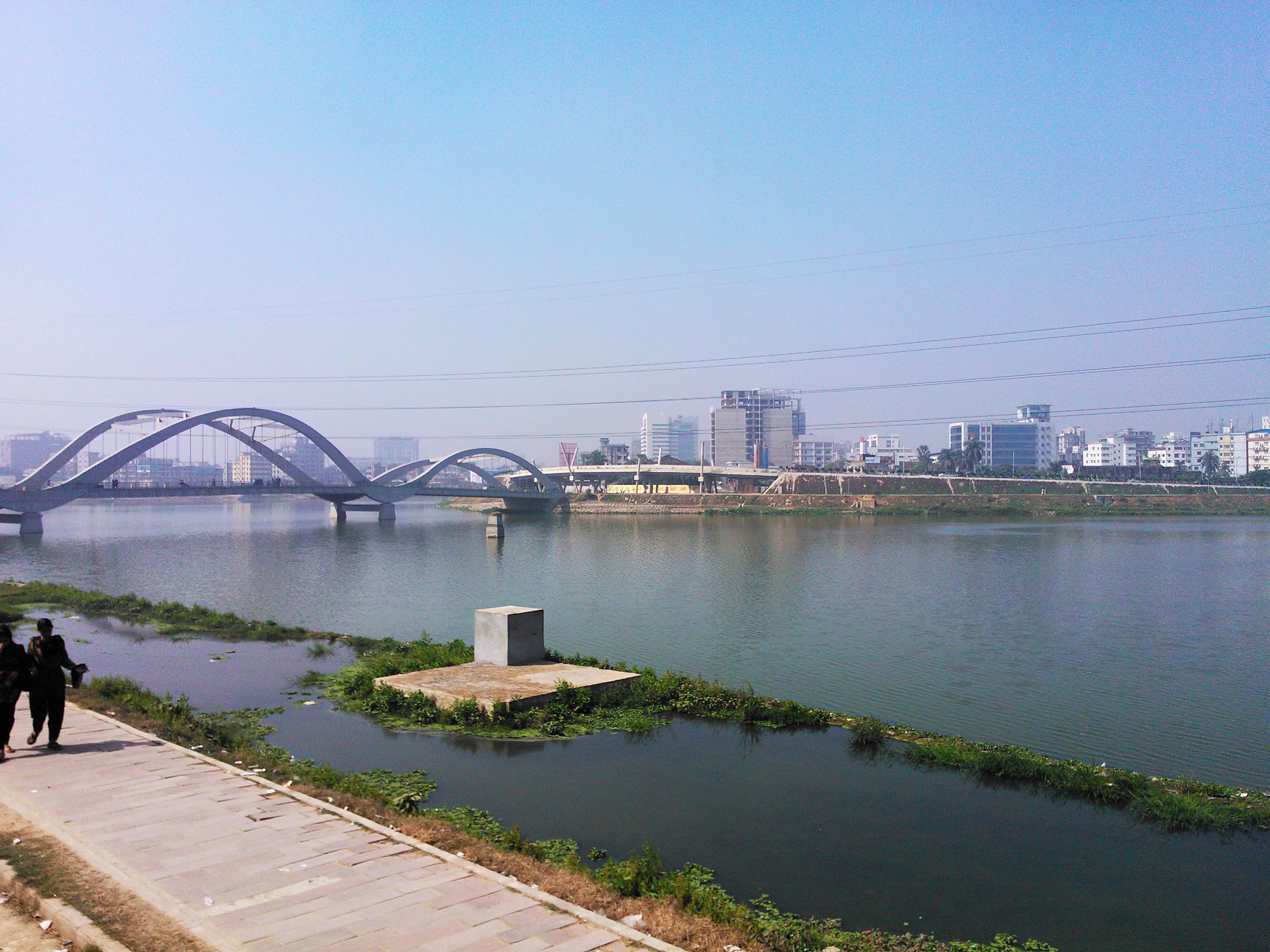
Hatirjheel is a lake and road network in the middle of Dhaka developed from the Hatirjheel and Begunbari area. When the scheme was formally opened in January 2013, The Daily Star described it as a 302-acre site between Airport Road and Rampura, running along Tejgaon, Gulshan, Modhubagh, Moghbazar, Badda and Ulan. Of that land, the paper reported, 46 acres belonged to Rajuk, 34 acres to other government agencies and 81 acres to the Court of Wards, while 141 acres were private.
The Financial Express reported on 2 January 2013 that Rajuk (Rajdhani Unnayan Kartripakkha, the capital's development authority) had started the project in 2007 to protect the water body from encroachment and turn it into a rainwater retention pond, and that it was later redesigned to add roads, bridges and recreation facilities. The paper put the revised cost at Tk 19.71 billion. According to The Daily Star, Rajuk, Dhaka Wasa, the Local Government Engineering Department and an army engineering corps carried out different parts of the work from 2008, with the Bangladesh University of Engineering and Technology as consultant. The then prime minister inaugurated the infrastructure on 2 January 2013.
The Daily Star listed the main structures as a nine-kilometre east-west express road, eight kilometres of service roads, three bridges across the lake, three viaducts along the peripheral road and four overpasses, along with a nine-kilometre footpath and a ten-kilometre lakeside walkway. The plans also included a theatre, a viewing deck, landscaping and park furniture.
Drainage was the project's core purpose. The scheme was designed to link the Begunbari canal with the Gulshan-Banani lakes and to carry storm water from four Dhaka Wasa zones, protecting areas such as Paribagh, Karwan Bazar and Eskaton from waterlogging, while also helping rainwater soak into the ground. The Dhaka Metropolitan Development Plan designates the Begunbari canal as a natural water body and a flood flow zone, and the head of the project's technical expert team told The Daily Star that the canal was a vital drainage channel for preventing urban flooding. The green verges, walkways and parks along the water are where trees such as the shimul and palash in the Jagonews24 photographs stand.
Shimul: the red silk-cotton tree
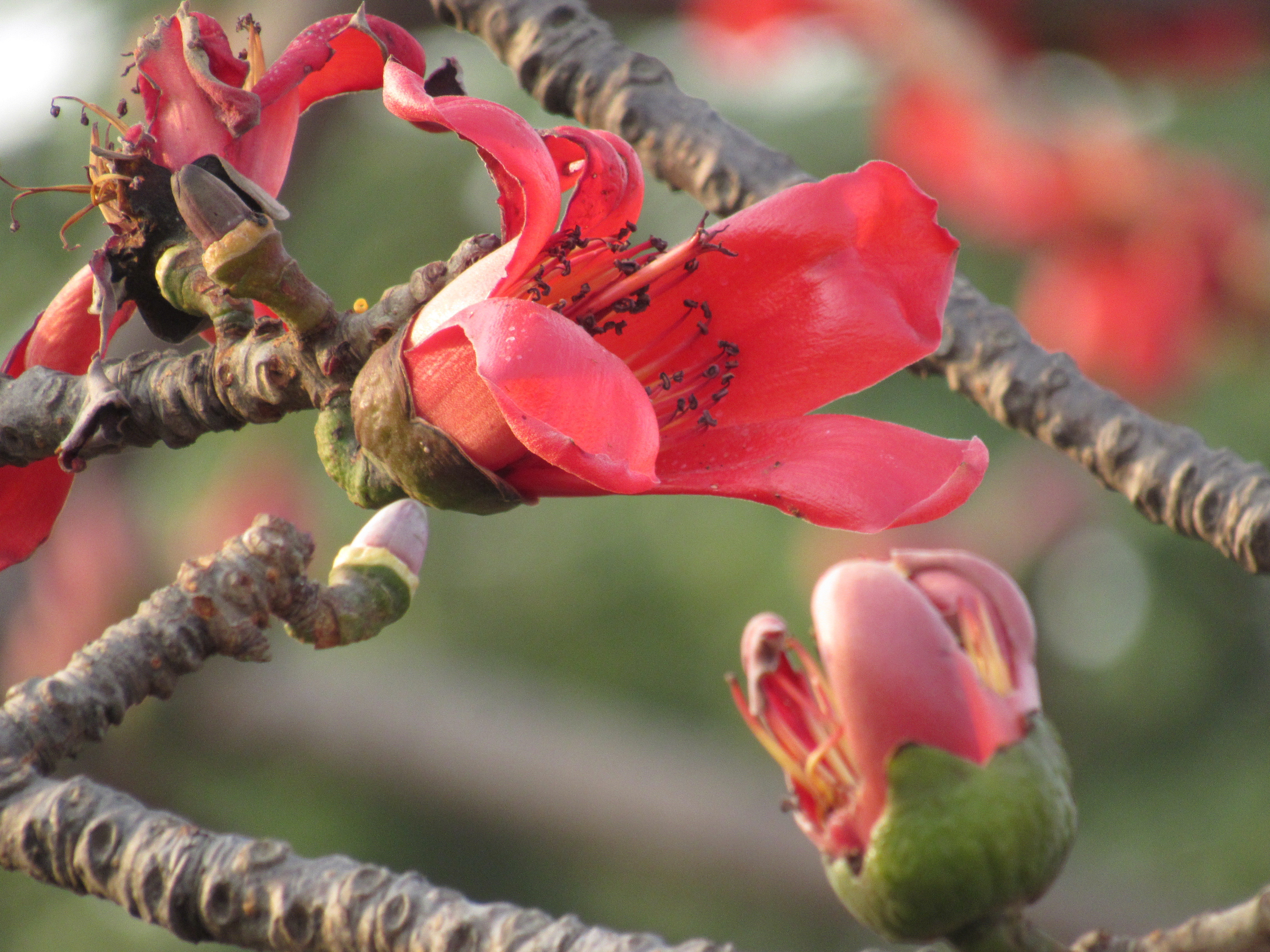
Shimul is the Bengali name of Bombax ceiba, known in English as the red silk-cotton tree or simply the cotton tree. Banglapedia, the national encyclopedia of Bangladesh, describes it as a tall deciduous tree of the family Bombacaceae (botanists now place the genus in the wider mallow family, Malvaceae) that reaches about 30 to 40 metres, with a straight, unbranched trunk and grey, very rough bark. Young trees carry many sharp spines on the trunk; the Bengali edition of Banglapedia notes that older trees are usually free of them.
The leaves are palmate, with about six leaflets spreading from the tip of a long stalk. The tree drops them in the dry season and, before new leaves come, produces large cup-shaped flowers, red or orange, with five petals, at or near the ends of the bare branches. That is why a shimul in full bloom looks like a mass of red against the sky. The fruit is an oblong capsule packed with white silky floss in which many dark seeds are embedded.
Banglapedia records that the shimul occurs in the forest areas of Chittagong, the Chittagong Hill Tracts and Sylhet and is also grown all over Bangladesh. Its wider native range runs across tropical Asia, from Pakistan, India, Nepal, Bangladesh and Sri Lanka through Myanmar, southern China and South-East Asia to Australia. In India it is widely planted in parks and along roads for its flowers.
A 2005 study in the journal Ornithological Science by A. J. Solomon Raju and colleagues, made in India's Eastern Ghats, described the tree's yearly cycle: leaf fall, flowering and fruiting all take place in the dry season, and new leaves flush in the rainy season. A tree produces few fruits, but each holds numerous seeds. When the capsules ripen they split open and the seeds, carried on their floss, are dispersed by the wind, still in the dry season.
Wood and floss: what the shimul gives
Although the trunk is massive, its wood is soft, light and not durable. Banglapedia lists its main use as the match industry, for matchboxes and match splints, and notes a strong demand for it for packing cases, toys, second-grade pencils, planking and coffins. The floss inside the fruit, known in Bengali as shimul tula, is used to make good-quality pillows, beds and mattresses.
Banglapedia adds that the gum and roots of the tree are held to have some medicinal value. The flowers have also drawn research interest: a review published in August 2025 in the journal Chemistry & Biodiversity described shimul flowers as a source of fibre and carbohydrates containing vitamin C, iron, sodium, phosphorus and calcium, and set out the phenolic and flavonoid compounds that laboratory studies have identified in them, with the aim of assessing their potential in food and pharmaceutical products. Such reviews describe research, not proven treatments; anyone thinking of using any part of the tree as a remedy should consult a doctor first.
The tree's spring display has made it a destination in its own right. In February 2023, the Dhaka Tribune reported on the shimul garden at Manigaon in Tahirpur upazila of Sunamganj, about 28 kilometres from the district town, on the bank of the Jadukata river. According to the report, a local tree lover had planted 3,000 shimul saplings on 100 acres about 25 years earlier; that year 2,000 of the trees had blossomed, and visitors from across the country crowded the garden on Pahela Falgun and Valentine's Day. The garden's owner told the paper that more than 300 new saplings had been planted that year.
Palash: the flame of the forest
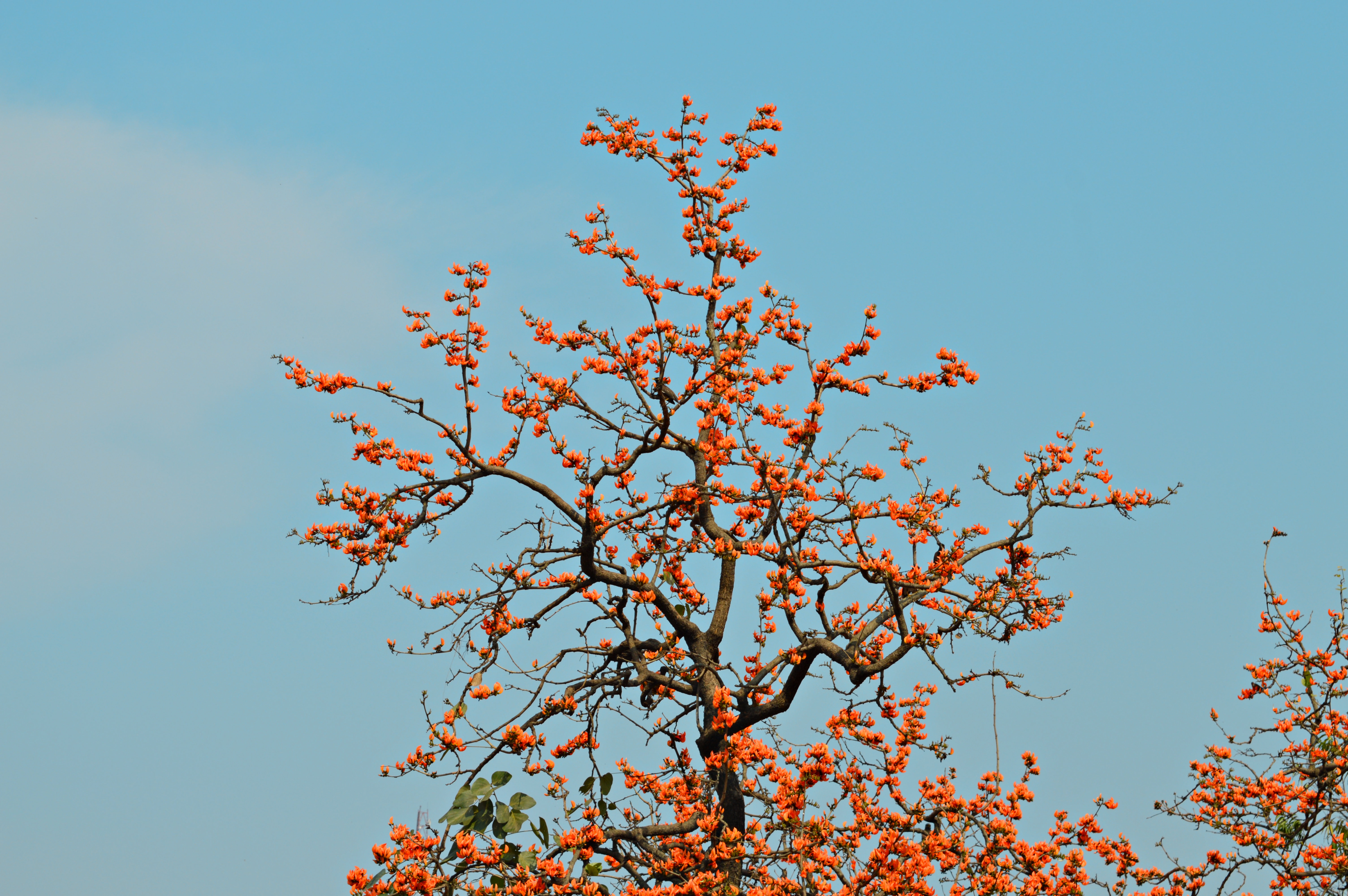
Palash is Butea monosperma, a tree of the legume family, Fabaceae, known in English as the flame of the forest and also as dhak and Bengal kino. It is native to the tropical and subtropical parts of South and South-East Asia, Bangladesh included, and is grown elsewhere as an ornamental. It is smaller than the shimul: a medium-sized tree that sheds its leaves in the dry season and grows to about 15 metres.
Each leaf has three broad leaflets. The flowers are about 2.5 centimetres long, bright orange-red and borne in dense clusters on racemes up to about 15 centimetres long. Like a pea flower, each has a large upper petal, two wings and a keel, which in the palash is curved like a parrot's beak. The fruit is a flat pod 15 to 20 centimetres long, and the species name monosperma refers to its single seed.
The most detailed study of the tree's flowering is a 2003 paper in the Annals of Botany by Rajesh Tandon, K. R. Shivanna and H. Y. Mohan Ram, based on about 200 wild trees in the Central Ridge Forest of New Delhi. The trees that flowered began to shed their leaves in December and were completely bare by January. Flowering ran from February to April: buds began to open in the first or second week of March and peaked in the first week of April, and a tree stayed in bloom for six to eight weeks, although each flower lasted only one or two days. An inflorescence was about 21 centimetres long and carried, on average, about 166 flowers.
The study also confirmed something many people notice: not every palash flowers every year. Of 30 trees followed by the researchers, 27 flowered in the first year of the study and only 18 in the second.
The palash also carries a strong cultural association with spring in Bengal. Rabindranath Tagore likened its flowers to fire in his songs and poems, and at Santiniketan the flower became part of the celebration of spring. Palashi, the place that gave its name to the Battle of Plassey, is named after the tree.
Lac, dye and leaf plates: the uses of palash
The palash has long been a working tree. Tandon and his co-authors listed the non-timber products it yields: a water-soluble dye, lac resin, fodder, and leaves used as platters. In India the tree is one of the main hosts of the lac insect, whose resinous secretion is processed into shellac.
The flowers yield a yellow to deep orange dye, used to colour silk and sometimes cotton and, in India, as a festival colour. The bark gives a red gum that dries into the substance sold as Bengal kino, valued by leather workers for its tannin. The wood is soft but lasts well under water, and the leaves were once used to serve food where disposable plates are used today. Farmers also plant the tree on field bunds to reduce soil erosion.
Like the shimul, the palash has a long place in traditional medicine in South Asia, and researchers have studied extracts of its flowers, bark and seeds in the laboratory. Those studies do not make it a proven remedy. The oil of the seed and a compound in the flower sap are considered poisonous, so the flowers and seeds should not be taken as medicine without a doctor's advice.
Why birds crowd the blossoms
The small birds the Jagonews24 photographs showed searching the flowers are part of how both trees reproduce. Both shimul and palash flower when their branches are bare, which leaves the large, bright, nectar-rich blossoms in full view of the animals that feed on them.
In the New Delhi palash study, nectar was secreted by five nectaries and collected in the cup of the calyx; a single flower produced about 73 microlitres between five in the morning and six in the evening, most of it between nine and eleven in the morning, and the flowers opened between nine and half past ten. Seven bird species from six families visited the trees: the house crow, the Indian treepie, the purple sunbird, the rose-ringed parakeet, the red-vented bulbul, the jungle babbler and the white-eye. Only the purple sunbird, which fed from the front of the flower, proved an effective pollinator among the birds; the three-striped squirrel also pollinated the flowers. Fruit set was low, about five per cent under natural conditions, against about 22.5 per cent when the researchers cross-pollinated flowers by hand.
The shimul depends on its visitors even more. Raju and colleagues found that its open, red, cup-shaped, nectar-rich flowers were pollinated by bees, birds and bats, and that the tree is an obligate outcrosser: only pollen carried between different shimul trees produces fruit. They also recorded some birds, squirrels and monkeys eating flower parts or whole flowers every day, which reduced the trees' fruiting success.
A 2022 genetic study in Frontiers in Plant Science, made on Hainan Island in southern China, where the shimul's flowering peaks in late February and early March, described its flowers as having a bright upward-facing corolla and copious dilute nectar at a time of year when few other plants flower there. The researchers traced how far pollen moved between trees and found an average distance of about 203 metres, with the longest beyond one kilometre, a pattern consistent with generalist birds such as white-eyes and bulbuls. Fruit set was only about 3.3 per cent, which the authors linked mainly to the birds' short flights and to human disturbance, and they attributed the trees' low genetic diversity largely to logging and the collection of fruits.
Read alongside that research, the scene at Hatirjheel is more than a pretty photograph: a flowering shimul or palash is a source of nectar for birds at the end of the dry season, and the trees in turn depend on those birds to set seed.
Photo: Saad Faruque / Wikimedia Commons (CC BY-SA 2.0)
Sources: Jagonews24, Banglapedia, The Daily Star, The Financial Express, Dhaka Tribune, Annals of Botany, Ornithological Science, Frontiers in Plant Science, Chemistry & Biodiversity, Wikipedia

Comments
(0)