
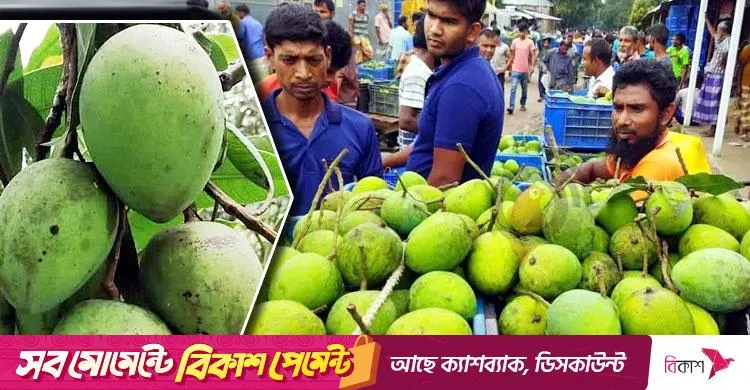
The Haribhanga mango holds a special place in the hearts of Bangladesh's mango lovers. Born in Mithapukur in Rangpur, it has now crossed the country's borders and reached markets abroad. With its fibreless flesh, unmatched sweetness and small stone, it is more than a fruit: it has become the pride of the northern region. But many people are curious about the name "Haribhanga", which means "broken pot". Why this name, and where did it come from?
The mango, known as the king of fruits, comes in many varieties and flavours. Among them, Haribhanga has carved out a place of its own and has become Rangpur's "brand". Its journey began in Tekani village of Mithapukur upazila, and the story behind its name is as delightful as the mango itself.
A broken pot and a joke
It is said that the Haribhanga mango was founded by Nafal Uddin Paikar, a lover of trees. Around 1949, possibly, Balua Masumpur village in Mithapukur was full of scrub and jungle. Nafal Uddin brought two mango saplings from a plot of land there and grafted them. At the time the mango was called Maldia.
Unfortunately, one tree was stolen. A clay pot was tied to the remaining tree as a filter to water it. One night someone broke the pot. In time, however, the tree bore a huge crop of mangoes that were beautiful to look at and very tasty. When they were taken to market, curious buyers wanted to know about them.
Nafal Uddin replied jokingly: "These are mangoes from the tree whose pot people broke, the haribhanga tree." From then on, the mangoes from that tree became known as Haribhanga. A comic incident and a unique taste together began a new history.
From one tree to orchards
As word spread of the sweet, tasty mango, people rushed to take grafts from the mother tree. Local people planted the grafts and orchards began to grow. After Nafal Uddin died, so many people came to graft from the mother tree that its branches began to bend. From the 1980s, many started planting orchards with commercially produced grafts.
Many people have been involved in spreading Haribhanga, but Lutfar Rahman and Abdus Salam Sarkar are particularly well known. They began growing Haribhanga commercially after 1990. Today it is grown beyond Rangpur district, in Nilphamari Sadar, Saidpur, and Parbatipur, Khansama and Chirirbandar in Dinajpur.
The mother tree still stands quietly in Tekani village of Khoragachh union in Mithapukur upazila. Its branches spread wide and its trunk is so thick that two people together cannot wrap their arms around it. However many new trees are planted, the mother tree remains a living witness to history, and it still bears fruit.
The tree and the fruit
The tree is attractive, with healthy, sturdy shoots. Grafted branches grow quickly, and blossom appears the year after planting. The branches spread sideways rather than growing tall, and because the tree is short it is not uprooted by storms and drops fewer mangoes.
The Haribhanga mango is fibreless, sweet and tasty. The upper part is thick and broad and the lower part narrow. It looks shapely and fleshy, with a round, slightly elongated pulp and thin skin. The stone is very small. Even when the skin wrinkles, the mango does not rot easily, and it tastes different at each stage from young to ripe.
Each mango weighs 200 to 300 grams. Picking begins in the second or third week of June every year, and as a seasonal fruit it has won a firm place in consumers' interest.
Source: Jagonews24. First published in Bengali on The Agro News.


Comments
(0)