
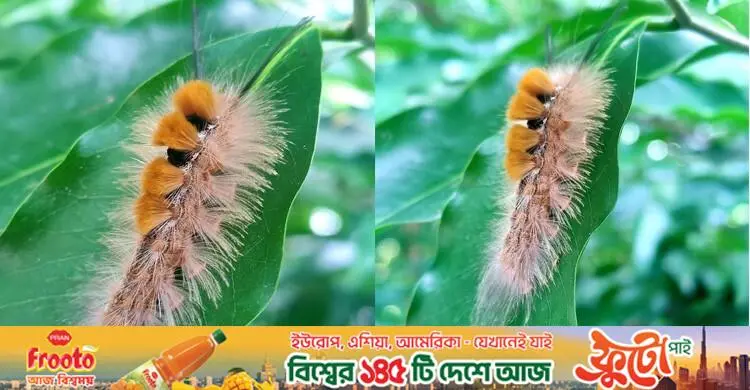
One morning I was walking along the village road near my home when my eye was caught by the leaves of a small debdaru tree by the roadside. A strangely beautiful creature was moving slowly across a leaf. Its whole body was covered in thick golden-white hair, and along the middle of its back were four yellowish-orange tufts like brushes. At first sight it might seem a fine piece of nature's art. But as a zoology student it did not take me long to understand: this was no ordinary insect but a hairy caterpillar, which will one day become a moth. However charming it looks, it is a mistake to touch it with bare hands, because its hairs are an effective defensive weapon. On sensitive skin they can cause itching, burning or allergic reactions.
What kind of caterpillar
The caterpillar I saw is an insect of the class Insecta in the phylum Arthropoda, a member of the order Lepidoptera and the family Erebidae. Because of the dense hair all over its body it is commonly called a hairy caterpillar. Judging by its outward features, it is probably the caterpillar of a tussock moth. The caterpillar is the second stage, or larval stage, in the life of butterflies and moths. After hatching from the egg, its only aim is to eat and grow quickly, feeding on leaves to store the energy it needs. When mature, it builds a cocoon around itself and enters the pupal stage. Then, through a remarkable transformation, a winged adult moth breaks out of the cocoon. Although it may look like a butterfly, it is not one: butterflies are bright and colourful, while moths are somewhat dull and grey.
Why its hairs sting
Various species of hairy caterpillar are found across Bangladesh, especially in the monsoon and summer. They are most often seen on the leaves of fruit, forest and ornamental trees. Although they are an important part of the food chain, when their numbers rise abnormally they can damage farm crops and forest plants by eating the leaves. Their most notable feature is their dense hair, which is their main means of defence. In many species the hairs carry fine spines or chemicals that can irritate the skin. If these hairs touch human skin they can cause itching, burning or allergies, so they should never be touched with bare hands. If hairs get on the body by accident, the affected area should be washed quickly with soap and clean water. In rural areas many people rub salt on the affected spot, but there is no strong scientific evidence that this works, so it is safer to follow medical advice than home remedies.
A living wonder of metamorphosis
One of nature's most astonishing events is metamorphosis, or complete transformation. A caterpillar born from a tiny egg encloses itself in a cocoon within a few weeks. It seems still from outside, but complex biological changes go on inside. In time a moth with spread wings breaks out. From a biological point of view it is one of nature's most striking transformations. Many people kill caterpillars out of fear as soon as they see them. Yet observed from a safe distance, this small creature teaches us about nature's diversity, adaptation and the extraordinary story of the life cycle. It also plays an important role in maintaining the food chain and the balance of biodiversity. The hairy caterpillar walking silently behind the leaves reminds us that every creature in nature has its own beauty, purpose and unique way of surviving. It is not just an insect but a living wonder of nature's boundless creativity, evolution and life cycle.
Source: Jagonews24. First published in Bengali on The Agro News.



Comments
(0)