
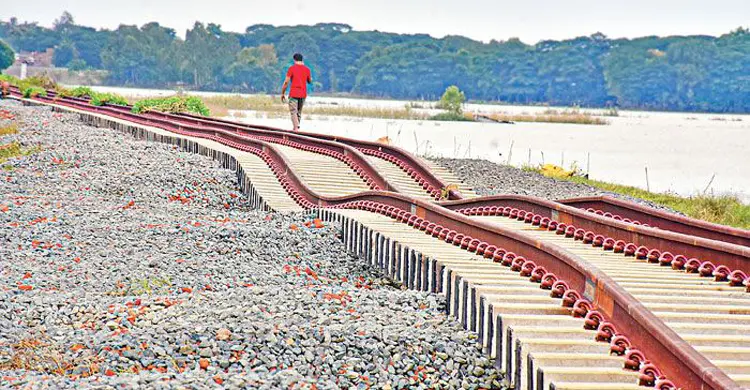
Trains are due to start running on the Dohazari-Cox's Bazar route in October. Heavy rain for a week last August damaged various parts of the railway under construction, and pictures of bent tracks went viral on social media. The authorities, however, claim the damage was not great and say the line will be opened in October.
Dr Md Hadiuzzaman, a professor of civil engineering at BUET and a transport expert, spoke to Jagonews about these issues. The interview was conducted by Saiful Haque Mithu.
Why a railway to Cox's Bazar
Jagonews: Dhaka is already linked to the tourist city of Cox's Bazar by river, road and air. How justified is adding a rail link?
Dr Md Hadiuzzaman: Many Asian countries are growing economically strong on the back of tourism. We too had huge potential in tourism. Bangladesh has the longest sea beach and a mangrove forest, and hills, rivers and every other tourist attraction. Tourism has not spread widely because of weak communications. It takes 10-12 hours to reach Cox's Bazar from Dhaka by road, and road, river and air travel are expensive, not to mention traffic jams on the road. Considering all this, the new rail network will bring a revolutionary change on the Dhaka-Cox's Bazar route.
Not only tourism: Cox's Bazar's salt industry and its dried fish and betel leaf trade will expand. If we want to spread these products across the country, we will have to depend a lot on the rail link. World-renowned experts studied the feasibility of this project. But the ecology of Chattogram is somewhat different, with forests, hills and wetlands.
The hydrological dynamics here, the flow of water, differ from any other part of Bangladesh. Elsewhere in Bangladesh water flows north to south, which is why structures built on embankments do not cause problems.
This rail link has been built through a wetland where the dynamics of water flow are completely different. Where there are high hills to the west, rainwater rushes down, often as flash floods, and a canal and river system carries it away. When we built this railway on an embankment, we obstructed those hydraulic dynamics. When you obstruct nature, nature will try to take revenge, and that is what happened here. There is room to check whether the environmental impact assessment in the feasibility study was done properly.
Climate change and flooding
Jagonews: Was climate change taken into account? The railway was recently submerged by heavy rain. You spoke of revenge; what do you mean?
Dr Md Hadiuzzaman: Climate change is another important issue. It is not enough to look at rainfall. There are big rivers in the project area: the Bakkhali, Sangu and Matamuhuri are all linked to the Bay of Bengal. Because of climate change the sea bed rises a little every year. I think there is a weakness in taking into account not just rainfall but the effect of the sea bed rising due to climate change.
Whether holding the water that rushes down from the hills was considered has become a very big issue. The disaster we saw recently (the tracks bending and going under water) has become a death trap for people living within about three kilometres of the area.
Jagonews: The railway says the damage is not great. What will happen when heavy rain starts again?
Dr Md Hadiuzzaman: This is not just a matter of damage to the railway. What the railway says is a lame argument. They say they will repair it with a few crore taka. We are looking only at the railway's loss. But the people living around the affected area have fallen into a long-term waterlogging problem, and its impact is an irreparable loss. There is hilly land to the west and we built the rail embankment; the residents are now trapped in between. The settlements here will be affected. This effect is not a matter of crores of taka; it is a long-term effect.
We also say the railway will run through a wildlife sanctuary, and there is the question of elephants. Floods like this will affect wildlife too. The Department of Environment has also said this is a red-category project. The IUCN and various organisations in developed countries working on the environment also say it is a highly sensitive matter. A project like this needed deeper public engagement, the views of local experts, and the involvement of people who work on the environment and hydraulics.
Risk of derailment
Jagonews: Pictures show gaps under the tracks. Do you see a risk of accidents on this railway?
Dr Md Hadiuzzaman: The railway argues that the line had not been welded. But I don't think welding is the issue. Flash floods washed away the soil, stone and ballast from underneath. With no support below, the rail bent under its own weight. When you repair a bent rail, trying to bring it back to its original state, its temper will be damaged. Since rails are made of metal, their temper will keep deteriorating, and there will be a risk of them bending again, not only in rain but even at modest temperatures.
Derailment is a major cause of our rail accidents. Once the rail's temper is damaged, there will be a risk of derailment. They say trains will run from Dohazari to Cox's Bazar at 120 kilometres an hour, so the tracks must be risk-free. How rational the plan to build the railway on an embankment was is now the big question.
Jagonews: Could box culverts have prevented the disaster? How else could the railway have been built, without an embankment?
Dr Md Hadiuzzaman: Those involved in the project say that even seven or eight more culverts would not have prevented such a disaster. Local people say there are only a few culverts in the area and water flow and drainage have been obstructed. So the question now is why the railway was built on an embankment. You yourselves say seven or eight culverts cannot solve the problem. The residents' complaints must be taken seriously. In the 1997-98 cyclone in southern Chattogram the storm surge was very high. Now local people say that since the railway was built, the surge water level has become two to three times higher. Building railways on embankments is an outdated technology.
The Akhaura-Agartala rail link is about 15 kilometres long, five kilometres of it in India. We built our part on an embankment here too, while the Indian part was built on a viaduct, on pillars. They considered keeping water flowing uninterrupted in the face of climate change, and not obstructing the movement of wildlife. That is the philosophy of sustainable development.
Flaws in the feasibility study
Jagonews: What flaws do you think there were in the feasibility study? Could the rail link have bypassed the forest?
Dr Md Hadiuzzaman: Large firms from three countries, Bangladesh, Canada and Australia, studied the feasibility and justification of this route. I have serious doubts about how capable they were of understanding the hydraulics and hydrodynamics of the area the railway passes through. Water has flowed here for centuries in an unusual way. When hill torrents come down, this canal and river system holds them. But in the dry season it cannot be found. If you study feasibility there in the dry season, you will see no canal, and it will be assumed that building the railway on an embankment is appropriate. The environmental assessment I have mentioned again and again should have been long-term.
Local people were involved only on a small scale. People in every upazila the line passes through were consulted. But what matters is how much those involved in the project told residents about it and its background.
How long the study ran, who was involved, and in what context residents were spoken to: there are weaknesses in all of this. That is why we saw the line damaged by flash floods even before its opening. Hills on one side, the railway on an embankment on the other, and residents sitting in between.
There was an alternative. Something could have been built parallel to the N1, the Chattogram-Cox's Bazar highway. There are some challenges there: infrastructure has developed alongside it, and some junction points have become commercially very prosperous. But there was scope to bypass them.
When the line was taken through the forest, the forest had to be acquired, and that could be done cheaply. Going along the N1 would have cost more in acquisition. We cut land acquisition costs by going through an ecologically sensitive area. But I would say this is an ecologically reckless project, because development projects have already begun to come to this area, with business, trade and industrialisation starting. This is the last sanctuary, hill area and forest on the Bay of Bengal.
Elephants in the way
Jagonews: There are elephant habitats and routes at 21 places along the railway. Will the railway become a barrier for elephants?
Dr Md Hadiuzzaman: The railway runs through 29 kilometres of forest. Medhakachhapia, Chunati and Fashiakhali are in fact wildlife sanctuaries. The India-Bangladesh-Myanmar corridor passes through Chunati. It is an active passage for the Asian elephant, and elephants often move through it. There were supposed to be 13 overpasses here, though one overpass has been mentioned for Chunati. Green belts have been planted to guide the elephants, but elephants will not be guided. Barriers have been put up on both sides of the railway and some salt lakes made, because elephants like to eat salt. But more overpasses were needed for elephants to move from one hill to another. The steps taken are greenwashing measures, an attempt to divert environmentalists' attention. As far as I know, nowhere in the world has a train been taken through a sanctuary. In India a very small corridor passes through forest, and there are frequent reports of elephant accidents there.
We have seen conflict between elephants and people. I estimate that nearly a hundred people have died in such conflict in a decade. People are often killed at railway level crossings, and the railway has not been able to solve that. Now another problem has been brought in: whether trains will collide with elephants at level crossings. The railway has come under more pressure here. In India, elephants have been hit by trains even in a small forest. Camera tracking for elephants must be set up here. When an elephant or other wild animal is detected on the track, the train's loco master must be told at once. A train cannot stop suddenly; it must be given a set time to stop. We must put this system in place.
Opening before completion
Jagonews: There is talk of opening the railway even though work is not fully complete. How do you see this?
Dr Md Hadiuzzaman: The projects we have taken up in the 52 years since independence are undoubtedly modern, timely and profitable. Naturally, these projects will be a big factor in election campaigning, so they are being opened after partial implementation. Every one of them has its usefulness, and a mega project's usefulness will naturally be huge. But opening them partially is also backfiring, and the image of those implementing them is being called into question. To achieve the projects' aims and ensure a return on investment, it is sensible to open them only when they are fully ready.
Source: Jagonews24. First published in Bengali on The Agro News.
Comments
(0)