
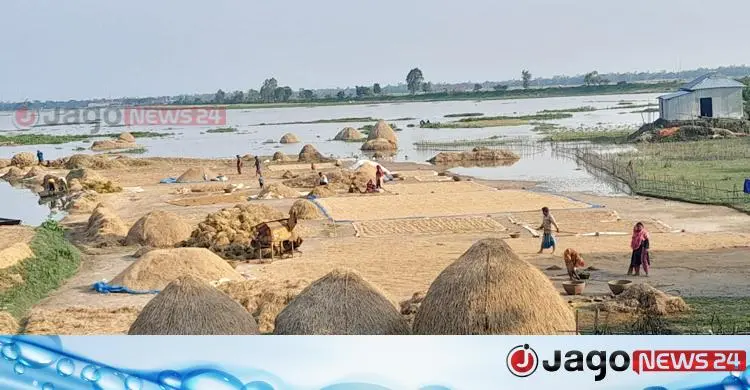
For the people of the haors, Baishakh is the month of festivities: the moment when the golden crop, grown with three long months of sweat, is brought home. The smell of new paddy mixes with the bustle of homemade pithas, and relatives from the towns come back to the villages to share the joy. This year the picture is completely different. The usual liveliness is gone, and a shadow of grief hangs over every haor in Habiganj.
In the district's haor areas, paddy has been cut on about one-third of the land while two-thirds remains under water. Some farmers have lost their entire crop; others managed to cut some but could not dry it because of the rain. Seedlings have sprouted in the heaped paddy and it has started to rot. Many farmers, watching the fruit of their back-breaking work go to waste, have been left numb with grief.
Farmers count their losses
Oliur Rahman of Boilakipur village in Nabiganj said: "I farmed 20 kedar (each kedar is 30 decimals). I cut the paddy too, but there is no gain at all. With no sunshine, all the paddy has rotted. Not even one maund fit to eat will survive. I don't know whether this rotten paddy can be sold, and even if someone takes it, it will fetch very little. There is no profit in farming any more."
He added: "Baishakh is a month of great joy for us. Bringing in the new paddy goes together with the pitha festival. This time that joy is gone; nobody is smiling."
Mahbubur Rahman Chowdhury of Sujatpur Shatamukha village in Baniachong upazila said: "Whenever the water in the Khowai river rises even slightly, all the haor land goes under. This time everything was submerged just as the paddy began to ripen. I managed to cut the paddy from one or two kedar, but it has started rotting."
"When Baishakh came, the whole place used to be busy gathering food for the entire year and with relatives visiting," he said regretfully. "This time we don't even have food for ourselves. What would we celebrate with?"
SM Suruj Ali of Atukura village said: "Whatever land I had, it is all finished. There are no labourers to be found, and the harvester machines cannot be taken into the fields because of the water. What little I managed to cut has also started to rot because it was wet. There was a little sunshine on 4 May, so I have put it out to dry. I don't know how much of it will survive."
What the figures show
According to the Department of Agricultural Extension (DAE) in Habiganj, the boro target this season was 123,848 hectares and 123,644 hectares were planted. The rice production target was set at 529,651 tonnes, of which only 135,218 tonnes has been produced so far.
Of the planted land, paddy has been harvested on 44,739 hectares so far: 29,835 hectares in haor areas and 14,904 hectares in areas other than the lowlands. Paddy on 78,905 hectares is still to be cut, of which 10,439 hectares is completely under water.
Dipak Kumar Paul, deputy director (horticulture) at the DAE in Habiganj, said: "This year the planting target was almost reached. Had the disaster not come, paddy production would have exceeded the target."
"Our advice is that farmers should grow hybrid and short-duration varieties on low-lying land, and plant them at least 15 days earlier," he said. "To plant a little earlier, the water standing in the fields will have to be drained into the beels through drains. That needs a plan. We are advising farmers accordingly."
Source: Jagonews24. First published in Bengali on The Agro News.

Comments
(0)