
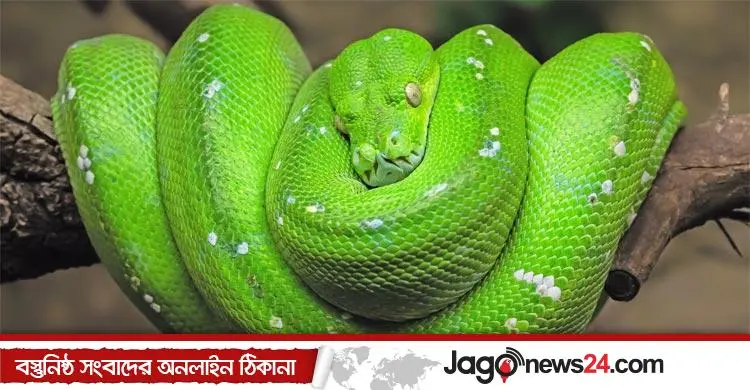
Green snakes usually blend superbly into nature, which makes them both beautiful to look at and very adept at surviving in their habitats. Scientific research has shown that among green snakes some are dangerously venomous while others are entirely calm by nature. Here are seven of the most striking green snakes, drawing on a report in the Times of India.
1. Green tree python
The most eye-catching of the green snakes is the green tree python, found in the dense forests of Australia, Papua New Guinea and Indonesia. Coiled on a tree, it often merges with the leaves, so it escapes the eyes of predatory birds and of its prey. Its colour changes from infancy: hatchlings are yellow or red and turn green as they grow, one of the most striking transformations in nature. It eats rats, small birds and lizards, and breeds by laying eggs. The mother wraps her body around the eggs to keep them warm, a remarkable maternal behaviour among pythons.
2. Emerald tree boa
The deep Amazon jungle of South America is home to the emerald tree boa. White markings on a bright emerald-green body make it highly attractive. It habitually sits looped and coiled on branches. It is mainly nocturnal and hunts by lunging suddenly. Strikingly, the emerald tree boa does not lay eggs; the mother gives birth to live young. Even when fully grown it poses no risk to people, as it is not venomous and kills its prey by squeezing it tightly.
3. Green mamba
The green mamba is the fastest snake of Africa's coastal forests. Its bright green body combined with incredible speed makes it one of the world's most dangerous green snakes. Its neurotoxic venom can quickly cause paralysis and breathing difficulty once it enters the body. It usually lives in trees and rarely comes close to people. Small mammals, birds and bats are on its menu. The female lays eggs, from which the young hatch. Scientists say the green mamba's colour is its greatest defence, as it is almost impossible to find among the leaves.
4. Rough green snake
The rough green snake is a harmless, placid green snake of North America. True to its name, its scales are slightly rough and glisten when light falls on them. It does no harm to people and often roams trees and bushes looking for insects. Its diet includes insects, caterpillars and small earthworms. It is very timid and flees at any sudden noise. It lays eggs, and its green colour greatly helps it survive in the forest.
5. Smooth green snake
Its body is a lovely bright green and smooth, hence the name smooth green snake. It is found from Canada across many parts of the United States. Remarkably, it does biodiversity a great service by eating insects, so its presence on farmland is very beneficial. It does no harm to people and is not venomous. In the breeding season the female lays her eggs under leaves or in soft soil. To protect itself it lies hidden among leaves or grass, where it is hard to spot.
6. Mexican green rat snake
The Mexican green rat snake lives in the dry and dense woodlands of Mexico and Central America. It is slender, long and very agile. Its eyes are brightly coloured and shine even more when light falls on them. As the name suggests, its main food is rats and other small mammals, so it plays an indirect role in protecting farmers' crops. It lays eggs and is not dangerous to people.
7. Asian vine snake, or whip snake
The whip snake, seen in the jungles of South and South-East Asia, has a body so slender that it looks like a twig. Its eyes are large and sharp, which helps it catch prey from a distance. Frogs, geckos and small lizards are its main food. Its green colour is so perfect that it melts into the leaves and becomes completely invisible. It is fast-moving but generally timid, and breeds by laying eggs.
Source: Jagonews24. First published in Bengali on The Agro News.
Comments
(0)