
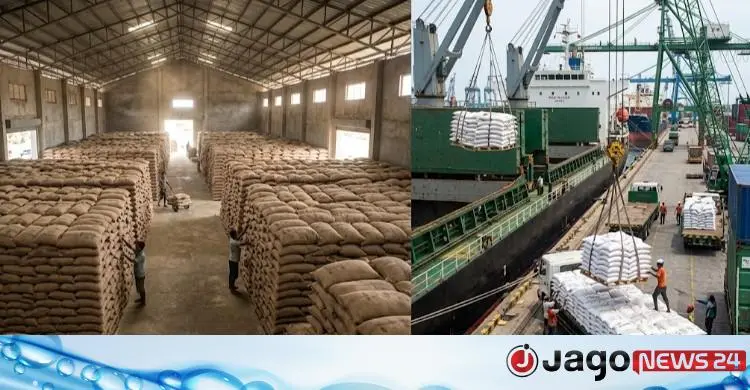
Government food grain stocks are currently at their highest level, and procurement of paddy and rice in the just-ended Boro season has exceeded its target. Even so, the government has decided to buy about two lakh tonnes more rice from domestic mills.
Those involved allege that the extra purchase is being made under heavy pressure from mill owners and politically influential people. Because only rice is being bought, without raising the paddy target, ordinary farmers are directly left out.
Under the government's procurement policy, paddy is bought directly from farmers and processed rice from millers. With the new decision limited to rice, the whole benefit goes into the pockets of commercial millers.
Procurement above target
According to the Ministry of Food, the government procured a total of 18.94 lakh tonnes of paddy and rice in the Boro season: 5.78 lakh tonnes of paddy, 12.11 lakh tonnes of parboiled rice and 1.05 lakh tonnes of atap (sun-dried) rice, all above the initial targets. At the start of the season the targets were 5 lakh tonnes of paddy, 12 lakh tonnes of parboiled rice and 1 lakh tonnes of atap rice.
The government's stock of paddy and rice now stands at 20,23,293 tonnes. The total food grain stock, including wheat and atap rice, is 23.39 lakh tonnes, the highest for this time of year in any year. It is also the first time in several years that the government has procured so much paddy and rice in a Boro season.
Sources say that because stocks and procurement are at their peak, many food warehouses have no room left for paddy and rice, and there is a severe shortage of jute sacks for procurement. Even so, the decision to buy rice was taken only because of the millers' push.
Lobbying with MPs' DO letters
The Directorate General of Food says about 850 mill owners from across the country have already applied for the new allocation. More than 150 of them have submitted DO (demi-official) letters from their local members of parliament. Some have gone further, bringing MPs to the directorate in person and lobbying continuously by phone.
The Ministry of Food faces the same situation. A source said recommendations of various kinds reach the ministry's departments and senior officials every day.
Speaking to Jagonews on condition of anonymity, an official of the Directorate General of Food said: "A mill owner who failed to deliver 1,000 tonnes of rice in the main procurement season, and whose daily production capacity is only six tonnes, is now coming with MPs' DO letters asking for an allocation of 5,000 tonnes. There is no end to the recommendations and pressure."
Food security analysts say that where there is a surplus stock, allotting new rice supply contracts under such personal or political pressure from mill owners and MPs calls the government's normal food management policy into question.
What the officials say
Asked about this, Jamal Hossain, additional director general of the Directorate General of Food, told Jagonews that it was true recommendations for millers' rice allocations had come from various quarters, and the ministry had asked for the allocations. An allocation list of 1.15 lakh tonnes has already been prepared in response to applications. "Paddy prices were low this time, so millers profited by supplying rice to the government. That is why interest is higher this time," he said.
On the need for procurement, the official said the new government also wants to increase the food security stock so that ordinary people can buy grain at comfortable prices.
Inquiries show that millers profited mainly because paddy prices were low in the market this year. The government bought parboiled rice at Tk 49 a kg, higher than the wholesale market price, and millers made a profit of Tk 3 to Tk 7 a kg by supplying rice.
Market analysts say buying rice only from millers, leaving out farmers even when stocks are ample, risks wasting public money and spreading syndicates. There is anger that, while marginal farmers are deprived of a fair price for paddy, public food policy is being carried out to protect the interests of middlemen mill owners.
Agricultural economist Dr Jahangir Alam Khan told Jagonews: "It is not only that the stock is at its highest. The government does not even have the capacity to store so much rice. Still, this purchase serves only the interests of one class. There is no sufficient justification for it. The decision should be reconsidered."
He added: "If mill owners are so eager in Boro, paddy prices will fall in the coming Aman season, and farmers will be hurt by that too. If necessary, the government should increase paddy procurement in the Aman season."
Source: Jagonews24. First published in Bengali on The Agro News.

Comments
(0)