
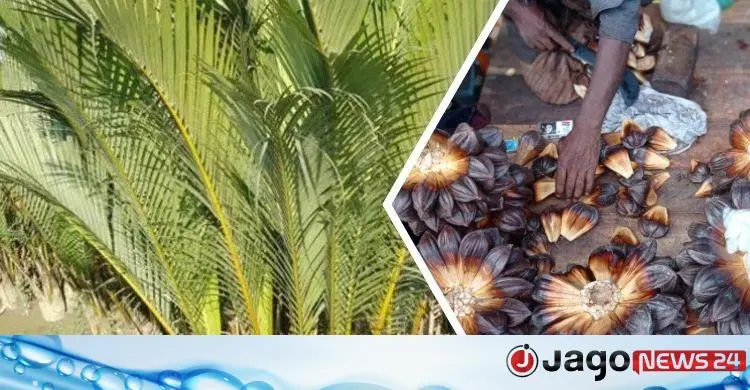
Neither the golgachh (nipa palm) nor its golpata leaves are round. So how did the word "gol" (round) become attached to the tree and its leaves? Plants are usually named after their flowers or fruit. When the golfal fruit spreads out in a cluster, it looks just like a neat, round jackfruit or keya fruit. It is because of this eye-catching sight of fruit hanging in clusters that, since ancient times, the fruit has been called golfal. In the same way the plant came to be called golgachh and its leaves golpata, names passed down by word of mouth to us.
In the Barishal dialect the fruit is called gabna. It is brown when unripe and slowly turns blackish. The segments of the fruit are shaped remarkably like the hood of a cobra. Each seed is 3 to 4 inches long, and a normal ripe golfal weighs 50 to 100 grams. Each bunch carries about 50 to 150 seed-fruits. The flesh can be eaten unripe and tastes much like the jelly-like kernel of the palmyra (tal) fruit.
Fruit, flower and name
Golfal is a rich source of vitamins and minerals and is notably used against worms, for rehydration, for boosting energy and in treating skin ailments. Commercial trade in the fruit has not yet taken hold. Forest workers who go into the Sundarbans and coastal people eat its flesh and serve it to guests from inland.
The golful flower blooms first on the bunch around which the fruit forms. These spadix-type flowers are 1 to 1.5 metres long, and the head of the flower is about 30 cm across. Flowers and fruit are seen all year round, but seasonal fruit hangs from bunch after bunch in the month of Asharh. The scientific name of golgachh is Nypa fruticans, and in English it is called the nipa palm.
Known as golgachh in Bangladesh and India, especially West Bengal, the plant goes by many local names around the world: dani in Myanmar, gin pol in Sri Lanka, buah nipah in Malaysia, buah atap in Indonesia, attap in Singapore, nipa in the Philippines and dua nuoc in Vietnam, among others. Its main place of origin is the tidal, saline, low-rainfall mudflats of the Indian and Pacific Ocean coasts. Scientifically, it is the only species of its genus, Nypa, with a subspecies, Nypoideae. In the low and moderately saline parts of the Sundarbans, our national forest and a world heritage site, the golgachh grows over vast areas.
Where it grows
Besides Bangladesh, the golgachh has spread across the mangrove forests and coasts of India, Myanmar, Thailand, Malaysia, Indonesia, Singapore, the Philippines, Vietnam, Australia, Borneo, Papua New Guinea and Cambodia. In Bangladesh, as well as in the Sundarbans, natural and cultivated gol groves can be seen along rivers, canals and wetlands in the coastal districts bordering the forest: Bagerhat, Khulna, Satkhira, Pirojpur, Barguna and Patuakhali. Gol cultivation is also scattered across at least 16 to 19 districts along the Bay of Bengal and riverbanks.
There is a saying that an elephant is worth a lakh of taka alive and a lakh dead, because of its valuable tusks, or ivory, from which many costly goods are made. In the same way, nothing of the golgachh goes to waste. Golpata leaves are usually more than 20 to 25 feet long and 1.5 to 2.0 metres wide, and each tree usually carries seven to 10 leaves. Leaves are harvested once the seedlings are four to five years old. The greenish leaves look like coconut fronds, with 60 to 120 leaflets in opposite pairs on each leaf, and a full-grown golgachh looks just like a coconut tree three to four years old.
The golgachh grows in clumps. Its rhizome, or stem, rises about 50 cm above the soil. Its ideal habitat is tidal, silty, saline mud with low rainfall. As well as growing from fruit, one plant produces another through its rhizome, and so the golgachh survives from age to age.
The bawalis and the harvest
People who make a living by collecting golpata in the Sundarbans are called bawalis. Coastal people have followed this trade since time immemorial, and this is how the bawali lineage arose in the Khulna region.
January to March is the golpata collecting season in the Sundarbans, and a Forest Department pass is needed to harvest leaves. In the season about 30,000 bawalis set out to collect golpata from the coupes or zones named on their passes. The leaves are cut and stacked on boats in a special way, and at least 5,000 boats, large and small, are used. Between 70,000 and 80,000 tonnes of golpata are collected from the Sundarbans each year.
Bawalis face a high risk of death while collecting golpata, because the fearless Royal Bengal tiger crouches hidden in the thickets of golgachh, where it is hard to spot, and attacks with great force when it gets the chance. Many people have been killed by tigers over the years, and some, after a life-or-death fight with a tiger, have survived by God's grace and live on disabled.
There is also the fear of crocodiles, pythons and many other animals. Even so, people face death in so many ways for the sake of food and clothing, and our civilisation has been built on the sacrifice of countless such workers. Golpata is used mainly as roofing. From early times until a few decades ago it was the main roofing for homes in Bangladesh's coastal settlements and neighbouring subdivisions, covering at least 20 to 25 of today's districts. Golpata played a graceful part in all kinds of roofing, house walls and many items of our traditional way of life.
Source: Jagonews24. First published in Bengali on The Agro News.
Comments
(0)