
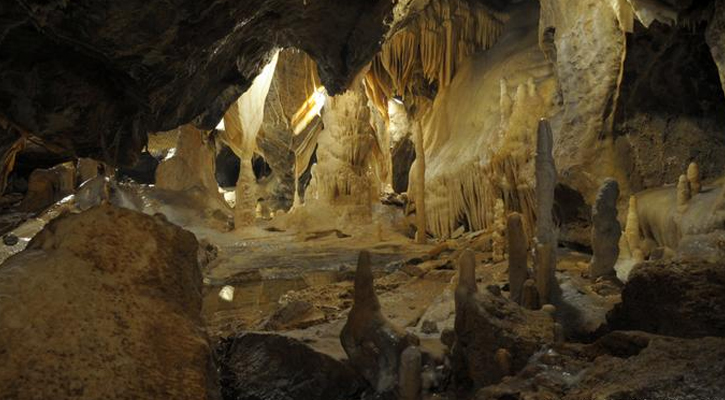
Germany is surrounded by natural beauty, but that beauty is not confined to its hills and rivers. There are many sights below ground as well.
Grottoes and cave dwellings
Saalfeld Fairy Grottoes: in 1993 these grottoes entered the Guinness Book of Records as "the world's most colourful grottoes". Mining for alum slate left the cave in the state of Thuringia filled with stalactites of many colours, and more than a hundred shades of brown and yellow can be seen in it.
Langenstein cave dwellings: carved out of sandstone, these cave houses look just like a princess's palace from a fairy tale. In fact they were built in the 19th century by local farm workers in the Schaeferberg area of the Harz mountains. Today the life story of the caves' last resident, Ludwig Schmidt, is depicted inside.
Kalkberg cave, Bad Segeberg: northern Germany's only natural cave holds the world's largest winter roost of bats. To avoid disturbing the animals' hibernation, tourist visits are limited to between March and October.
Atta cave, Attendorn: this cave in the state of North Rhine-Westphalia is Germany's largest and most popular. It was discovered by chance in 1907. A special cheese called Atta cheese is found in the 6,000-metre-long cave.
Kluterthoehle, Ennepetal: with many lakes and 300 passages, this 6-kilometre cave was once thought to be Germany's largest. Now the North Rhine-Westphalia cave offers visitors various adventurous tours, and the air inside is said to be good for asthma patients.
Man-made and prehistoric caves
Schlossberg caves and castle, Homburg: this cave in the state of Saarland was made by people, not nature. It was discovered while digging for red sandstone. Scientists say it began to form in the Middle Ages, but it only took its full shape after explosions during excavation.
Sophie's Cave (Sophienhoehle): bear bones 60,000 years old were found inside, along with the remains of many Ice Age animals. Local audiences now flock to the cave for events and concerts.
Dripstone cave, Zwiefaltendorf: Germany's smallest cave measures just 88 square feet. It was found in 1982 while a tunnel was being built. Its entrance is through a hotel and bar, which has made it an extra attraction for the hotel's guests.
Untersberg's long and icy caves
Riesending cave: Germany's longest cave, 3,770 feet long, is in the Untersberg. Inside are lakes of various sizes and several waterfalls. It has been closed to tourists since an accident in 2014, and now only scientists can go there.
Schellenberg ice cave: also in the Untersberg is Germany's only ice cave open to the public. It holds 60,000 cubic metres of ice, some of it nearly 3,000 years old. Visitors cannot tour the whole cave: only 500 metres is open, and only for hiking.
Source: Banglanews24. First published in Bengali on The Agro News.
Comments
(0)