
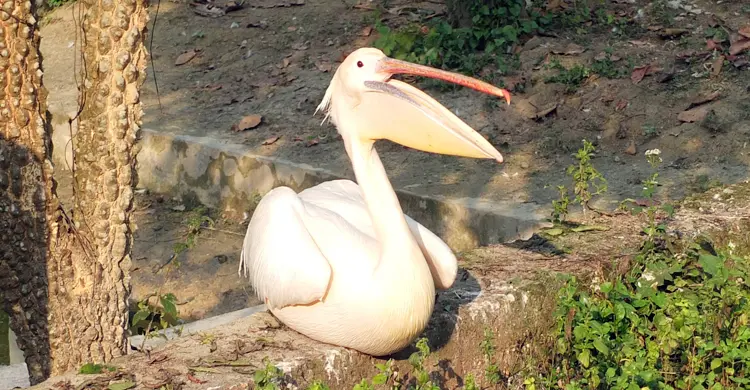
The great white pelican is a large water bird that lives near lakes and seas in Europe and the United States. The bird first came to Bangladesh in 2014.
Two pelicans were brought to the Bangabandhu Sheikh Mujibur Rahman Safari Park in Gazipur, along with various foreign animals, when the park was set up to entertain visitors. The female fell ill and died early in 2017. Since then the male has been alone, and in four years it has found no mate.
A bird with a pouch
According to the safari park authorities, the pelican is a water bird famous for its large bill, with a skin pouch under it in which it stores food. Fish is its main food, and the ways it sits by the water looking for prey are very varied. It is about one and a half metres long, with short legs and toes joined by skin.
When it hunts, it scoops up fish with water, then keeps the fish in its pouch and lets the water out. It swims well and travels in flocks. There are eight species of pelican in the world. In the breeding season they mainly build nests in trees and lay one to four eggs, which hatch after 28 to 36 days of incubation. Despite its size, it can fly at 60 miles an hour.
Life in the aviary
Anisur Rahman, wildlife inspector at the park, told Jagonews24 that the pelican lives in the park's hornbill aviary, a fenced area of about one acre where it spends its days. Sometimes it sits quietly alone and sometimes it tries to fly; it also shows off to visitors in various ways, and many people, including children, enjoy seeing this bird that is unfamiliar in the country.
He said that since its mate died, the male is given 1.5 kg of small rui fish (nola) a day. It has not had any serious illness so far, and although it is foreign, it seems to have adapted well to the environment here.
Tabibur Rahman, officer-in-charge of the safari park, told Jagonews24 that the male has been alone for four years since its mate fell ill and died. With a mate there would have been a chance of breeding, but no way has yet been found. Still, visitors to the park enjoy seeing the surviving bird.
Source: Jagonews24. First published in Bengali on The Agro News.
Comments
(0)