
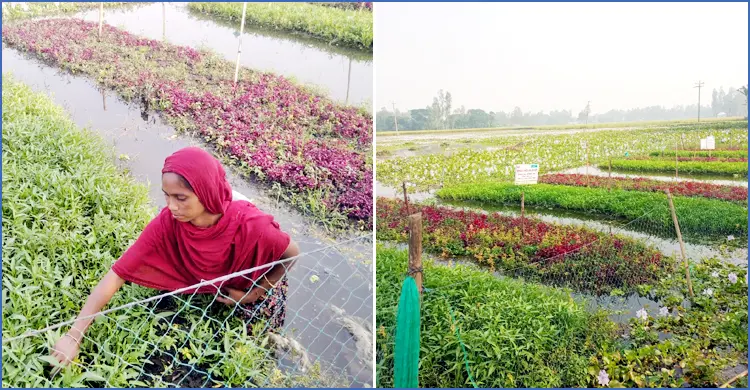
Floating vegetable farming shows great promise in Gaibandha's submerged beels. Land in the beels of the upazilas along the Jamuna, Brahmaputra and Teesta rivers, which flow through Sadar, Saghata, Fulchhari and Sundarganj upazilas, stays under water for half the year. In Saghata, vegetables are being grown without soil on floating beds of water hyacinth. Because floating farming costs little and earns more, farmers are becoming self-reliant.
Marginal farmers, men and women, are succeeding with vegetables on floating beds under the food security project of the NGO Udayan Swabalambi Sangstha, with support from the Melonais Central Committee Bangladesh (MCCB). The organisation has set out to spread the method among the people of Gaibandha.
Floating vegetable beds have become popular in Jharabarsha beel in Ghuridah union, Saghata upazila. Farmers were doubtful at first, but after a successful trial, local people are now being encouraged to take it up.
Eight beds by the road
Jharabarsha beel lies right beside the road. A visit found eight floating beds in a row, with water spinach, red amaranth, Malabar spinach and other vegetables. The beds were made by rotting water hyacinth on top of banana stems, and seeds were scattered on each bed, so the vines and leaves of the vegetables are spread across them.
The district office of the Department of Agricultural Extension (DAE) says the riverside beels of Saghata upazila often stay under water even after the rainy season, and winter vegetables can be grown on floating beds. This year the method was tried at three sites in Saghata.
Floating vegetable grower Bilkis Begum told Jago News: "Momota apa from the Udayan NGO came and told us to grow vegetables on floating beds in the pond. We made the beds under her guidance. Nasima Begum, Sharifa Begum, Tahmina Begum and I grow vegetables on six beds in the pond: one with water spinach, one with red amaranth, one with Malabar spinach and one with stem amaranth. This kind of farming is new to us. With the yield we get, we eat some ourselves and still sell Tk 300-400 worth a week."
"We eat some, we sell some"
"I have grown water spinach," said vegetable grower Tahmina Begum. "I pick it every other day. We eat some and sell some. It has turned out well: you can eat it and you can sell it. Next time I will grow more."
Sharifa Begum, who had come to tend the red amaranth bed, said in the local dialect that seeing the vegetables at their place, everyone in the village now wanted to do the same. "We are very happy. This month I sold about a thousand to twelve hundred taka worth of greens," she said.
Farmer Motiar Rahman said: "With Udayan's help, my wife Nasima Begum and I tended the floating beds, and this month, after eating our share, we sold Tk 1,300 worth of greens. Many people have become interested after seeing us, and floating vegetable farming has caught on well in the area. But if we got training and support from the agriculture department, we could farm on a bigger scale."
How the beds are built
Momota Khatun, a field organiser with Udayan Swabalambi Sangstha, said: "Trial floating vegetable beds have been started in 11 northern districts including Gaibandha. A family here meets its own needs and still earns Tk 300 to 400 a week. So far 24 beds have been made at three separate sites in the area, including Jharabarsha beel."
"One bed can grow red amaranth three or four times, and Malabar spinach or stem amaranth once," she said. "A single crop on one bed can earn Tk 2,000-2,500. Each bed can be 25-30 feet long (it can be smaller or larger) and four or five feet wide. The bed is built in two layers: the lower layer is made of banana stems and water hyacinth is put on top. When the hyacinth has rotted, seeds are scattered on it."
Belal Uddin, deputy director of the district DAE office, told Jago News: "Floating farming is more common in the haor areas. A development organisation in Gaibandha has started growing vegetables on floating beds, and we have learnt that farmers in the area are being inspired by it. We will give men and women farmers training and every kind of support in floating vegetable farming."
Source: Jagonews24. First published in Bengali on The Agro News.

Comments
(0)