
A food product sold at high prices in supermarkets is being grown in Gaibandha in the north of the country. Its cultivation is increasing year by year in several villages on the river-bound chars of Gobindaganj and other upazilas of the district.
The same quality of this tuber crop, grown in just three months and imported from Thailand, sells for nearly Tk 1,000 a kg in various supermarkets in Bangladesh. The crop that has quietly sparked a farming revolution over the past two years is a special variety of sweet potato. Grown with the direct support of a Japanese company, the variety is called "Koki-14-go". It may seem a cheap crop, but it is in fact a very valuable food product.
From 'char of sorrow' to 'char of happiness'
Residents of several villages on the banks of the Bangali river in Gobindaganj upazila, devastated by river erosion, once went hungry. Two decades ago, when farmers began growing three-to-four-month tuber crops on the char land after the floodwater receded, sweet potato became their lifeline. As markets gradually opened up in other districts, people's fortunes began to change. Sweet potato grown here was once the cheapest farm produce.
When it began to be marketed in various parts of the country and fetched several times the price, prosperity came to their households. Since then the residents of this once "char of sorrow", ruined by erosion, have started calling it the "char of happiness". Recognised as fertile land for sweet potato, the chars have recently taken up the improved, high-value Japanese variety Koki-14-go.
Over the last two seasons, sweet potatoes from here have begun to be exported to Japan and various other countries. With a Japanese company's help, cultivation has spread to Gaibandha and several other areas, and farmers in this northern region have become partners in a quiet farming revolution.
Sweet potato yields heavily as a rabi-season tuber crop on some riverside chars. Judging that good-quality Japanese sweet potato could be grown in this soil, cultivation began two years ago. Naruto Japan Company Limited, part of Japan's Maruhisho Pacific Group, started it by giving farmers seedlings, fertiliser and technical support.
How the company model works
The company supports farmers in five districts, Gaibandha and parts of Dinajpur, Bogura, Jamalpur and Sherpur, and has also begun buying their potatoes at a fixed price. Planting is now in full swing in Gobindaganj, Saghata and Fulchhari upazilas of Gaibandha. From this year, cultivation has also begun through demonstration plots in Mithapukur, Rangpur, and Debiganj, Panchagarh.
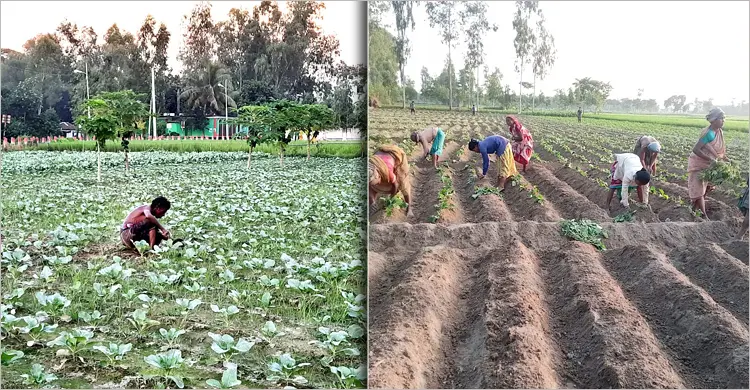
A visit found a flurry of activity in Boroda, Parsonaidanga, Charbalua and Bochadaha villages of Gobindaganj upazila and Kachua and Chandanpat villages of Saghata upazila. Farmers are planting seedlings across bigha after bigha. Men and women, children and the elderly work non-stop from morning to evening with no time to catch their breath.
According to Naruto Japan Company, seedlings are raised by tissue culture in nurseries in the farmers' own seedbeds, and the farmers are supplied with the original seed, fertiliser and all other inputs. The seedlings are then cut into ten-inch pieces, which the company buys from the farmers at 35 paisa each and supplies back to them free of charge.
The planting material is produced and supplied from 56 nurseries. Fertiliser and all other inputs are also provided free, and the potatoes are bought from the farmers' fields at a fixed Tk 12,960 per tonne. They are then processed at the company's factory in the Adamjee EPZ at Siddhirganj, Narayanganj, and exported to Japan, Thailand and other countries.
Khairul Alam Raja, a potato farmer in Charbalua village of Mahimaganj union, Gobindaganj upazila, told Jago News: "Because the company gives full support, we can farm without any loans or hassle. At the end of the season we do not have to worry about selling the crop for cash at a fair price. That is a big gain for farmers."
Alam Mia, another potato farmer from the same village, said: "Life used to be very hard. Now growing potatoes has changed our fortunes. Costs are lower and prices higher than for other crops, so we are profiting. Now we are people of the char of happiness."
Kazi Jahangir Alam, field monitoring in-charge of Naruto Japan Company, told Jago News that farmers are turning to the Koki-14-go sweet potato. Last year 90 tonnes were collected from the Gobindaganj area, 95 tonnes from Saghata upazila and 34 tonnes from the Fulchhari area. This year the aim is to produce and collect twice that amount here. This season the potato is being grown on 30 hectares across the country, he said.
Gobindaganj upazila agriculture officer Syed Reza-e-Mahmud told Jago News that good days have returned for the tuber crop. Varied support for farmers here has brought revolutionary change to sweet potato farming, and the agriculture department is giving full support to growing Koki-14-go for export alongside local varieties, he said.
Source: Jagonews24. First published in Bengali on The Agro News.


Comments
(0)