
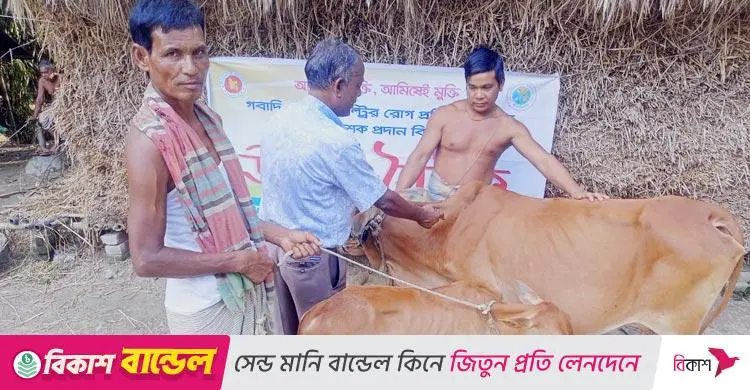
Livestock in Sundarganj, Gaibandha, are being vaccinated to prevent anthrax (known locally as torka). Allegations have arisen that owners are being frightened into paying Tk 20 for a vaccine that costs 80 paisa. As a result, livestock owners say, half a crore taka is going into the pockets of livestock officials, who in this time of crisis came not to serve but to loot money.
Sundarganj upazila borders Pirgachha in Rangpur district, where two people have died of anthrax and seven are infected. The disease mainly spreads from the meat of livestock. In Sundarganj, next to Pirgachha, more than a hundred cattle have died so far. Cattle infected with anthrax are being slaughtered all the time, and about fifty people have fallen ill after cutting their meat.
When news of this was published, the Sundarganj upazila administration sprang into action and decided at an emergency meeting to vaccinate livestock. Anthrax vaccination has been going on since then. But using various tactics and threats of harassment, Tk 20 to Tk 30 is being taken for the 80-paisa vaccine. And with no awareness campaign, 90 per cent of livestock remain unvaccinated.
Of the roughly 2.5 lakh livestock in the upazila, about 2 lakh will be vaccinated, from which those involved in the vaccination will take more than half a crore taka, owners say. They have called on them to be humane at such a difficult time.
Owners' accounts
Md Sajib Mia, a day labourer and livestock owner of Phalgachha village in Bamandanga union, said: "I have four cows and two goats. Two men came and told me to get the vaccine. When I asked the price, they said Tk 20. When I asked them to charge less, they said the (livestock) office would charge more for this vaccine, and then we wouldn't find them. Out of fear I paid Tk 20 for the vaccine." He said they charged Tk 5 each for the two goats, Tk 10 in all, and Tk 20 each for the four cows, Tk 80 in all.
Md Ful Mia (52), a van driver of Tokoi village, said: "Some people came on motorcycles and told me to get the vaccine. When I asked the price, they said Tk 20, and that everyone was taking it at that price. So I paid Tk 20 for one vaccine."
Posing as a livestock owner, the reporter spoke to vaccinator Chandan Kumar Roy, who said: "We're taking Tk 20 per animal for the vaccine. This money has to be deposited at our office."
Officials respond
Upazila Livestock Officer Dr Biplob Kumar Dey acknowledged that the vaccine costs 80 paisa per cow, but said Tk 10 had been set because of some incidental costs, and action would be taken if more was charged.
He added that instructions had been given not to frighten any livestock owner, and to vaccinate even those unable to pay.
So far 26,400 doses of vaccine have arrived, of which 22,000 have been given, and vaccination continues with the rest. A fresh request for 50,000 doses has been sent. The upazila has about 2.5 lakh livestock, of which 2 lakh will be vaccinated.
Upazila Nirbahi Officer (UNO) Raj Kumar Biswas said the livestock department could better say how much may be charged per vaccine. "As far as I know, they are taking Tk 10 per dose. But that is their decision; we have nothing to say about it," he said.
Source: Jagonews24. First published in Bengali on The Agro News.


Comments
(0)