
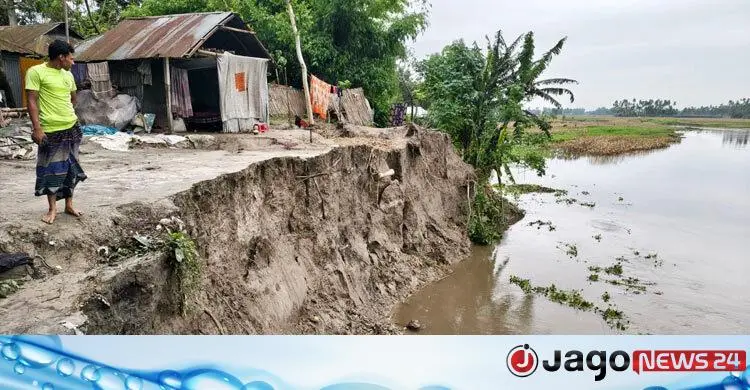
The water in Gaibandha's Teesta, Jamuna, Brahmaputra and Karatoya rivers keeps falling and rising. As a result, crops on at least 118 hectares of low-lying land have been damaged. The fluctuating water has caused widespread erosion along the riverbanks and in the char areas, and homes are being swallowed by the rivers.
According to the district Department of Agricultural Extension (DAE), floods have damaged crops on about 118 hectares in the district's seven upazilas: Aus rice on 45 hectares, jute on 30 hectares, sesame on 25 hectares, Aman seedbeds on eight hectares and vegetables on 10 hectares.
River levels
According to the latest data from the Gaibandha Water Development Board (WDB), in the 24 hours from 3pm on Monday 29 June to 3pm on Tuesday, the Teesta fell 43 cm at the Kaunia point and was flowing 44 cm below the danger mark. The Brahmaputra rose 19 cm at the Teestamukh point in Fulchhari and was 70 cm below the danger mark; the Ghaghat rose 20 cm at the New Bridge point in the district town and was 130 cm below the danger mark; and the Karatoya in Gobindaganj rose 53 cm at the Chakrahimapur station point and was 354 cm below the danger mark. So far no river in Gaibandha has crossed the danger mark.
Locals said erosion continues on the main rivers as the water rises and falls. Homesteads and farmland are being lost every day in the eroding areas, and erosion is under way at at least 25 points in four upazilas of the district.
Hundreds of families homeless
In Sadar, Sundarganj and Fulchhari upazilas, severe erosion caused by rising water from hill runoff from upstream over the past few days has left more than 800 riverside families homeless. Large areas of farmland have been lost to the rivers, and people along the banks live in fear of erosion.
Chowmohon Char, Khatiamari and Kauabada in Fazlupur union of Fulchhari upazila face severe erosion. Brahmaputra erosion has already left more than 350 families there homeless. A government primary school, several hundred bighas of farmland and a large number of trees have been lost to the river. Balashighat and Rasulpur in Kanchipara union and Ratanpur in Uria union have also been hit.
In the Lal Chamar Keranir Char area of Kapasia union in Sundarganj upazila, continuing erosion has so far taken the homesteads of more than 200 families and more than 100 bighas of cropland. Also hit are Shokher Bazar in Kalir Khamar village of Kanchibari union, Char Charitabari and Raghab in Haripur union, North Sicha in Chandipur union, and Lalchamar, Keranir Char, Mintu Miar Char and Badamer Char in Kapasia union.
Farmers count losses
Farmer Ashraf of Chithtulia Digar village in Mollarchar union, Sadar upazila, told Jago News that the Aus paddy on his three bighas had been submerged by the flood.
Ripon Mia of Sidhail village said: "In my lifetime our homestead has been swallowed by the river nine times. It happened many times to my father. Erosion is going on this year too. More than 20 families have moved away from here because of it, and many more families are at risk."
Farmer Tofazzal Islam of Kalirkhamar village in Kanchibari union, Sundarganj, has two bighas of jute now under neck-deep water, and the plants have started to rot.
Another farmer, Angur Mia, said the river rose because water was suddenly released from India, and his one bigha of sesame has gone under water.
Aynul Mia of Rasulpur village in Fulchhari upazila said vegetable land is being lost to the river as the water rises, and the erosion is slowly moving towards homes.
Md Atiqul Islam, deputy director of the DAE in Gaibandha, said field-level estimates show crops on 118 hectares damaged in the district. If the floodwater stays for long, the list of damaged crops will grow.
Gaibandha WDB executive engineer Shariful Islam said rising water has triggered erosion at at least 25 points along the riverbanks and in the chars. "We are trying to stop the erosion with geobags and other necessary measures," he said.
Source: Jagonews24. First published in Bengali on The Agro News.

Comments
(0)