
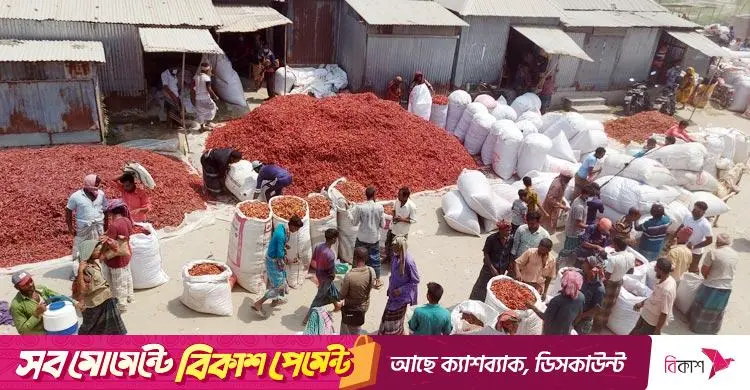
From daybreak, farmers from the chars hurry to the market with dried red chillies, bright red in white sacks. This is the familiar face of the Fulchhari market in Gaibandha. The temporary market on the Brahmaputra is one of the largest wholesale chilli markets in the north of the country.
The traditional market sits in the old headquarters area of Gazaria union in Fulchhari upazila, about 20 kilometres from Gaibandha town, and many know it simply as the red chilli market. It is held on Saturdays and Tuesdays, and chillies worth crores of taka are bought and sold from morning until midday. The market has no address of its own: it is set up on privately owned land that has emerged from the river.
Chillies are grown widely on 165 chars across four upazilas of Gaibandha, namely Sadar, Saghata, Sundarganj and Fulchhari, and the dried chillies from these chars are sold here. Besides local traders, wholesalers come from Jamalpur, Naogaon, Rajshahi, Dinajpur, Bogura, Rangpur, the capital and other parts of the country. Representatives of well-known packaged food companies also buy chillies here regularly.
Boats, horse carts and bargaining
At the Brahmaputra ghat in Fulchhari, boats of all sizes arrive one after another, each loaded with white sacks packed with red chillies, with boatmen and helpers busy at their work. On market days the ghat is this busy from dawn, and a festive mood takes hold whenever a boat docks.
Depending on the season, farmers must cover about half a kilometre, sometimes more, from the ghat to the market. Those with small amounts carry the chillies on their heads or on shoulder poles along sandy paths; those with larger loads use horse carts.
As the day goes on, buying and selling begins and the ground fills with haggling over variety, size and quality. Three grades of chilli are sold here, good, medium and low, and prices vary by season. Trading runs from morning until 2pm, with wholesalers from different districts much in evidence. Local sellers and traders say the chillies of Fulchhari's chars are of a quality found nowhere else in one place, which is why buyers come from far away.
Farmers unhappy with prices
Farmers are, however, unhappy with this season's prices. Several complained that market rates are low compared with production costs, depriving them of the profit they expected.
Hasmat Ali, a chilli seller from Golnachar in Gazaria union, said: "I've come to sell chillies at this market. I grew chillies on four bighas and the yield was good. But there's hardly any price this time. Selling chillies won't even bring the money back."
Farmer Asgar Ali from Ratanpur told Jago News that prices were somewhat lower this year. Last year the wholesale price was Tk 9,000 to Tk 12,000 a maund. This year it started at Tk 8,000, but later wholesalers offered Tk 6,000, and on Saturday Tk 5,000.
Zahid Pramanik, a farmer from Khatiamari char in Fazlupur union, told Jago News that it costs Tk 30,000 to Tk 35,000 to grow a bigha of chillies. Forty to 50 maunds of green chillies dry down to seven or eight maunds. If they sell at Tk 10,000 a maund, there is a profit of about Tk 20,000 excluding his own labour; with low prices this time, there will not be much profit.
Traders and officials
Shah Paran Sultan, a chilli wholesaler from Naogaon, said he has bought dried chillies at this market for a long time because the quality is very good and in great demand, and he supplies them to different parts of the country. Rafiqul Islam, a wholesaler from Bogura, said they buy regularly here, but traders from far away face a shortage of places to stay overnight; otherwise there is no problem.
Market lessee Ohidul Islam said it is the largest chilli market in the north, where char farmers of the district sell and wholesalers and companies from various districts come to buy. Chillies worth Tk 1.25 crore to Tk 2 crore are traded on each market day, he said.
Khorshed Alam, deputy director of the Department of Agricultural Extension (DAE) in Gaibandha, said the char soil is good for chilli, char people are turning to chilli farming and becoming self-reliant, and the agriculture department is giving farmers advice and all kinds of support.
Gaibandha's dried red chillies are prized across the country. Because the soil and weather of the chars suit chilli, the pods grow large and attractive, and yields on char soil are two to three times higher than on other soils. Chillies are grown on hundreds of bighas on the chars of the Brahmaputra, Teesta, Jamuna and Karatoya. Usually, after flood water recedes, the silty soil is ploughed two or three times and levelled before sowing. Once the plants grow a little, weeding two or three times at 15 to 20 day intervals brings a large yield without fertiliser, and production costs are relatively low.
Source: Jagonews24. First published in Bengali on The Agro News.


Comments
(0)