
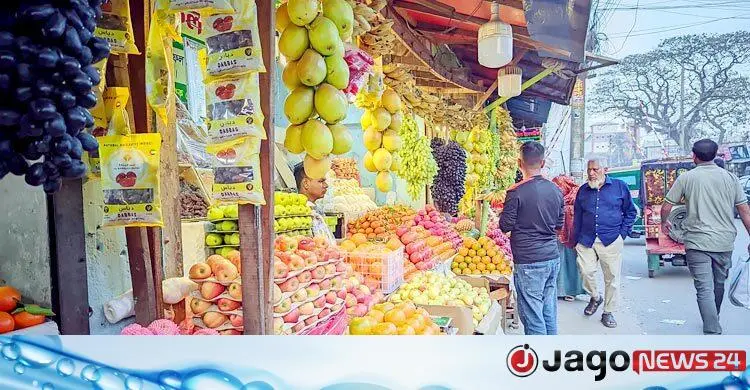
Nothing beats fruit for easing tiredness at iftar after a day of fasting in Ramadan. But fruit prices in Gaibandha's markets are now so high that fruit has become a "luxury item" for low- and middle-income people. The fruit markets are crowded, but many buyers hear the prices and go home empty-handed.
A visit to DB Road, the Hawkers' Market and the old bazar in Gaibandha town showed that fruit prices have risen by Tk 50 to 150 a kg compared with a few days earlier. Dates, a staple of iftar, cost several times more than last year.
- Dragon fruit: Tk 300-350 a kg
- Pomegranate: Tk 380-420 a kg
- Orange: Tk 320-360 a kg
- Apple: Tk 280-340 a kg
- Malta: Tk 260-300 a kg
- Grapes: up to Tk 450-500 a kg
Buyers and sellers
Rezaul Karim, who came to buy fruit at the Hawkers' Market, said buying a little fruit for the family's iftar costs a thousand taka. "It is very hard for ordinary people to buy fruit at these prices."
A buyer named Sahana Begum said: "Apart from bananas and guavas there is no local fruit in the market, so we are forced to buy foreign fruit at several times the price. There is no fruit under Tk 300."
Traders, on the other hand, say prices are rising because of higher transport costs, unstable wholesale markets and dependence on imports. They say demand has risen compared with before Ramadan, so prices have naturally gone up.
Anisuzzaman, a fruit seller on DB Road, said: "As retailers, we sell at a fixed margin over the price we buy at. Demand for fruit rises in Ramadan, and that is why prices go up."
Asked about this, Paresh Chandra Barman, assistant director for Gaibandha district of the Bangladesh consumer protection directorate, said: "We are monitoring markets in different parts of the district for Ramadan, and penalties are imposed wherever we find irregularities. These drives will continue in the public interest."
Source: Jagonews24. First published in Bengali on The Agro News.
Comments
(0)