
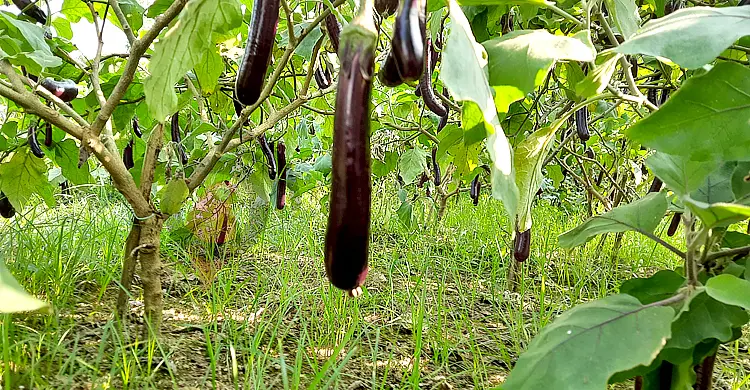
Mymensingh's soil is like heaven for farming: every kind of fruit and crop grows there. Alongside some industry, farming largely drives the district's economy, and each upazila is famous for its own crops, which dominate markets in Dhaka and elsewhere. One such vegetable is the round Lafa brinjal of Gafargaon upazila, which once reached markets abroad. But high-yielding and longer-lasting varieties and other crops have pushed it towards extinction. Farmers and agriculture officials say the vegetable now sold in the market as Lafa brinjal is not the real one.
In Gafargaon, Phulbaria and Borochar in Sadar, brinjal holds its ground alongside lemons, tomatoes and green chillies, but farmers look for profit. Charalgi in Gafargaon was once famous for its black round brinjal. Each one weighed more than a kilogram, with a ridged rather than smooth skin, and it was in special demand across the country for mashing and frying. Many farmers changed their fortunes growing it alone. But its short life, low yield and heavy disease slowly drove farmers away from Lafa brinjal. Round varieties including Islampuri are still grown in the upazila and passed off as Lafa brinjal.
'The famous one has probably been lost'
Md Lutfe Al Muiz, an agriculture extension officer in Gafargaon, told Jagonews24 that brinjal is grown on a total of 195 hectares: Islampuri on 90, Uttara on 57, Singnath on 30, Lafa on 30 and BT brinjal on 3 hectares. "The famous Lafa brinjal of Gafargaon has probably been lost. A variety from Islampur in Jamalpur is sold as Lafa brinjal. I tried hard to find the original but could not. Elders also say what is found now is not Lafa brinjal."
"There is no facility at upazila level to conserve its germplasm, but if a researcher from Bangladesh Agricultural University came forward, it might be possible. Other high-yielding brinjal varieties have arrived. The brinjal shoot and fruit borer is the main enemy, and it attacked Lafa brinjal more. Cropping patterns are also changing. Lafa brinjal is grown, but we have found evidence that it is not really Lafa brinjal."
Gafargaon upazila agriculture officer Anwar Hossain told Jagonews24 that as far as they know Lafa brinjal is almost extinct. People do not grow it as before. He has heard it is found in some areas and research is going on, but they are not actually finding the variety, and other brinjals are grown much more.
The black round Lafa brinjal is mainly a winter crop. A farmer at Borochar who has also planted a round variety said it had not fruited yet because it is a winter brinjal. In the next field a long variety was bearing heavily. Brinjal is grown on several hundred hectares here.
Long brinjal pays in Phulbaria
Mofiz Uddin of Anantapur village in Phulbaria upazila has grown brinjal for about 20 years. He plants seedlings of a black long variety on one bigha in Baishakh and harvests from Asharh. It costs Tk 20,000. He picks once a week, sometimes twice, getting five to 10 maunds each time, and earns a lakh of taka in six months. At current market rates he gets Tk 400 to 500 a maund, though at other times he has sold at Tk 1,500 to 1,600. His brinjal goes to Dhaka, Mymensingh, Netrokona and elsewhere.
He told Jagonews24: "I used to grow it on more land, now less. It's hard work, so I'm growing lemons and beans. Wholesalers come and take it. Mine is Lal Teer's Purple King brinjal. Round brinjal doesn't last long; the long one is available almost all year and can be sold for nearly a year."
Md Abu Raihan, sub-assistant agriculture officer in Phulbaria, said this variety is much like Singnath brinjal and is near the end of its season now. The main enemy of brinjal is the fruit and shoot borer, which cuts the shoots and bores into the fruit, lowering the price. Brinjal should not be crooked either; that is caused by nutrient deficiency.
"Farmers usually think fertiliser means urea, TSP and MoP. Farmers are now applying boron. Brinjal gets the most pesticide of any crop, which is not good for health. Pheromone traps can also control pests. But brinjal is a tempting crop because it brings big profits. We discourage pesticides. Mahogany seed can also be used to control pests. In the upazila, most brinjal is grown in Charpa, Barta, Kaladaha, Rangamatia, Enayetpur and Naogaon."
According to the agriculture office, brinjal is being grown on about 425 hectares in Phulbaria upazila.
Source: Jagonews24. First published in Bengali on The Agro News.

Comments
(0)