
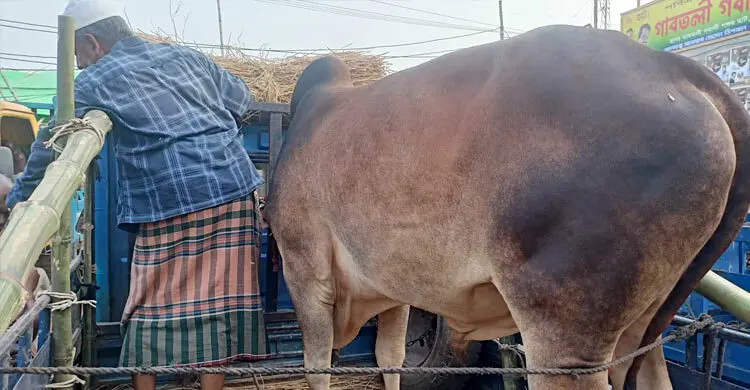
Only four days remain before Eid-ul-Azha, when devout Muslims do all they can to sacrifice a cherished animal for the sake of the Creator. Sacrificial animals have started arriving at Gabtoli, the only permanent animal market in the capital. Cattle are coming by truck from Kushtia, Meherpur, Manikganj, Pabna, Sirajganj, Jhenaidah, Chuadanga, Chapainawabganj and other parts of the country. Sales have not really begun, but leisurely bargaining is under way.
Traders say buyers have no idea of the cost of raising cattle, which is why they offer low prices, and do not try to understand traders' hardship. Buyers complain that traders are asking sky-high prices, leading to lengthy bargaining. Buyers are looking at cattle, but sales have not properly started. This time no cow is available at the market for less than Tk 80,000.
That was the picture on 11 June. At the market entrance, a cow was tied up awaiting payment of the levy (hasil). The animal, not big enough to yield two maunds of meat, had sold for Tk 81,000.
Buyers complain of high prices
Arefin Sayeed of Savar bought a medium-sized black-and-white crossbred cow for Tk 1 lakh 1 thousand. Traders claimed it would give four maunds of meat, but it will be hard to get three. Sayeed complained that prices were too high.
"The traders won't let the cattle go; they are asking a lot," he told Jagonews24. "I entered the market at 11am and it's now 4pm. I walked around for five hours to buy one cow."
Siddique Bepari of Kushtia is not happy with the price he got in Dhaka. He sold a pair of local cattle for Tk 2 lakh 30 thousand, which he says will yield 8 maunds of meat. He did not get the price he expected at Gabtoli, and says he would have done better at a village market.
"I sold two home-raised cattle for Tk 2 lakh 30 thousand in total," Siddique told Jagonews24. "I can't tell you what a mistake it was to bring cattle here. I had to pay truck fare for nothing. I won't bring cattle to this market again, brother. Is there any profit in spending so much to bring them so far? I have to go home in tears."
Shafiqur Rahman, another trader from Kushtia, brought five home-raised cattle to Gabtoli on Monday. The large animals are four to five years old. He has named one of them "Kushtiar Don" (the Don of Kushtia); it is expected to yield 18 maunds of meat and the asking price is Tk 12 lakh. Shafiqur is not alone: five others from the same area hired several trucks together to bring local cattle to Gabtoli in hope of better prices.
"All the cattle are from my home. One weighs 18 maunds, and I'm asking Tk 12 lakh," Shafiqur said.
Asked about buyers' complaints of high prices, he said: "Buyers don't understand our pain. They don't know how much it costs to raise cattle. Feed is expensive, and if you keep workers, their wages are high too. Each animal costs a thousand to twelve hundred taka a day. So you tell me what it costs in a month! Then there's electricity, soap, shampoo and mosquito coils."
Who is buying now
In the capital, sacrificial animals usually sell most one or two days before Eid. Most of those buying now are from areas around Dhaka, especially Keraniganj and Savar, people with open space at home. Most people in Dhaka live in rented flats and apartments, and space to keep a sacrificial animal is a big problem.
Jalil Haji of Keraniganj was heading home with a cow on a pickup. "I bought a cow for Tk 1 lakh 53 thousand; the rest is in Allah's hands," he told Jagonews24.
On the ground, buyers were mostly coming to learn prices and were not yet keen to buy. Traders said demand this year was higher for medium-sized local cattle.
Ataul Islam came to Gabtoli from the Chhapra Mosque area on Mirpur 60 Feet Road with his two sons and a daughter. "My budget is Tk 1.5 lakh," he told Jagonews24. "But cattle prices are much higher this year. The traders are asking extra. A cow I bought for Tk 1 lakh last year costs Tk 30,000 to 40,000 more this year. Even so, the traders don't want to sell at that price. But they will let the cattle go a day before Eid; if need be, I'll buy on the night before Eid."
Minister says there is no shortage
Although prices at the market are high, there is no shortage of cattle and goats for Eid-ul-Azha, Fisheries and Livestock Minister Abdur Rahman said. "As there is no shortage of animals in the country, devout worshippers will be able to celebrate Eid-ul-Azha well this time," he told Jagonews24. "About five lakh animals went unsold last year, and another four and a half lakh have been added this year. Demand in our country is 1 crore 29 lakh animals, and we have more than 1 crore 30 lakh."
Dhaka's two city corporations have finalised the leases of 16 temporary animal markets in the capital for Eid-ul-Azha. The Dhaka North City Corporation (DNCC) and Dhaka South City Corporation (DSCC) invited tenders for 20 markets in total. The DNCC wanted to hold 9 markets including the permanent Gabtoli market, and the DSCC 11 including the permanent Sarulia market. But the number of temporary markets has fallen somewhat for various reasons, including High Court directives. Although both city corporations invited tenders for a market at Aftabnagar, it remains halted on the higher court's order.
Source: Jagonews24. First published in Bengali on The Agro News.
Comments
(0)