
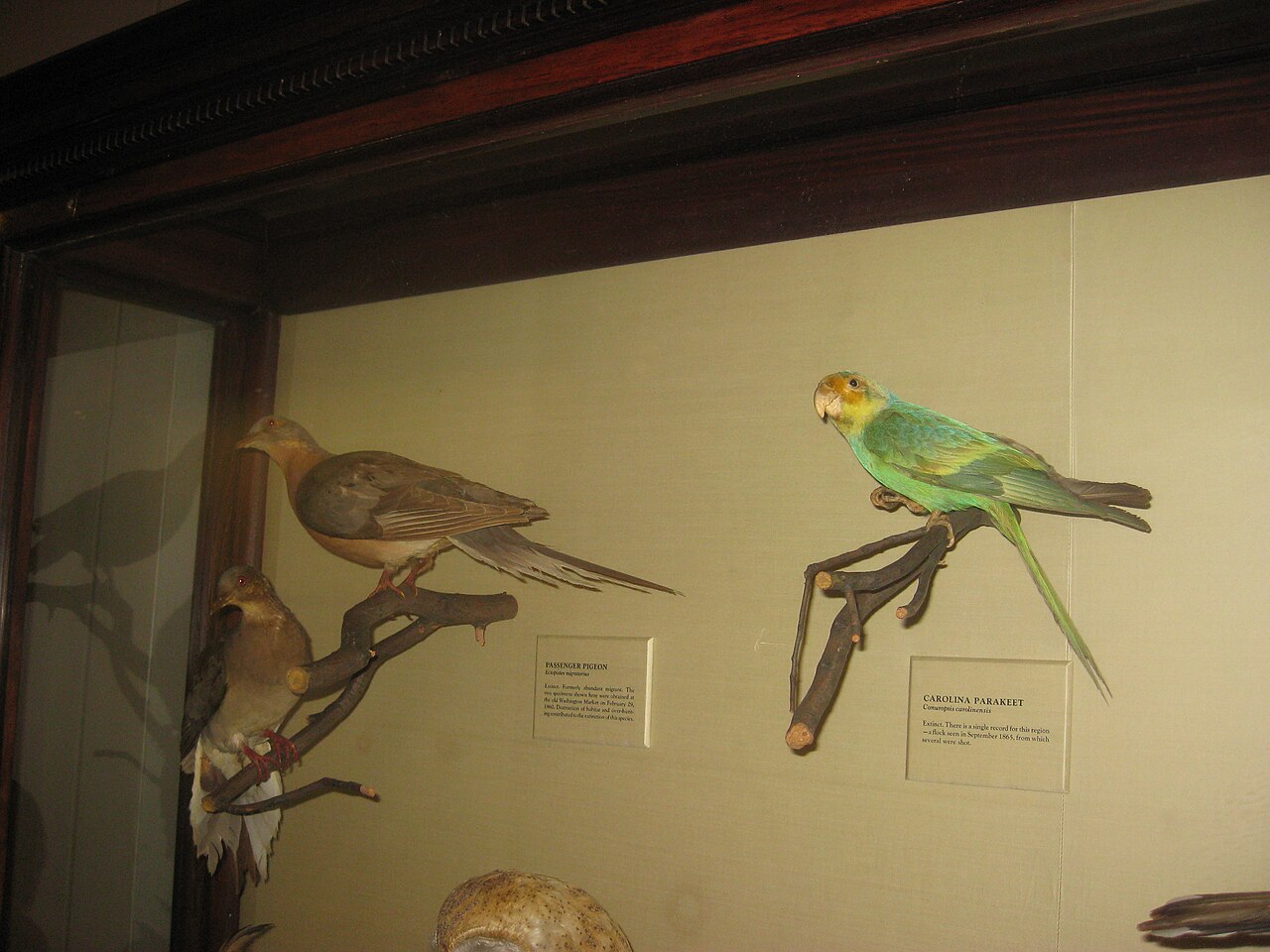
Five extinct bird species kept at the Smithsonian's National Museum of Natural History in the United States have become a reminder of how biodiversity is lost. They are the Bachman's warbler, the heath hen, the Kauai oo, the Carolina parakeet and the passenger pigeon, all gone through human activity: overhunting, forest clearing, habitat destruction and disease.
The specimens are part of an exhibition titled "From These Lands: Sharing Our Natural and Cultural Heritage", built from more than 600 natural history objects representing the 50 states, Washington DC and five US territories. Its aim is to show visitors why species disappear and how people affect ecosystems.
The olive, black and yellow Bachman's warbler was last seen in the wild between 1958 and 1961 around Charleston, South Carolina. A 166-hour search in 2002 failed to find it, and in 2023 the US Fish and Wildlife Service formally declared it extinct. The loss of its breeding and wintering habitat is thought to be the main cause.
The heath hen, a subspecies of the greater prairie-chicken, made its last stand on Martha's Vineyard in Massachusetts, where wildfire, harsh winters, predators and disease finished what overhunting began. The Kauai oo of Hawaii was lost to habitat destruction, mosquito-borne disease and introduced mammals. The Carolina parakeet went through forest clearing, hunting, disease and the pet trade. The passenger pigeon, which once crossed North American skies in vast flocks, ended with "Martha", the last known bird, who died at Cincinnati Zoo in 1914.
Citing Rob Cooke, an environmental modeller at the UK Centre for Ecology and Hydrology, the report said a 2023 study estimated that 1,300 to 1,500 bird species have died out over the past 130,000 years, about twice earlier estimates. Some 90 per cent of those extinctions happened on islands, where species with small ranges are most exposed to introduced predators. A BirdLife International report of September 2026 found that 45 per cent of migratory bird species are declining and one in nine is threatened with extinction.
Museum specimens are also research material. Measurements and tissue samples let scientists study the genetics of extinct species, and even reconstruct genomes. Torben Rick, the museum's curator of North American archaeology, said genetic work can show whether a species had already lost genetic diversity before it vanished, while stable isotope analysis of feathers reveals past diets and migration patterns.
The exhibition also shows a recovery: the Guam rail, considered extinct in the wild for about 40 years, has come back through captive breeding and release, whereas attempts to breed the last passenger pigeons in captivity failed. Because birds disperse seeds and pollinate plants, experts say losing one species affects the wider ecosystem. In Rick's words, human activity has done great damage to the environment, but working together can reverse some of it.
Photo: Tim Krepp / Wikimedia Commons (CC BY 2.0)
Source: Channel i Online




Comments
(0)