
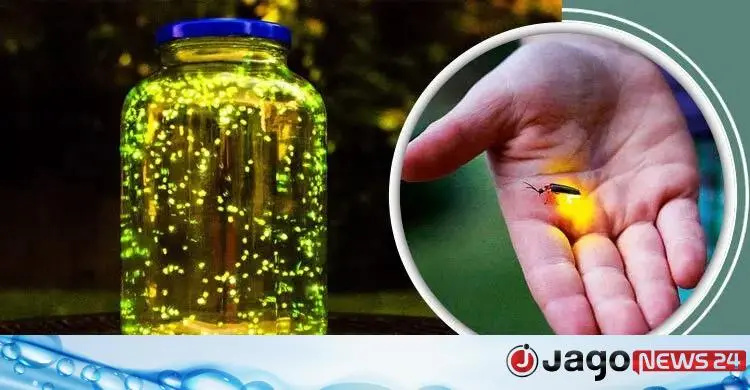
The firefly, known in Bengali as jonaki, is an insect of the beetle order, called a "lightning bug" or "firefly" in English. The beetle order has many divisions, and only beetles of the family Lampyridae are fireflies. Although the name says "fly", none of them is actually a fly. They are small, dark brown, slightly elongated insects, with the light-producing part at the rear of the abdomen. There are about 20,000 species of firefly in the world.
They look like very ordinary insects, less than an inch long, about two centimetres, with long yellow marks on the wings and head. They have six legs, two antennae, compound eyes and a body divided into three parts. Every firefly carries a lamp at the end of its body. The light is not the same in every species: some glow green, some yellow and some orange, and their light signals differ too.
They have many names in English: firefly, firefly beetle, glow worm, glow fly, moon bug, lightning bug, golden sparkler. According to the article, the Japanese call them hotaru, Jamaicans bitlongki, Malayalam speakers minna-minna, the Spanish luciernaga, the Portuguese laga-lam, Malays kelip-kelip, kunang-kunang and api-api, Germans Leuchtkafer, the French luciole, Italians lucciola and Thais hing hoi.
Signals for finding a mate
Fireflies do not glow continuously; their light switches on and off. As soon as the warm weather and rains arrive, they come out of their homes. Males fly through bushes flashing their lights in the hope of finding females, while the females wait under the bushes, on grass or on the ground to watch the males' lights, and choose a partner. The females then start flashing too. That is why fireflies are also called moving lamps.
The light signals of one species never exactly match those of another. So females recognise only the signals of males of their own species. Getting the signal wrong is dangerous: a female of one species does not pair with a male of another, and if that ever happens by accident, the female traps and kills the male when he comes close. Fireflies talk to each other by exchanging light signals. Without the light this would be impossible, fireflies would have no young, and they would vanish from the earth.
The chemistry of the light
According to the article, the firefly's rear or tail holds two chemicals, luciferase and luciferin. Luciferase is an enzyme that gives off light, and luciferin resists heat and keeps the light cool. A firefly can turn all of its energy into light, while an ordinary electric bulb turns only 10 per cent of its energy into light and the other 90 per cent into heat. That is why a firefly's light gives off no heat.
Where they live and what they eat
Fireflies generally like damp places and make their homes by water, though that does not mean they need much water. A pond, ditch, drain, canal, beel or river will do. They settle in the grass and bushes growing along the banks, and like long grass. By day they hide under bark, in holes or cracks in trees, under dry leaves and in grass, and come out at night. They are rarely seen in winter. The young of some species live in water, surviving there like fish for about a year. Fireflies are found on every continent except Antarctica.
Firefly larvae eat soil-dwelling snail young and the young of other insects in rotting places, and even rotting animals and rubbish. They look rather like tiny dry leaves and have sharp scissor-like mouthparts, which they use to overpower enemies; if the enemy is large, several attack together. As soon as the sharp parts pierce the prey they release a venom that paralyses it, and then they all eat it. The larvae change shape as they grow and start to glow. In some species even the larvae and eggs give off light.
Adult fireflies live only a few months, moving from tree to tree and flower to flower, feeding on pollen and nectar. Sometimes angry females lure males of other species close and bite and eat them, and they also do it out of mischief. Adult females die soon after laying eggs, and males die before that.
Enemies and defences
Fireflies have predators too, but they know tricks. When something tries to catch them, they release a drop of blood that is both bitter and poisonous, so few animals want to hunt them; even lizards and snakes do not dare. But they are no match for bats, which see well at night and catch fireflies as they fly about with their lights on.
Researchers say firefly numbers have fallen, mainly because of light pollution. Bright night-time lighting causes great difficulty for insects, animals and birds, especially nocturnal ones, and it is reducing their numbers. Fireflies, being nocturnal, are among them.
In Kansas in the United States there are fireflies that do not glow. Some fireflies flash like a camera flash to confuse predators and then escape. Not only adults and larvae but also some fireflies' eggs glow. Some firefly larvae have venom sacs that they use to defend themselves. Half of a firefly's body weight is its lamp. Fireflies also flash during the day, but we cannot see it because of sunlight.
Source: Jagonews24. First published in Bengali on The Agro News.


Comments
(0)