
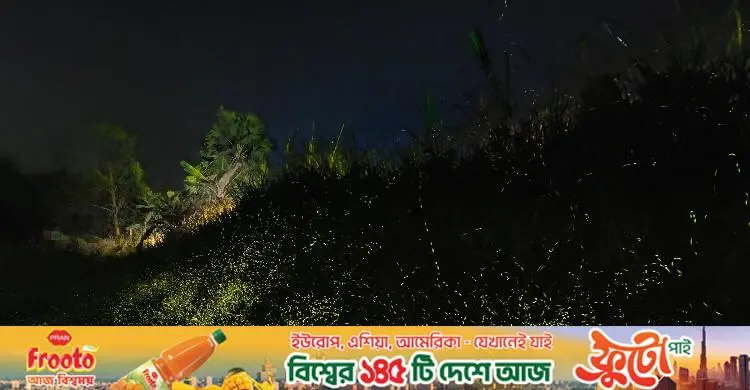
Once, as a summer evening fell, small lights would flicker through the village darkness. In the grass of the courtyard, on pond banks, in the bushes or along the ridges of paddy fields, a tiny firefly would suddenly glow. Then another, and then many at once.
Children ran after those lights. Some caught them in their fists, some collected them in glass bottles, and some simply watched from a distance. On dark nights, the fireflies' glow was nature's own illumination.
That sight has now all but disappeared. The Belgian researcher Raphael De Cock has similar childhood memories. At just nine he found in real life the fireflies he had read about in his grandfather's nature book, and later, on a humid summer night, he was enchanted by hundreds of them glowing in the same spot. Returning many years later, he found the fireflies gone: the place had been covered with houses and factories.
De Cock now studies fireflies, and his childhood experience matches that of many people around the world. Seeing fewer fireflies on summer nights is not just nostalgia; there are scientific reasons behind it.
There are more than 2,600 species of firefly, found on every continent except Antarctica. But scientists know very little about most of them. The conservation status of only about 150 species has been assessed so far, and about 20 per cent of those are at risk of extinction.
Researchers say the most important causes of the decline are habitat destruction, light pollution, overuse of pesticides, climate change and unregulated tourism.
Losing their homes
One of the biggest threats is loss of habitat. The wetlands, forests, grasslands and scrub where fireflies breed are changing fast. As towns and settlements grow, natural areas are turned into houses, roads and industrial zones. If a species needs a particular environment, losing it makes survival difficult.
Malaysia's Pteroptyx tener is a good example. This species, famous for flashing in unison, needs mangrove forest to breed, but its habitat has shrunk as many mangrove areas have been converted into oil palm plantations and aquaculture farms.
Artificial light and pesticides
Artificial light is another enemy. Street lamps, house lights, commercial signs and the glow over cities are all making nights brighter than before, yet dark nights play an important part in a firefly's life. Many species produce light through a chemical reaction in their bodies and use it to attract mates. When artificial light increases, their signals are hard to see, which can disrupt breeding and communication.
Researchers estimate that more than 23 per cent of the world's land area has some level of artificial light at night, so the darkness fireflies need is steadily shrinking.
Pesticides are another major cause. Overuse can harm fireflies at different stages of their life cycle and reduce the small animals they feed on, so both the insects and their food supply suffer. Researchers have raised concerns about several pesticides used in agriculture.
Climate change and tourism
The effect of climate change on fireflies is also growing. Prolonged drought can make some areas unfit for them, and in coastal areas, sea-level rise and stronger storms can flood or destroy their habitat. The crisis is therefore not only a local environmental problem; it is also linked to global climate change.
People now travel to many countries to see fireflies. Firefly watching has long been a popular pastime in Japan, Taiwan and Malaysia, but this tourism is growing fast, and research notes that more than two lakh people travel to see fireflies every year.
Too many visitors can harm them. In Thailand, tourist motorboats on mangrove rivers are damaging trees, riverbanks and firefly habitat. In parts of North Carolina in the United States and in Mexico, flightless fireflies are being trampled underfoot by tourists. Managing tourism has become important for protecting fireflies.
How to bring them back
The first need is to protect their habitat: wetlands, forests, grasslands, mangroves and scrub must be conserved, and small refuges for fireflies can even be created in back gardens.
- Cut unnecessary night lighting and avoid overly bright lamps.
- Reduce unnecessary pesticide use in gardens and on farmland.
- Leave grass a little longer rather than cutting it very short.
- Do not rush to clear away dry leaves, since part of the firefly life cycle takes place in leaf litter and close to the soil.
- Children need not give up the old joy of catching fireflies, but they should release them back into nature after a while.
One of the biggest problems is lack of information. Although there are thousands of species, scientists know very little about the lives and habitats of most. The Firefly Specialist Group of the International Union for Conservation of Nature (IUCN) is working to fill the gap: since 2018 it has been collecting data on fireflies in different regions, compiling species lists and assessing conservation status.
Researchers say long-term monitoring must increase, to show which species are declining and by how much, where they survive and which environments matter most to them. They also call for separate rules for firefly tourism, setting out how fireflies can be watched while reducing the impact of footfall, artificial light and pesticides.
The firefly's story is not just the story of an insect. It is a story of changing nature, of changing nights, and of a lost scene from human childhood. Spotting a few fireflies in a village or on the edge of a town today may seem merely a pretty sight, but that small light is a reminder that the surrounding environment has not been lost entirely.
Restoring dark nights, protecting natural habitats, reducing pesticides and tackling the risks of climate change are what can keep that light alive. Then perhaps one summer evening hundreds of lights will glow over the grass again, children will again run after fireflies, and that childhood scene will no longer be only a memory.
Sources cited: CNN, The Guardian, BBC, National Geographic.
Source: Jagonews24. First published in Bengali on The Agro News.

Comments
(0)