
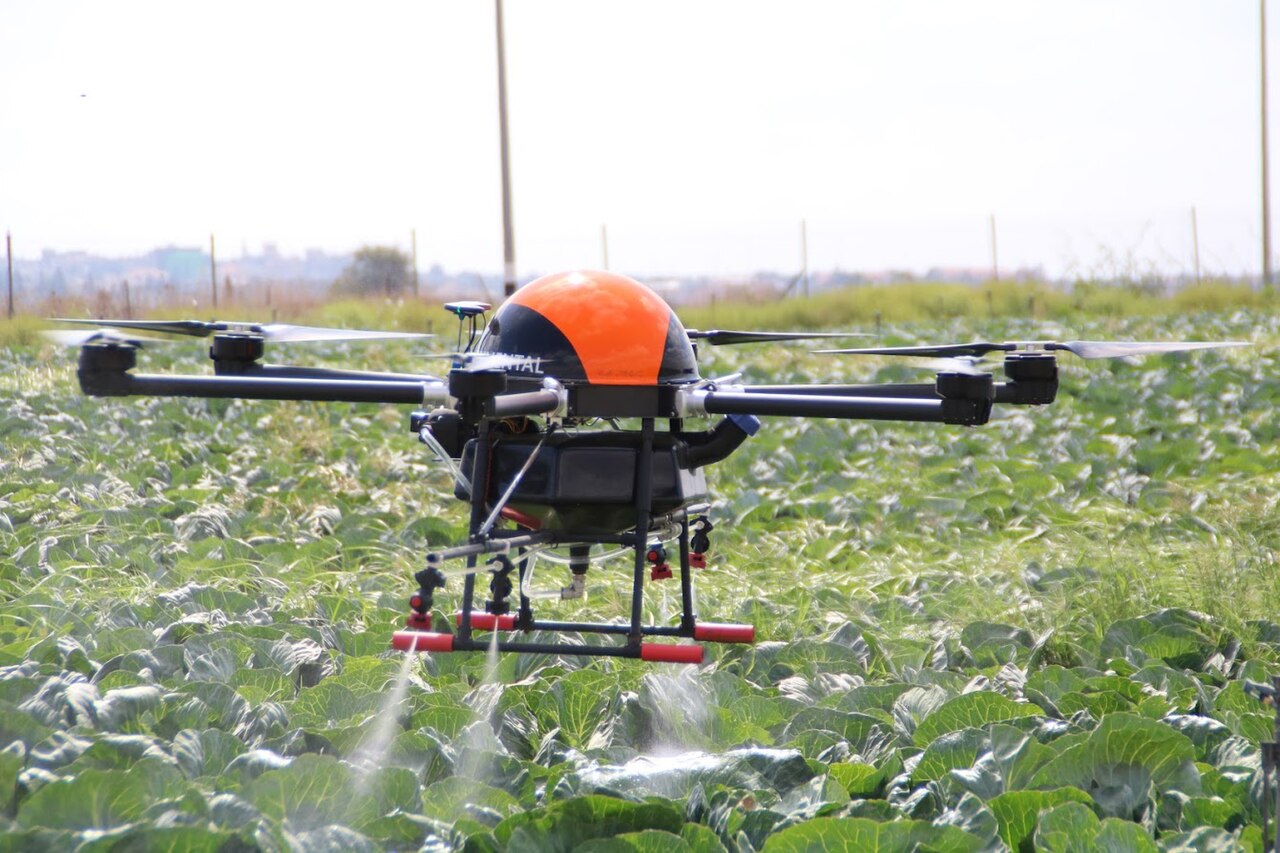
Engineers at the University of Missouri have developed FieldVision, an artificial intelligence framework that helps fleets of agricultural drones decide where to process the images they collect: on the drone itself, on a nearby edge computing server, or in the cloud.
The problem it tackles is practical. Crop counting, crop-health monitoring and targeted inspection only help if the imagery is analysed while a mission is still under way, but drones have limited computing power and battery, and wireless connections in rural areas are unpredictable. When several drones fly at once and share bandwidth and edge servers, offloading work may help one drone while causing congestion or delays for another.
FieldVision treats each drone as an intelligent decision-making agent. Using multi-agent reinforcement learning, the drones learn when a task should run on board, go to an edge server or be sent to the cloud. They are trained together, so they learn how shared resources get contested, and then decide on their own using local information once deployed, without needing to talk to each other during a mission.
In simulation tests the system outperformed traditional rule-based approaches and single-drone AI methods: it achieved higher rewards, missed fewer deadlines and was more reliable.
The researchers say farmers, agricultural researchers and others who use drones for precision agriculture stand to benefit most, because faster processing turns aerial imagery into usable information sooner, for crop counts, crop-health checks, spotting anomalies and inspecting fields. The same approach could apply to disaster response, wildfire and flood monitoring, and infrastructure inspection.
The work was led by Mizzou investigators including Andrew Hellman, Bishwas Wagle, Alicia Esquivel Morel, Juan Mogollon, Jianfeng Zhou, Kannappan Palaniappan and Prasad Calyam, with collaborators from Florida Gulf Coast University, Stony Brook University and the University of Memphis, and was supported by the US National Science Foundation. AgroPages carried the university's release.
Photo: Agridrones Solutions Israel / Wikimedia Commons (CC BY-SA 4.0)
Source: AgroPages
Comments
(0)