
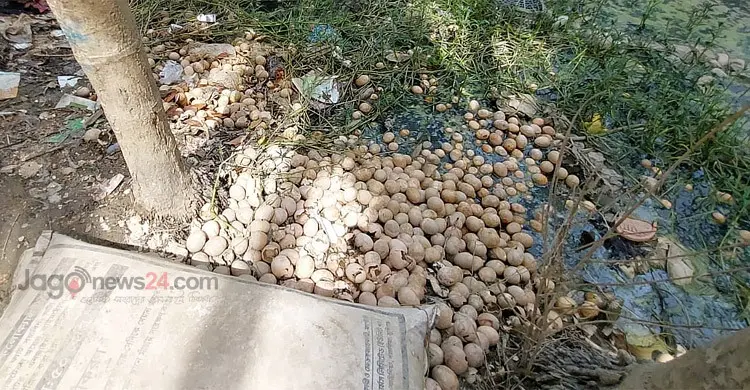
"I have 14 farms of my own and another 74 under me. Together there were 95,400 broiler, Sonali and layer birds, and 1 lakh 16 thousand eggs. Apart from a few birds, everything is gone. Crores of taka are lost, and now I am stuck with dead chickens and rotten eggs."
That is how Jafar Uddin, a poultry trader at Bhor Bazar in Sonagazi upazila of Feni, described his situation. Recalling the day the flood began, he said the water surged in after 3am and the whole area went under in moments. "We were busy saving our lives; there was no chance to save our assets. Many farmers like me are on the verge of ruin. To get back on our feet we need government and private support," he said.
Like everyone else hit by the floods, Feni's farmers are in despair, and not everyone can understand their silent grief. On one side their homes are damaged; on the other, they have lost assets worth crores of taka. Paying what they owe companies and repaying bank loans in particular weigh on them. In the first days of the most devastating and sudden flood in living memory the struggle was to stay alive; now their concern is how to recover.
A visit found Feni to be one of the districts worst hit by the floods. Several upazilas of the district are still waterlogged, though the water has receded from some, laying bare raw wounds. Everything, from people's homes onwards, has been damaged, and the true picture is almost impossible to capture. The farmers who supply a large share of the country's protein are now close to ruin.
According to government figures, 39 unions and municipalities in all six upazilas of Feni district have been affected. Among them, 1,827 poultry farms have been damaged, with financial losses of Tk 41 crore 38 lakh 49 thousand 550.
Dead birds dumped in ditches, the stench unbearable
A visit to Sonagazi upazila on 3 September found farms across most of the area; a poultry farm appears after every two or four houses. But there are no birds, and the farms stand empty. Dead birds have been dumped nearby, and the stench is suffocating.
Farmers say the water rose chest-high, and in places above head height. In many places they had to swim. "Should I save myself and my family, or save the farm?" they asked.
At Bhor Bazar in Sonagazi, Jafar Uddin, owner of Bhor Bazar Poultry Centre, said water had risen waist-high in his office. On the farms it had been chest-high in some places and waist-high in others.
"I have 14 farms of my own. The other 74 farmers are my customers; they all take chicks, feed and medicine from me. They are all in the same situation. Those who took their birds into their houses or onto their roofs have been able to save them. By my count about 1 lakh 16 thousand eggs have been ruined, worth about Tk 12 lakh 76 thousand. In addition, on my own farms and those under me, 14,860 broilers, 54,200 Sonali birds and 26,340 layers have died," he said.
He said the medicines, documents and fridge in his office at Bhor Bazar had been ruined, as had the feed in the warehouse, along with the birds and eggs. "The broilers and Sonali birds could not be saved. I have kept some layers alive, but they are eating feed without laying eggs, so there is no point keeping them. Staff wages, rent and electricity bills are all a loss. We will not recover the money from these."
Same picture at Raju Poultry Farm
The same picture was found at Raju Poultry Farm in Lakshmipur village of Sonagazi upazila, where 15,000 layer birds are kept in sheds in several houses, alongside a fish farm. Six thousand of the layers have died and 30,000 eggs have been ruined.
The farm's owner, Abul Kalam, told Jago News that the water rose suddenly at 3.30am. "I came from home and got some birds out and up to higher ground. But what good did it do? A day later they started jumping about; there was no water, no feed, and they were dying just like that. I gave them dirty water from below. Where would I get feed? All the roads were under water and no feed came. We were in a terrible situation. I saved what I could, and some survived because we fought so hard."
The owner of Raju Poultry Farm said: "I am an agent. More than one lakh broiler and layer birds are under me, and most of them have been affected. Water also entered our shop in the market and ruined all the medicine and feed."
Farmers ask for cheaper loans
Asked how he would make up the losses, Jafar Uddin said: "There is no way to recover this loss. If the government looks kindly on us and cuts the interest rates on our loans, or gives us new interest-free loans, then we can get back on our feet."
"So far we have received no government help. But they have asked us to make a list, and we are coordinating that," he said.
Asked whether the company from which he takes chicks and feed was helping, Jafar Uddin said the company's support was still hanging.
On bank loans, Jafar Uddin said: "The bank has allowed loan repayments to be suspended for two months, but we have to pay extra interest in the meantime. For an instalment of Tk 1 lakh 28 thousand, we would have to pay an extra Tk 60,000 in interest over two months. I said I don't need it; I will repay on time. This was a clever blow, oppression in the name of help."
Abul Kalam, owner of Raju Poultry Farm, said: "If the government helps us, gives incentives, waives some instalments on our bank loans or gives us some facilities, we can get back on our feet. Otherwise we are finished. Everything is finished. Everything we have is on loans; we did this with borrowed money. If the government does nothing, there is no way to recover in this sector."
Asked whether government officials had taken any steps, poultry association president Abul Kalam said: "The livestock officers have asked for a list. We are doing that, and together we will submit it."
Livestock office: final count will take time
Feni district livestock officer Dr Mozammel Haque told Jago News: "We have made a preliminary estimate of the damage, but it will take a few more days to get the real figure. There is still water in various upazilas of Feni district and people are marooned. When their losses are added, the total may change."
He said 39 unions and municipalities in all six upazilas of Feni had been affected. The district's farms held 36 lakh 43 thousand 400 chickens during the flood, of which 20 lakh 74 thousand 810 died. There were 5 lakh 12 thousand 554 ducks, of which 1 lakh 88 thousand 402 died. In all, 1,827 farms were affected, and 21 lakh 86 thousand 210 ducks and chickens combined were affected. The loss in money is Tk 11 crore 32 lakh, and feed worth about Tk 30 crore 6 lakh 49 thousand 550 was ruined.
Asked whether the government had any plan to keep farmers afloat, the officer said there would certainly be government action, but it would come gradually. The full damage will be assessed first, and then the government will plan and take steps step by step. "For now they have asked us for damage reports and we are providing them, that is all. Perhaps they are planning at the top how to rehabilitate the farmers," he said.
Source: Jagonews24. First published in Bengali on The Agro News.
Comments
(0)