
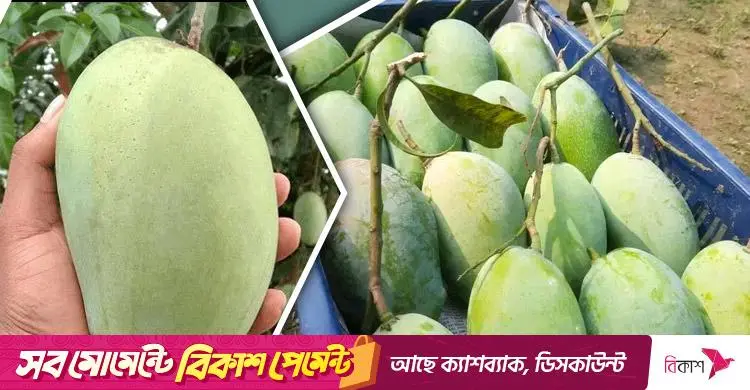
Every summer the mangoes arrive, sometimes Himsagar, sometimes Langra, sometimes Haribhanga. But at the end of the season a large, fragrant, juicy mango appears in the market by the name of Fazli. It feels as if a royal guest has arrived for the last part of the mango festival.
"Fazli" is not just the name of a mango; it is a historic identity and a name of pride. But what story lies behind the name? Who was that "Fazli"? These questions come to mind as we sink our teeth into the fruit.
Among the many mangoes, such as Himsagar, Khirsapati, Langra, Gopalbhog, Ranipasand, Amrapali and Ashwina, Fazli stands apart for its taste, size and grandeur. It enjoys a kind of respect as a king of mangoes, and it is also said to be known as "Fakirbhog".
Fazli is grown most in Rajshahi and Chapainawabganj, and the Fazli mangoes of these two regions have received geographical indication (GI) recognition. This traditional variety spread from Bangladesh, north-eastern India and north-western Myanmar. So how did this juicy, fibreless, sweet mango with a tangy aroma come to be called "Fazli"? Let us go back to the story.
Fazli Bibi of Gaur
In the colonial British period, around 1800, an elderly woman lived in a dilapidated house in Gaur in ancient Bengal. Her name was Fazli Bibi. Mangoes were her great love, and she would treat passers-by, sannyasis and fakirs to the fruit of a mango tree in her courtyard.
Once the British collector of Malda, Mr Ravens, came to Gaur on tour and set up camp next to Fazli Bibi's house. One day the sahib, parched with thirst, met Fazli Bibi. Instead of giving him water, she gave him a sweet mango.
The sahib was so charmed by the mango that he asked its name. Fazli Bibi, who did not know English well, simply said her own name, "Fazli". The collector took that to be the name of the mango. So a woman and a mango together gave us today's Fazli mango.
Sultana Fadli Bibi
There is another, more colourful story about the name. Sultana Fadli Bibi, wife of Sultan Yusuf Shah (1474–1481 AD) of the Iliyas Shahi dynasty, one day ate a mango in the palace garden and threw away the stone. A new mango tree grew from it.
When the tree bore fruit a few years later, people in the palace noticed that just as the mango was large, the sultana too had changed: she had become somewhat heavier than before. The servants jokingly named the mango "Fadli" after the sultana. When she heard of it she was displeased and complained to the sultan.
The sultan heard everything and first laughed, then tasted the mango, was pleased, and ordered its saplings spread. Over time, the pronunciation "Fadli" evolved into "Fazli".
Size, taste and season
On average a Fazli mango is 13.8 cm long, 9.5 cm wide and 7.8 cm high, and weighs 654.4 grams. It is long and slightly flat. The skin of a ripe mango turns somewhat yellow. The flesh is yellow, fibreless, juicy, fragrant, tasty and sweet. The skin is thin, and the stone is long, flat and thin. The mango has a sugar content of 17.5 per cent.
Fazli mangoes reach the market in the first week of July every year. Because they keep longer than other mangoes, they are also valued as an export variety.
There may be debate over the name, but combining history and taste, Fazli has made a place of its own. The royal mango still keeps its grandeur at the summer mango festival, just as it once did in a courtyard in Gaur or in a sultana's palace.
Source: Jagonews24. First published in Bengali on The Agro News.

Comments
(0)