
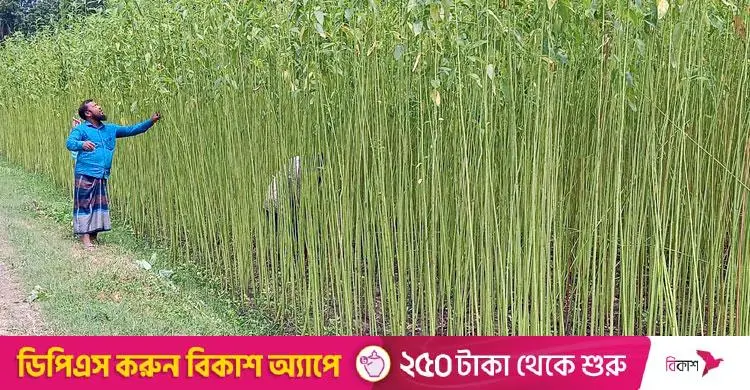
Farmers in Faridpur have done well by growing a new jute variety, "Sabuj Sona" (green gold). Its greater height, shorter growing time and tolerance of water make it a profitable crop, and farmers are getting good yields from it.
According to the Department of Agricultural Extension (DAE), jute has been grown on 86,500 hectares across the district this season. Yields are good, but costs have risen many times over. Jute covers more than 75 per cent of the district's cultivated land, and at least 5 lakh farmers are directly or indirectly involved in it.
How the variety was bred
The Jute Research Institute in Faridpur says Sabuj Sona was developed through one session of hybridisation with the Indian variety JRO 524. After passing quality tests at the research stage, it proved successful in the field and was declared the best jute variety of all. Sabuj Sona (BJRI Tossa Pat 9) gives higher yields, suffers less from disease and insect attack, and can be cut just 125 days after sowing. Its fibre is also of good quality.
Bidhan Chandra, a jute farmer in Saltha upazila, said: "This time I grew the new variety on a few bighas and have profited in every way."
Md Mokter Molla, president of the Saltha jute farmers' association, said: "We have done well growing this variety. It grows taller than other varieties. It takes about 100 days to grow, three to four weeks less than any other jute. Because it tolerates water, standing water in the field does it no harm."
Officials' view
"Most of the Indian jute seed sown in Bangladesh until now was weak. Some could not tolerate water, some took longer to grow, and some grew tall but were brittle with thin fibre. The new Sabuj Sona variety has overcome these weaknesses, and farmers growing it have been very successful," said Md Mujibar Rahman, chief scientific officer of the Faridpur regional centre.
Mohammad Khayer Uddin Molla, additional director of the DAE's Faridpur region, said: "We have seen in the field that Sabuj Sona beats other tossa jute in quality and yield. But there is a seed shortage. It is hard to supply as much seed as there is demand for."
Agriculturist Shahaduzzaman, deputy director of the DAE in Faridpur, said: "Heavy rain during retting this time means the jute will have good colour, so market prices should be satisfactory. More than 2 lakh tonnes of jute will be produced this season, with a market value target of more than Tk 2,000 crore."
Source: Jagonews24. First published in Bengali on The Agro News.

Comments
(0)