
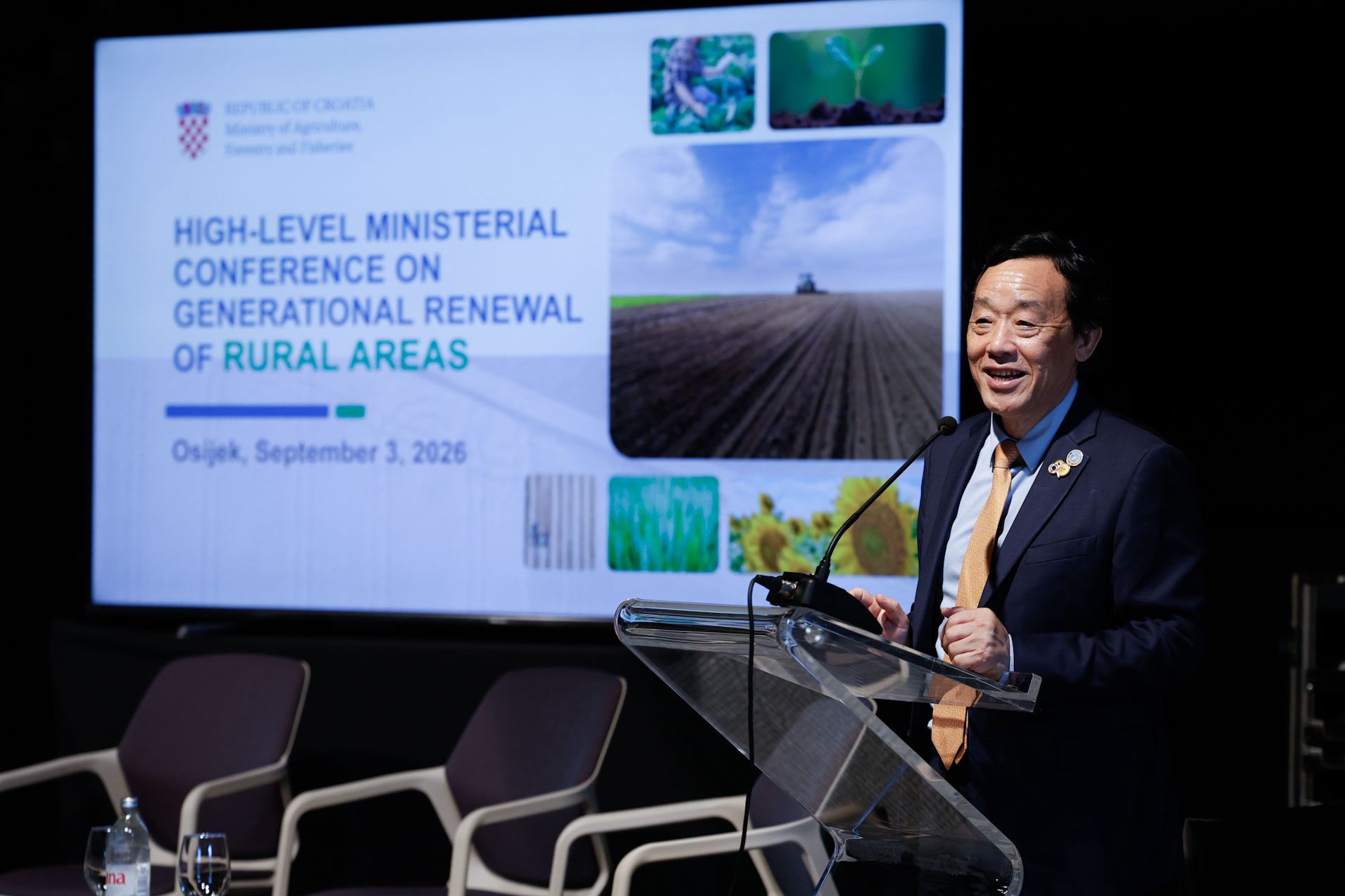
Securing the next generation of farmers takes more than farm subsidies, FAO Director-General QU Dongyu told a High-Level Ministerial Conference on Generational Renewal in Rural Areas hosted by Croatia. It takes access to land, finance, knowledge and technology, and alongside them affordable housing, connectivity, childcare, education and health services.
"Generational renewal is about choice," he said. "Our responsibility is to create the conditions in which young people can choose agriculture; they can choose to live in rural areas; and they can choose to invest their talent, knowledge and energy in transforming our agrifood systems."
The numbers explain the urgency. Globally, 44 percent of working youth depend on agrifood systems for employment and 46 percent of young people live in rural areas — yet many still face barriers to land, finance, skills and technology, and to decent jobs and the chance to start a business.
"This is why generational renewal requires a systemic approach, bringing together agricultural and rural development policies together with investment," the Director-General said. He pointed to the FAO Youth Committee, set up in 2019, and the World Food Forum it inspired in 2021, as well as the United Nations Decade of Family Farming 2019–2028, and argued that young people should be in decision-making from the start rather than consulted afterwards.
The conference brought policymakers from the region and beyond together to look at the demographic pressures on rural areas and at how agricultural, rural development and other policies can be made to work in the same direction.
Qu also acknowledged the summer's drought in the region. "It is a matter for generations working together through innovation and a science-based approach to ensure future generations continue to prosper with sustainable agrifood systems here and around the world," he said.
Alongside the conference, the Director-General opened the 71st World Ploughing Championship, which brought farmers from different countries and farming traditions together to exchange practice across generations. "I am delighted to be among the farmers of the world. You are ploughing the soil to sow the seeds of peace and I hope we have a bumper harvest," he said.
The pairing was deliberate: the championship showcased inherited farming knowledge, while the conference argued that such knowledge has to be joined to science, technology and sustainable mechanisation — which raises productivity, reduces drudgery and can be adapted to what farmers actually need locally.
Source: FAO Newsroom
Comments
(0)