
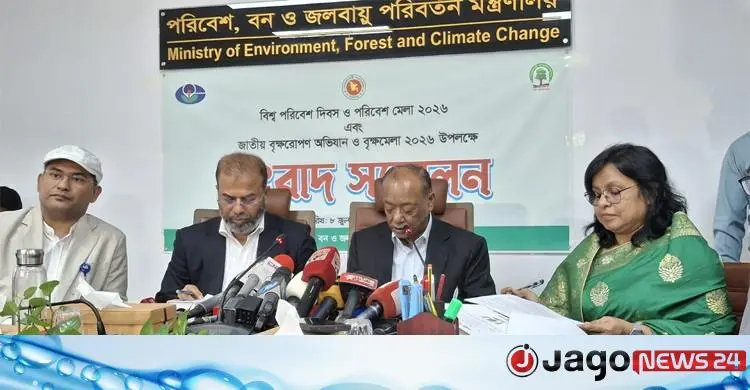
Environment, Forest and Climate Change Minister Abdul Awal Mintoo has said he expects a visible improvement in the country's environment over the next four years.
He was speaking at a press conference at the Secretariat on Wednesday, 8 July, marking World Environment Day and Environment Fair 2026 and the National Tree Planting Campaign and Tree Fair 2026.
The minister said sources of pollution in the Buriganga and other rivers around the capital were being identified and action taken. He added that 70 to 80 indicators based on international standards would be set for controlling water, air and noise pollution, and progress would be assessed regularly.
Dyeing factories and tanneries
Asked whether the government would take any special step to restore the Buriganga during its term, the minister said the Turag, Balu, Dhaleshwari and other nearby rivers were in much the same state, and the sources of their pollution were now being identified.
He said the two main sources of river pollution were textile dyeing factories and the leather industry. Many factories have effluent treatment plants (ETP/STP) but do not always run them: they switch them on when inspectors visit and off afterwards, and in many cases waste is dumped into rivers through hidden pipes. These matters will be investigated and action taken.
A big change may not be visible within a year, the minister said, but he was optimistic of a significant improvement in four years.
Indicators and a baseline
An integrated action plan has been adopted for tackling climate change, controlling water, air and noise pollution and improving the environment overall. Under it, about 70 to 80 indicators are being set in line with international standards. A baseline of the country's current state will be drawn up from them and progress assessed every year. The minister said progress on the indicators would be presented regularly to the media.
Dhaka's environmental crisis cannot be solved in a day, he said. Alongside cutting air, noise and water pollution, steps are being taken to modernise solid waste management from upazilas to city corporations. Where possible, electricity, gas and organic fertiliser will be produced from waste, and an action plan will be put into effect quickly in coordination with the LGRD ministry.
32 crore saplings for a net 25 crore trees
Based on the government's 180-day action plan, the environment sector's election pledges will be implemented over the next five years. These include planting 32 crore saplings to ensure a net 25 crore trees, science-based planting, an app to monitor trees, greening chars and islands, a green building policy, more renewable energy and wider use of water-saving technology in rice farming.
Asked about there being only three veterinarians for wildlife conservation, the minister said the number was not enough, far below what is needed, and steps would be taken to see how staffing could be increased.
A project on noise pollution control has been completed and will now move to implementation, he said. Decibel monitoring will be introduced in the noisiest areas and surveillance of pollution sources increased.
On illegal brick kilns and eco-friendly building materials, the minister said kilns not only pollute the air but also destroy fertile topsoil from farmland. The use of blocks instead of bricks will be increased step by step, but only once enough supply is assured.
The state minister said the block industry faces obstacles including the VAT structure, priority in government procurement and market expansion. Recommendations from block manufacturers will be reviewed and the necessary steps taken to make blocks cheaper and more popular.
Source: Jagonews24. First published in Bengali on The Agro News.
Comments
(0)