
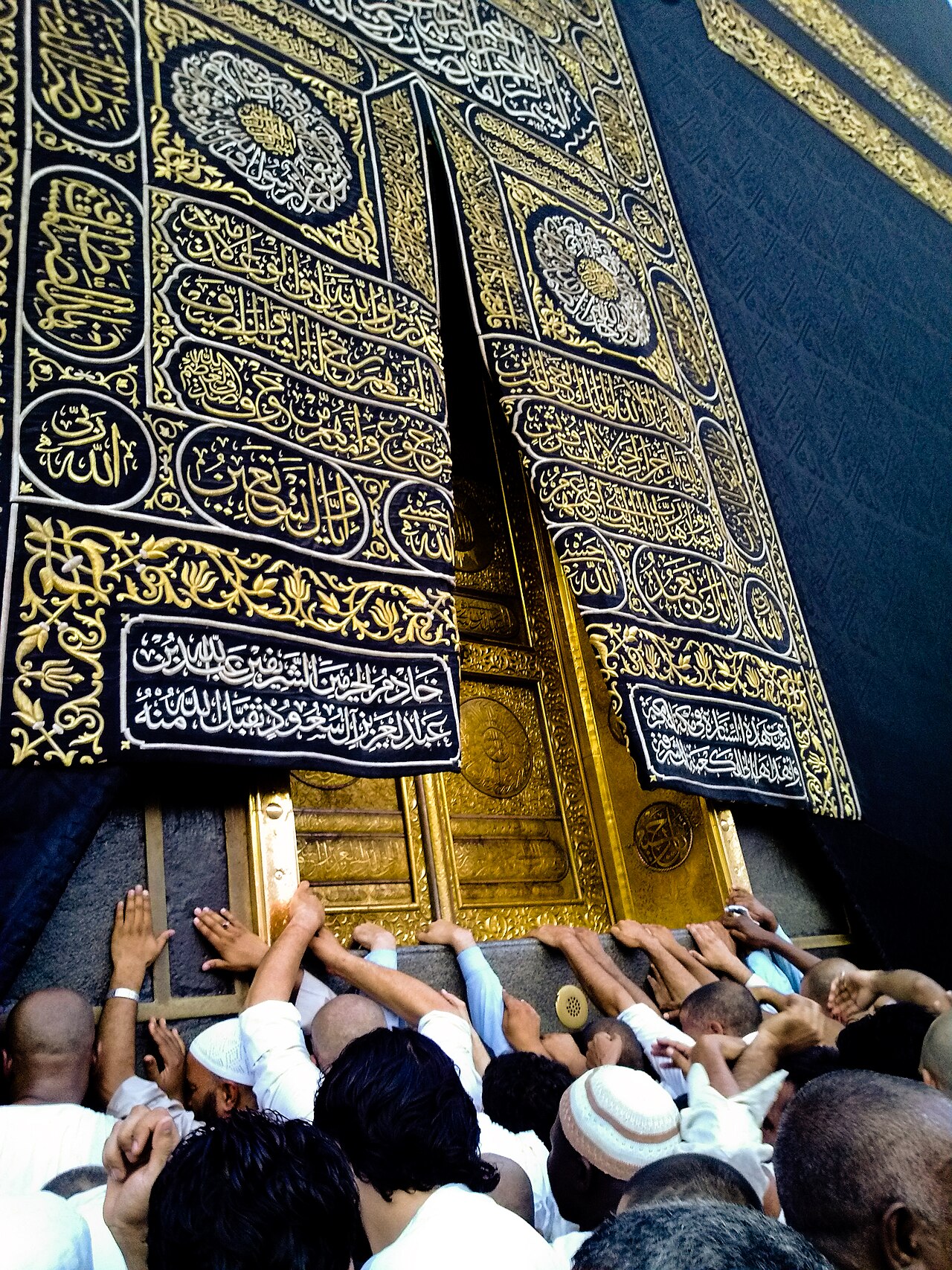
Pilgrims circling the Kaaba pass eight yellowish-brown stones set in a row on the Shadharwan, the white marble base of the wall, just to the right of the door. Writing in Prothom Alo, Ehsan Siraj says the small stones keep the memory of a spot in Masjid al-Haram tied to the history of how the prayer was taught.
The largest stone is about 33 centimetres long and 21 centimetres wide. Saudi Arabia's General Authority for the Affairs of the Two Holy Mosques says they are more than 800 years old. In Arabic they are called marmar; in English, alabaster or marble.
The stones once lined a hollow to the right of the door, lower than the floor of the mataf, known as al-Majan, "the place where clay was kneaded". By the reckoning of Makkah historian Mansour al-Daajani it was about two metres long, 112 centimetres wide and 28 centimetres deep, with room for only one person. The Ottoman historian Ayyub Sabri Pasha wrote in Mir'at al-Haramayn that Ibrahim (peace be upon him) is said to have mixed clay there while building the Kaaba.
A hadith relates that Jibril led the Prophet (peace be upon him) in prayer near the House for two days to teach the prayer times (Sunan Abu Dawud, hadith 393). The hadith does not name the hollow, but later historians, among them the seventh-century AH scholar Izz ibn Abd al-Salam, identified al-Majan as the spot.
According to Haramain researcher Muhiyuddin al-Hashimi, the Abbasid caliph al-Mustansir Billah gave the stones during a renovation of the mataf in 631 AH (about 1233-34 CE); the year was found written beneath a blue stone. In 1213 AH (about 1798-99) the stones were stolen. They were found 164 years later among the belongings a man left when he died.
They were returned in 1377 AH (about 1957-58), during the first Saudi-era expansion of the Haram. By then crowds praying in the hollow blocked the circling pilgrims, and some fell into it during Hajj, so the hollow was filled in and the stones were set on the Shadharwan as a marker. When the Shadharwan marble was replaced in 1417 AH (about 1996-97), the old pieces were kept in place.
Prothom Alo's article cites The Islamic Information as its source.
Photo: omar_chatriwala / Wikimedia Commons (CC BY 2.0)
Source: Prothom Alo

Comments
(0)