
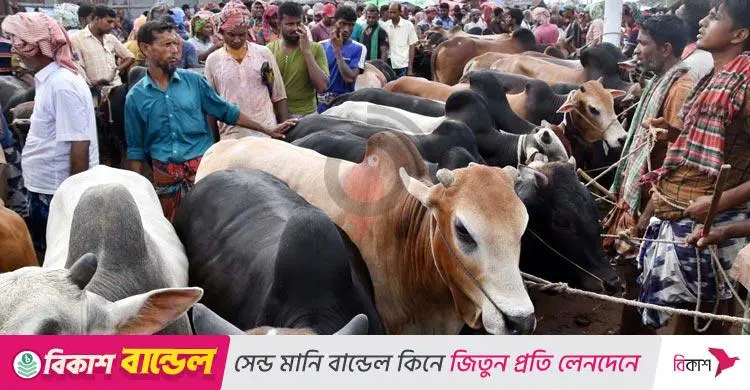
The total number of livestock fit for sacrifice at the coming Eid-ul-Azha is 1,24,47,337, and about 20,68,135 animals are likely to be left over this year.
Fisheries and Livestock Adviser Farida Akhter gave the figures at a press conference at the Secretariat on Sunday (4 May) on assessing demand for sacrificial animals, supply, and ensuring their free movement and transport across the country, including remote areas, ahead of Eid-ul-Azha. Subject to the sighting of the moon, Eid-ul-Azha, the second-largest religious festival of Muslims, will be celebrated in the country on 7 June.
She said that, as every year, the Department of Livestock Services and the Ministry of Fisheries and Livestock had assessed the number of animals fit for sacrifice. This year 56,02,905 cattle and buffaloes, 68,38,920 goats and sheep and 5,512 animals of other species, a total of 1,24,47,337 healthy animals, are expected to be available, with a likely surplus of about 20,68,135.
"Even if the demand we have estimated goes up, we have the capacity to meet it," she said.
She said a great deal of preparation was under way for Eid-ul-Azha, and it was being done carefully so that the livestock market stays stable and the work farmers do to earn at this time of year is not disrupted. At the same time, prices must stay within the reach of those who will sacrifice animals.
No imports, curbs on extortion
"We have said there is no need to import livestock this year. We will also make sure no animals enter Bangladesh through illegal routes. The livestock our farmers raise at home is enough. Our arrangements and management are in order relative to the need," the adviser said.
Seeking journalists' help so that no one can destabilise the market before Eid, Farida Akhter said the government was working to stop animal prices rising because of extortion. The issue had been discussed at an inter-ministerial meeting, she said.
Mobile courts against steroid use
The adviser said training on scientific fattening of sacrificial animals was under way across the country. On fattening and rearing livestock by scientific methods, 83,656 farmers have been trained, 6,600 courtyard meetings held and 2,74,378 leaflets and posters distributed.
"Training of farmers to raise awareness against the use of steroids and hormones is continuing, and mobile courts will keep operating with the joint cooperation of the district administration and the district livestock office."
She said 53,263 farms had already been visited to make farmers aware of the harm done by steroids or hormones.
Transporting sacrificial animals
Farida Akhter said awareness would be raised and instructions given so that goats and sheep are not carried in the luggage lockers of buses. Under the Animal Welfare Act 2019, cruelty towards sacrificial animals must be avoided and they must be carried by proper transport. Any breach will bring punitive action under the act.
20 veterinary teams at 19 markets in the capital
The adviser said that at every market a suitable, designated spot would be set aside, through the city corporation or municipality, for a veterinary medical team's camp, with logistical support while it is on duty. Aprons, masks, chairs and tables, buckets and mugs will be provided for the teams' staff.
As last year, 20 veterinary medical teams will be formed to give first aid to animals at 19 cattle markets under Dhaka North and Dhaka South city corporations, she said. Five central monitoring teams will oversee their work, and two expert medical teams will be formed, one each for Dhaka North and Dhaka South city corporations. Separate teams will handle central coordination, mobile courts and the control room.
"Monitoring teams formed by the ministry will monitor the veterinary medical teams in Dhaka city. Monitoring teams formed at division, district and upazila level will monitor the veterinary teams of the relevant upazila."
The fisheries and livestock adviser also said that, for hygienic sacrifice, 15,369 professional and 21,208 non-professional meat processors (butchers) had been trained in skinning sacrificial animals and preserving the hides.
Source: Jagonews24. First published in Bengali on The Agro News.

Comments
(0)