
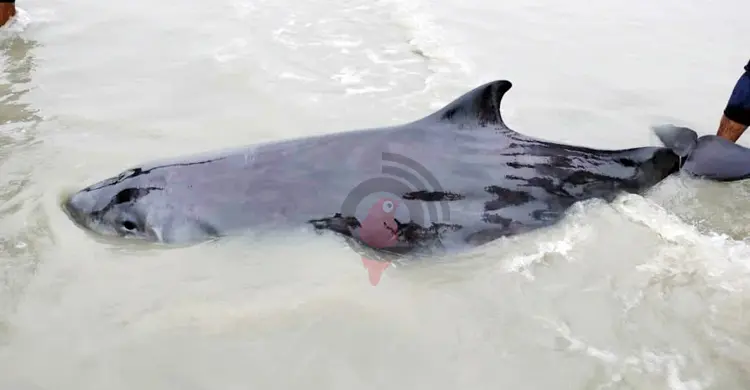
Mention a whale and most people picture a huge sea creature. So calling an animal smaller than a dolphin and shaped like a shark a whale may raise some curiosity. Yet researchers have found just such a whale in Bangladesh: a new species for the country called the dwarf kogia, or dwarf sperm whale.
The whale was found on Kuakata beach in Patuakhali on 22 May. Members of the Kuakata Dolphin Rokkha Committee found it alive near the shore. Despite repeated attempts to return it to the water, it could not be saved and died after struggling for about two hours. Researchers suspect it may have died from eating plastic debris.
The whale was preserved jointly by the Kuakata Dolphin Rokkha Committee, the Forest Department and Eco-Fish, and studied by the Wildlife Conservation Society (WCS).
How it was identified
Ruman Imtiaz Tushar, team leader of the Kuakata Dolphin Rokkha Committee, told Jagonews: "Usually in the monsoon, dolphins, whales, turtles and horseshoe crabs are found on Kuakata beach and the shore, sometimes alive and sometimes dead. We tried to save the whale we found alive on 22 May by putting it back in the sea, but every time it came back to shore. It died after struggling for about two hours."
"It looked a little different from the dolphins that had washed up before, so we were unsure how to identify it. We sent samples to WCS, and after research we were sure it was a new species of whale," he said.
Sagarika Smriti, associate researcher with USAID/Ecofish-2 and the WorldFish Bangladesh project in Patuakhali, said the whale was displayed to fishermen at the Alipur fish landing centre for preservation. From talking to local fishermen and from experience with dolphins that had washed up at Kuakata, they were fairly sure it was not an ordinary dolphin or whale, and research on samples confirmed the species.
She said the whale has been handed to the Forest Department. Two calves were found in its belly, and tests on them will show whether it died because of breeding or for some other reason.
WCS Bangladesh researchers identified it as a dwarf sperm whale first from photos and video, then by examining its ears, tail, blubber, flesh and stomach contents.
A whale that mimics a shark
Nadim Parvez, a member of the research team and senior coordinator at WCS, told Jagonews that the whale, known to scientists as Kogia sima, was found alive, and its photos astonished wildlife conservation workers. Analysis of the photos confirmed the first record of the species in Bangladesh.
"The whale's body shape is no coincidence. Dwarf sperm whales use these features to fool predators such as killer whales and large sharks into thinking they are a shark," he said.
"Studying its body, we found a small sac filled with reddish-brown fluid attached to the intestine. When predators are near, they squirt the fluid into the water and hide behind it, much like an octopus that releases black ink when frightened. They are the smallest whales in the world, so unlike other giant whales they cannot scare predators off with their size."
Rasel Mia, training and education officer at WCS Bangladesh, said the dwarf sperm whale is one of more than 90 known species of cetaceans. Cetaceans are mammals like us that spend their whole lives in water and breathe air. Like humans, mother cetaceans usually give birth to one calf, which drinks its mother's milk until it can live independently. Dolphins, porpoises, dwarf sperm whales and some other toothed whales have sharp teeth to catch slippery prey, but like all cetaceans they swallow prey whole rather than chewing it.
He said cetaceans have a powerful tail fin called a fluke. They move forward by beating it up and down, swim using two side flippers, and use the dorsal fin for balance and to regulate body temperature.
Why the find matters
"We know very little about this deep-sea whale," he said. "The species was never seen during more than a decade of WCS research in Bangladesh's seas. But dwarf sperm whales may be more common than we think, because they can only be seen when the sea surface is completely calm and they are lying still at the surface; otherwise they are very hard to spot."
On the cause of death, researchers said kogia whales mistake plastic debris for squid, octopus or cuttlefish, swallow it and die, which is why they are now at risk of extinction. Plastic debris can block their digestive tract and lead to death by starvation.
They added that the pregnant dwarf sperm whale found on the Bangladesh beach had two calves in its belly, which is extremely rare among cetaceans, as they usually give birth to one calf at a time.
Source: Jagonews24. First published in Bengali on The Agro News.

Comments
(0)