
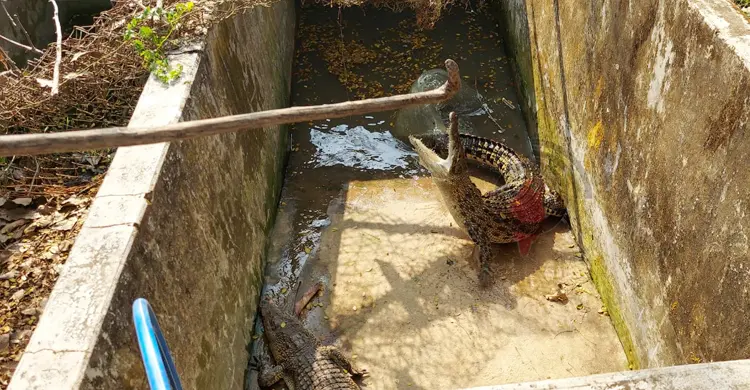
The Bangabandhu Sheikh Mujib Safari Park at Dulahazara in Chakaria, Cox's Bazar, has entertained nature lovers, students and people of all ages for nearly two decades. For visitors, a variety of animals are kept in 19 enclosures. Inside the park, under tight security, elephants, tigers, lions, hippopotamuses, gayal, African zebras, wildebeest, bears, wild boar, langurs, peacocks, freshwater and saltwater crocodiles, snakes, gaur and many other native and foreign species are kept both free-roaming and enclosed. Spotted, barking, sambar and hog deer range across the park.
There are also hundreds of kinds of birds, known and unknown, as well as huge, rare and valuable old trees, where monkeys leaping about catch visitors' eyes.
Staff at risk
Fifty-two forest staff in various posts look after these animals, and many must handle dangerous ones. Tigers, lions, hippos, gayal, zebras, wildebeest, bears, wild boar and other animals sometimes attack their keepers, and many are seriously injured.
Yet despite working at risk day after day, staff here receive no risk allowance, and many are eager to get transferred elsewhere.
Park curator Md Mazharul Islam said: "From outside it looks as though they are just handling a few caged animals, but in reality it is daring work. Getting wild animals used to living by human will is no small matter. All the caged animals must be fed on schedule: meat goes into the tiger and lion cages, live chickens to the crocodiles, and each keeper looks after biting animals such as bears, lamchita and boar. Managing huge elephants, hippos and others is risky. If they obey, fine, but if one suddenly gets angry and attacks, there is no option but to get hurt. If someone else sees the attack and comes to the rescue, the injury may be minor; if not, a much bigger accident could happen."
Giving an example, he said that one day before dusk, when meat was being given, a tiger suddenly got out of its cage and started walking towards the forest, leaving all the keepers frozen with fear. Its regular keeper called the tiger by name and made it stop. Called towards him, the tiger came back, and once beside him it was calmed by stroking and combing its fur and coaxed back into the cage. "It was a moment of extreme risk. Had the tiger attacked, nothing could have been done," he said.
He added that a few days earlier a forest worker named Birsen was injured by a wild boar. The boar had tried to slip out of its enclosure and got caught in a trap, and when he went to free it, it attacked him. Free-roaming animals do hurt someone or other like this, he said, yet the staff get no risk allowance despite the danger.
Call for allowance
According to curator Md Mazharul Islam, the risk will rise when the safari system is introduced, as staff may well be injured caring for and watching dangerous animals roaming free. He said introducing a risk allowance on top of normal pay is a demand of the times.
Md Rezaur Rahman Reza, a Cox's Bazar human rights activist and panel lawyer of the District and Sessions Judge's Court and Legal Aid, said those engaged in any risky state work have a moral right to a risk allowance. Handling animals at a safari park is certainly risky work, and since staff do it on government orders, it is very urgent to bring everyone posted there under a risk allowance.
The park is being modernised 24 years after it was set up. After recovering encroached forest land between the highway and the main gate, separate parking is being built for buses, microbuses and motorcycles, with entry on one side and exit on the other. A sculpture of Bangabandhu holding a white flying dove has been built just east of the park, with greenery and a flower garden being added around it. A resting shed for tourists is being built in the picnic spot to the south, and an artificial lake is being created beside it at the foot of the hills. Preparations are under way to move the dangerous animals into the safari section from next year.
Source: Jagonews24. First published in Bengali on The Agro News.
Comments
(0)