
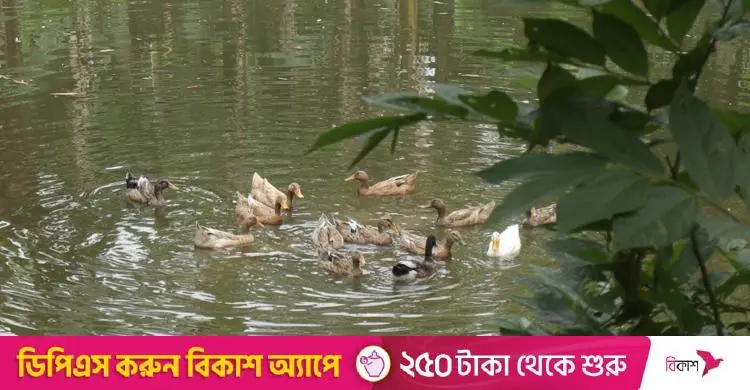
Watching a few ducks floating on the pond beside a house, it seems they have no troubles in the world. Floating with heads held high, now and then preening their feathers with their bills, or swimming together in a group, they make a peaceful picture of nature. The same scene can be seen on any small river near a home.
A duck's friendship with water is inborn; its body is built that way. Ducks do not get wet easily and do not sink, and they float very well. A duck has a small oil gland near its tail. It regularly combs its feathers with its bill to spread the oil evenly, creating a water-resistant layer on the feathers. So even after hours in the water, its body stays dry. Another special feature is its webbed feet. With a thin membrane of skin between the toes, a duck's feet push the water like paddles, letting it swim fast and easily. These feet also play an important part when it dives underwater to look for food.
Migratory ducks
In Bangladesh, the monsoon and winter make the world of ducks even more colourful. When winter comes, countless migratory birds are seen in the sky. At the start of winter, thousands of migratory ducks arrive after a long journey from distant wetlands in Siberia, Mongolia or China at haors and baors, rivers or the Sundarbans. Some fly as far as 4,000-5,000 kilometres. They travel not only to change habitat but also to escape the harsh winter, find food and complete their breeding cycle.
This journey of migratory ducks is one of nature's wonders. They follow set routes, take a few breaks on the way and return to the same places year after year. They can be seen at Hakaluki haor in Sylhet, Tanguar haor, the wetlands of the Sundarbans and the coast of Cox's Bazar.
Food and income
Duck meat and eggs are especially popular in many parts of the country. In winter in particular, duck cooked with potatoes has a distinctive taste. Duck eggs are larger than chicken eggs and rich in nutrients. In the Chattogram, Barishal and Sylhet regions, mashed duck egg and duck curry are known as special dishes.
Ducks play an important role in Bangladesh's rural economy. Rearing them is comparatively cheap, and selling eggs and meat brings families extra income. Ducks can find food even during floods, so in many areas they are more profitable than chickens. Ducks do not only meet food needs; they also help keep nature's ecological balance. By eating algae and insects in water bodies they help maintain water quality, help spread seeds and, as part of the aquatic food chain, help countless other creatures survive.
It is worth knowing that a duck can turn its neck almost 360 degrees. When it sleeps, it keeps one side of its brain awake while the other rests, so that it can react quickly to danger. A duck's eyes have a special kind of filter that helps it see clearly underwater. Many people believe a duck's quack has no echo; several studies have shown this is a myth. It does echo, but it is hard to hear.
Still, it would be wrong to think of ducks only as calm birds floating on ponds. They matter everywhere. When you see a duck swimming slowly, remember that it is not only cutting through the ripples but also drifting along with history.
The writer, Tanjid Shubhro, is a student at Bhawal Badre Alam Government College, Gazipur.
Source: Jagonews24. First published in Bengali on The Agro News.

Comments
(0)