
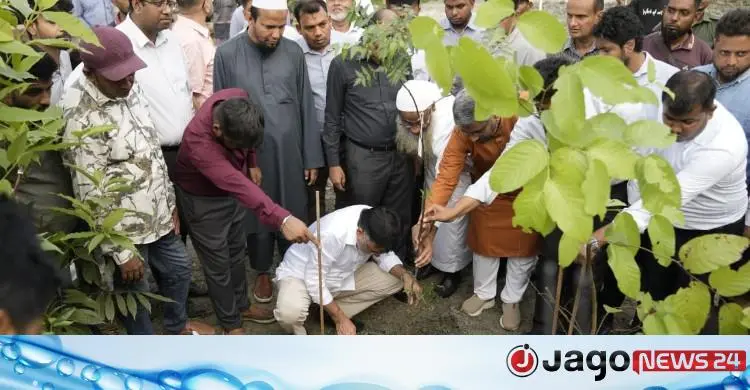
Against the backdrop of air, water and soil pollution in Dhaka, Dhaka North City Corporation (DNCC) has begun work on the country's largest urban forestation project, using the Japanese Miyawaki method, to help restore the environmental balance.
DNCC administrator Md Shafiqul Islam Khan inaugurated the work by planting trees on Monday (18 May) afternoon at a site marked as a green belt on the east side of the No. 11 lakeshore, next to the No. 4 bridge at Uttara Diabari.
Earlier, 14,000 trees were planted at the same site in phase 1 (chainage zero to 150 metres) between 26 November last year and 15 January this year. Following on from that, about 39,400 trees will be planted over about 2.60 acres in phases 2 and 3, which began today. They will include about 250 species, among them native fruit, flowering, medicinal, timber, ornamental, conifer, shrub and bushy plants.
How the forest is designed
Following biophilic design and biomimicry principles, the Miyawaki forest has raised and low mounds, winding paths and a walkway along the lakeshore.
Specially prepared loam soil has been mixed with vermicompost, coco dust, rice husk, bone meal and organic fertiliser to create conditions suited to a forest. Walking paths through the dense greenery are meant to offer the Japanese experience of "shinrin-yoku", or forest bathing.
Several government, private and voluntary organisations are involved, including the Forest Department, Shakti Foundation, Green Savers, Green Voice, Brighters, Youth Foundation of Bangladesh, OAB Foundation and Jubo O Paribesh Unnayan Sangstha. Ediface is helping with the feasibility study and survey for the Miyawaki forest.
Prof Dr Ahmad Kamruzzaman Majumder of Stamford University and Raufa Khanam of BRAC University are task force members for air quality analysis and action planning. Arham Ul Haque Chowdhury is providing technical support on the Miyawaki method, biophilic design and landscape concepts.
Five lakh trees in five years
As part of the Prime Minister's announced programme to plant 25 crore trees in five years, DNCC has already sent the ministry an action plan to plant 5 lakh trees over the next five years. The first-year target is 50,000 trees by December 2026.
The DNCC administrator said the corporation is pursuing the project to build long-term green infrastructure that improves the city's air quality, protects biodiversity and supports residents' health. Although everyone knows the benefits of trees, he said, there are very few initiatives where their real effect on city life can be felt. He will give the project top priority. Saying he felt a sense of mental relief at the site, he said such an environment will have a positive effect on residents' physical and mental health.
In his welcome speech, superintending engineer Abul Kashem said the forest will play a significant role in controlling pollution in Dhaka. More than 39,000 trees are being planted here as part of the plan to plant 5 lakh trees over the next five years.
Additional chief engineer Abul Hasnat Mohammad Ashraful Alam presided over the event.
Source: Jagonews24. First published in Bengali on The Agro News.
Comments
(0)