
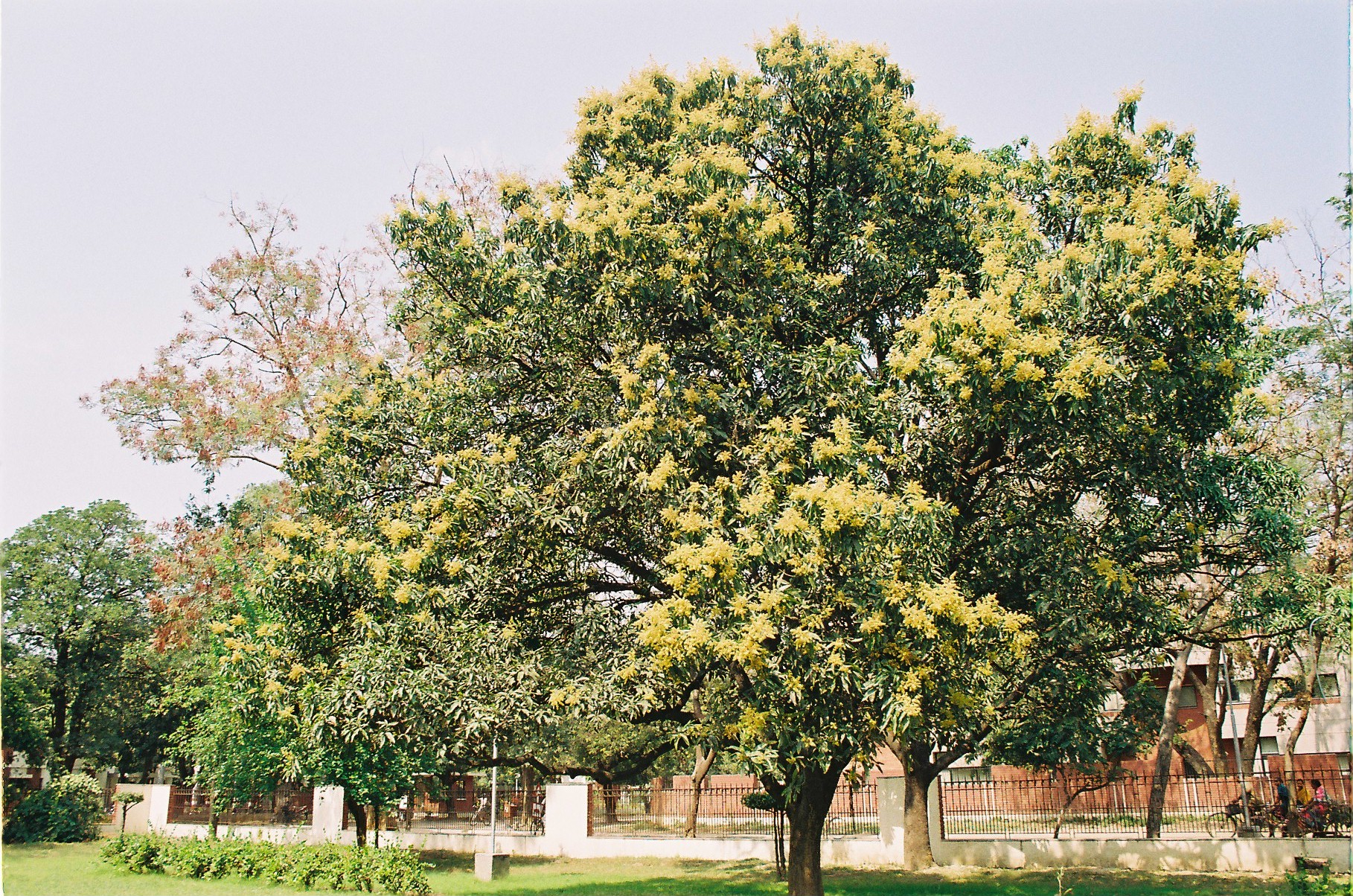
In the last days of January 2026, while the cold of the Bengali month of Magh still gripped northern Bangladesh, yellow blossoms began to appear on mango trees in Dinajpur. Jagonews24's Dinajpur correspondent reported on 31 January 2026 that, at a time when the chilly northern wind was disrupting daily life, the scent of these early blossoms was spreading through the air in different parts of the district, with bees buzzing around them.
Orchard owners told the paper that if the fog lasted, the blossoms could be hit by disease, which they described as powdery mildew or rot, and which they called the main reason yields fall. If the weather stayed favourable and the fog eased, they said, they hoped for a bumper mango crop that year. A senior official of the Department of Agricultural Extension (DAE) in Dinajpur said the early flowering came mainly from the weather and the variety of the trees, and that some trees flower early every year.
Where the early blossoms appeared
The correspondent visited villages in ten unions and spoke to orchard owners. Early blossoms were seen beside the Dinajpur-Dhaka highway, at Modern Mor in the town, in the toll plaza area west of Mohanpur bridge, on the premises of the No. 3 Fazilpur union parishad, at Gobindapur in No. 9 Askarpur union, and in various orchards of Parbatipur upazila.
Ruhul Amin, who owns a mango tree at Mohanpur Mor, said his 20-year-old guti mango tree had been flowering early for several years. The early blossoms lifted his spirits, he said, but he had one fear, dense fog: when the fog is heavy, the blossoms may rot.
Sagar Mia and Sohel Mia of Sarkarpara village in Rampur union said most of the trees were full of blossom, and that the blossoms had begun to appear about a month earlier.
Abu Reza Pramanik, who owns the orchard called "Dinajpur Aam Bagan" at Basirbania Baro Mereyapara village in Chandipur union, said his orchard had about 3,000 mango trees. He had been giving the trees their first round of care since the blossoms appeared.
What the agriculture office said
Md Anisuzzaman, additional deputy director (crops) of the DAE in Dinajpur, told Jagonews24 that the mango blossoms had started to appear ahead of the usual time mainly because of the weather and the variety.
He said some mango trees flower early every year, and that this year too they had begun. If such trees are not caught by dense fog, he said, they give an early crop; if the weather turns hostile, they give none. On the trees that blossom at the normal time, at the end of Magh, the blossoms will hold, he said.
Magh is the tenth month of the Bengali calendar. Banglapedia, the national encyclopedia of Bangladesh, places the winter season (shit) in the months of Paus and Magh, from mid-December to mid-February, and the spring (basanta) in Phalgun and Chaitra, from mid-February to mid-April. Banglapedia lists mango and jackfruit among the fruit trees that flower in spring, the season when bees become active gathering nectar. The end of Magh that the official described as the normal time therefore falls around the middle of February, at the turn from winter to spring. The trees that the growers described in late January had blossomed some weeks before that.
Dinajpur, the district and its upazilas
Dinajpur is a district of Rangpur division in the north-west of Bangladesh. Banglapedia gives its area as 3,444.30 square kilometres, with 13 upazilas, eight municipalities and 101 unions, and a population of 2,990,128 at the 2011 census. It borders Thakurgaon and Panchagarh to the north, Gaibandha and Joypurhat to the south, Nilphamari and Rangpur to the east, and the Indian state of West Bengal to the west. The district was established in 1786 under the name Ghoraghat district. Its notable rivers are the Jamuna, Tulsiganga, Punarbhaba and Atrai. Agriculture is the main source of income for 63.90 per cent of its people, according to the same entry.
Fazilpur and Askarpur, two of the places named in the report, are among the ten unions of Dinajpur Sadar upazila. Banglapedia describes the upazila as 354.73 square kilometres, bounded by Kaharole and Khansama upazilas to the north, West Bengal to the south, Chirirbandar to the east and Biral to the west. The Punarbhaba and Atrai rivers and the Ramsagar Dighi are its notable water bodies, and its main crops are paddy, wheat, sugarcane, potato, mustard and vegetables. The Atrai, Banglapedia notes, flows through the eastern part of Dinajpur town.
Parbatipur, the other upazila the report names, lies east of Chirirbandar. It covers 395.04 square kilometres and is divided into Parbatipur municipality and ten union parishads; the 2022 census counted 400,648 people there. It is home to the Barapukuria coal mine, the only active coal mine in Bangladesh, and to one of the largest railway junctions in the north of the country.
Dinajpur is better known for litchi than for mango. Officials of the DAE in Dinajpur told The Daily Star in March 2025 that 42,000 tonnes of litchi had been harvested from 5,787 hectares in the district in 2024, with a market value of 800 crore taka, and that the 13 upazilas had 5,418 litchi orchards. Rice is the other mainstay: the district agriculture office set a target of 270,550 hectares of transplanted aman rice for the 2024 season, BSS reported in July 2024.
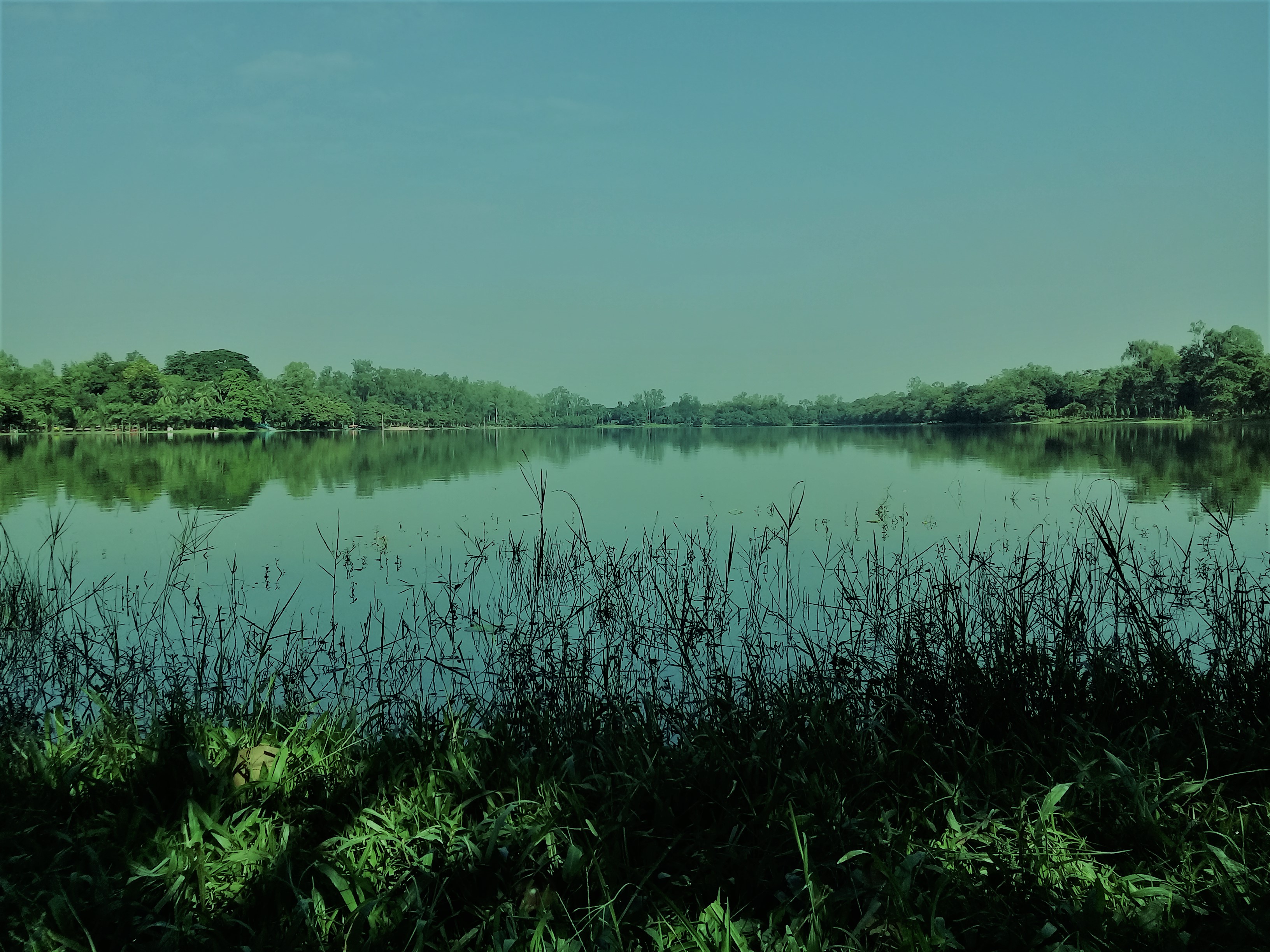
Why some mango trees blossom early
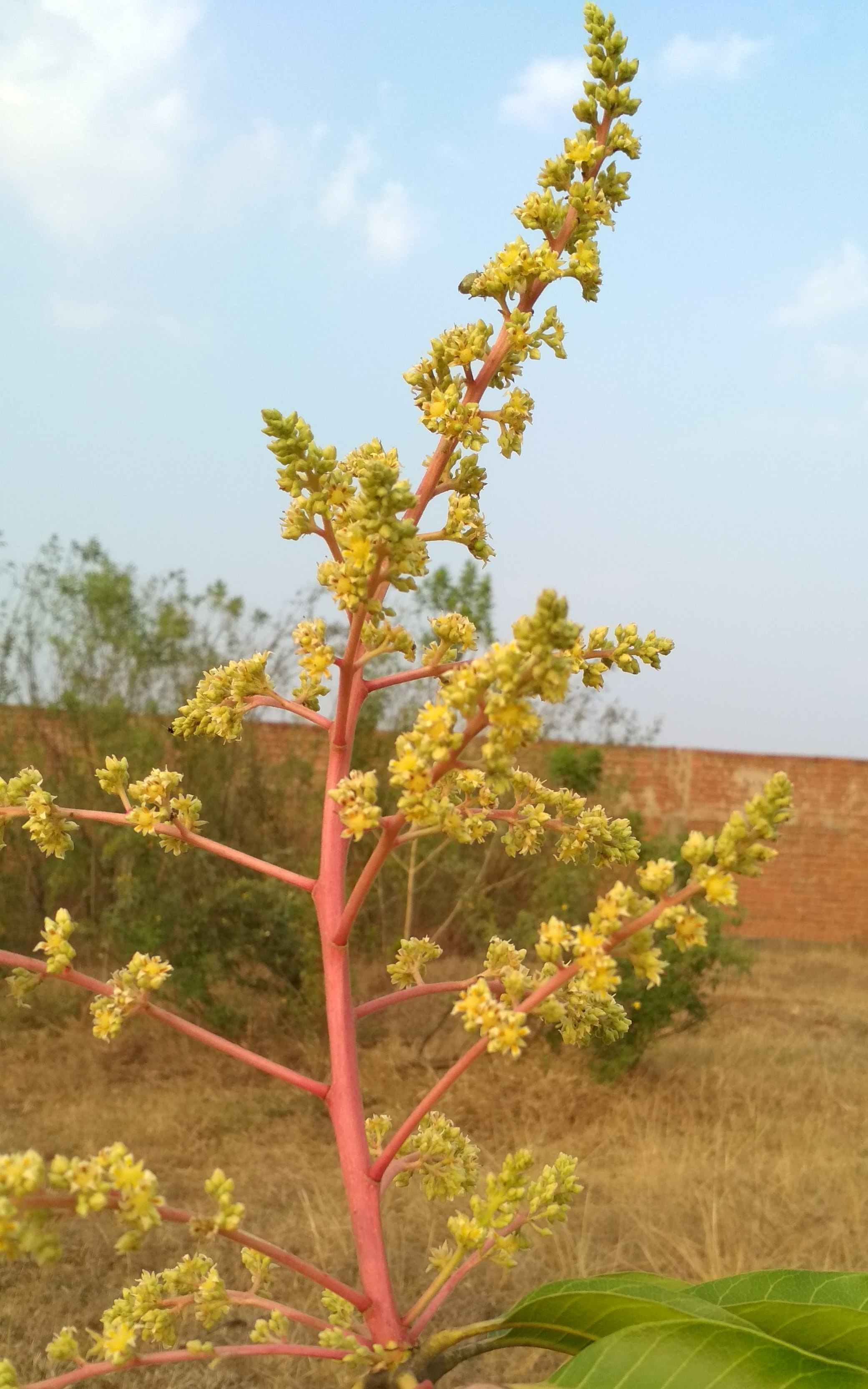
Banglapedia describes the mango tree as an evergreen whose small, fragrant flowers, white-yellowish or violet, are borne in large panicles at the ends of the branches. One inflorescence may carry 100 to 250 flower buds, not all of which open. The flowers may be unisexual or bisexual, and the number of fruits a tree sets depends on how many complete flowers it bears. Only about one or two flowers out of about a thousand may lead to a mature fruit, and two or three fruits in a panicle are often enough for a satisfactory crop. That is why the fate of the blossom in January and February decides much of the harvest that follows in summer.
The guti tree that Ruhul Amin described belongs to the second of the two groups into which Banglapedia divides the mangoes of Bangladesh. The first is the superior or elite varieties, propagated by grafting. The second is the local varieties raised from seed, known as deshi or guti mango, which have no recognised variety names and whose taste is not assured. Grafted trees begin to bear in the fourth year after planting and keep bearing until about the 45th year; trees raised from seed take several years longer to start, but tend to live longer and may bear fruit to the age of 60 or more.
Plant scientists have studied why mango trees flower when they do. In a review of mango reproductive physiology published in the Brazilian Journal of Plant Physiology in 2007, T. L. Davenport wrote that flowering in the subtropics is primarily governed by chilling temperatures, and that floral induction there is driven by the intensity and duration of cool weather. The older the last flush of leaves on a branch, the stronger its response. In warm tropical conditions, where cool weather is lacking, the age of the last flush is the main factor. The review also notes that young trees, and trees given high rates of nitrogen fertiliser in moist conditions, frequently put out new shoots of leaves rather than flowers, and that cultivars differ in how long a rest they need before flowering.
This research gives background to the DAE official's explanation that weather and variety bring the early blossoms. Practical advice published in Prothom Alo on 27 January 2026 by a horticulturist at the Falbithi Horticulture Centre in Dhaka made a related point: water and fertiliser should be withheld for 30 to 45 days before blossoming is due, because a tree that receives them at that time tends to put out new leaves instead of blossoms.
Fog and cold in Dinajpur's Magh
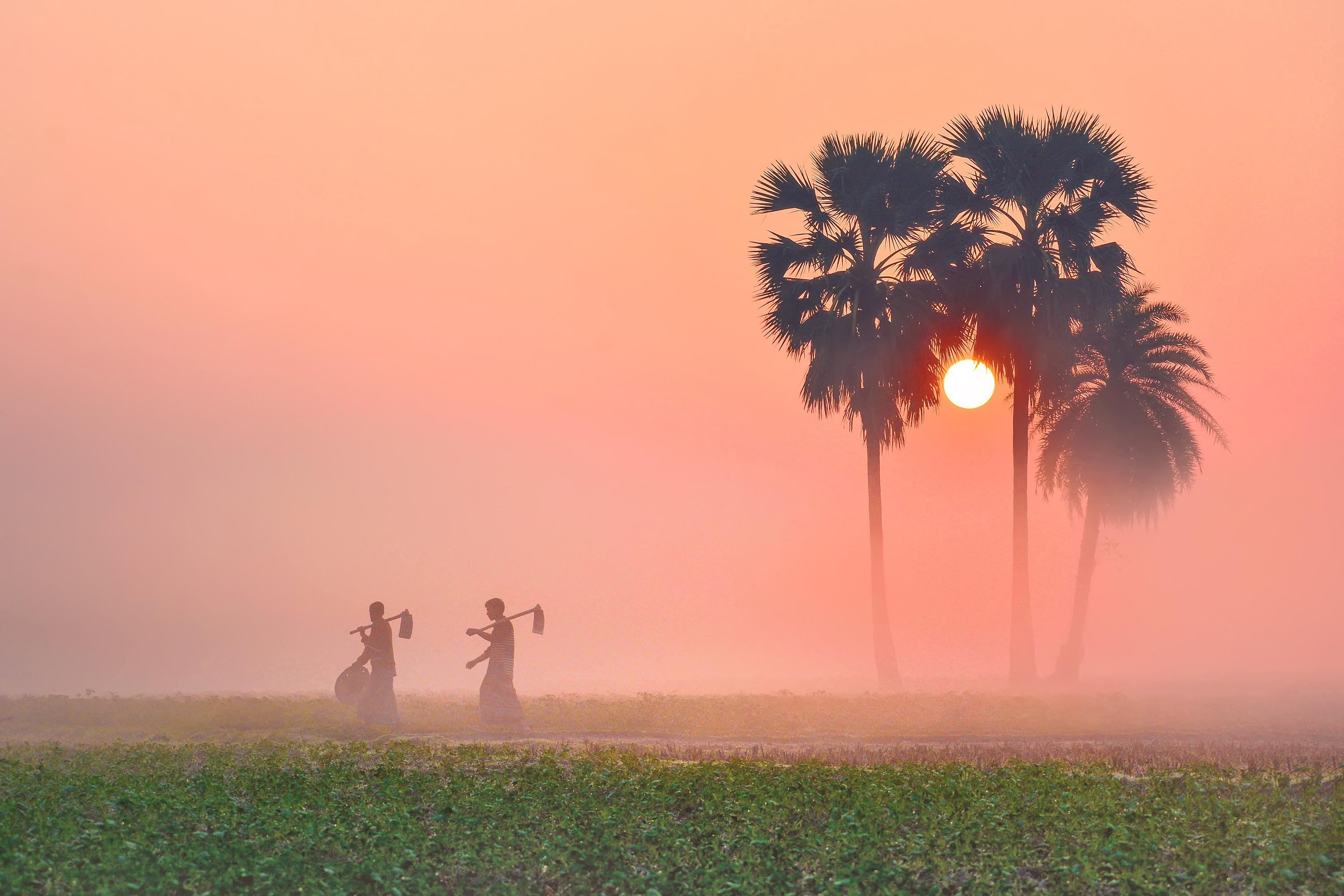
Northern Bangladesh is colder in winter than the south. Banglapedia explains that during the winter a centre of high pressure lies over north-western India, and a stream of cold air from it enters Bangladesh through its north-west corner. The season is very dry, with less than four per cent of the annual rainfall; the nights are longer than the days and the mornings are often foggy. Average January temperatures are about 11 degrees Celsius in the north-west and north-east, against 20 to 21 degrees on the coast.
The winter of 2025-26 followed that pattern in Dinajpur. On 1 January 2026, BSS reported from the district that the meteorological office had recorded the lowest temperature of the season so far, 9.7 degrees Celsius, and that dense fog had covered the district until noon. On 3 January the Dhaka Tribune reported a reading of 10.8 degrees, after 10.5 degrees the day before, with the temperature moving between 10 and 12 degrees for several days; the sun was not seen that Saturday as a thick blanket of fog covered the district, and the in-charge of the Dinajpur weather office said the cold could intensify further.
The Bangladesh Meteorological Department classifies a minimum temperature of 8 to 10 degrees Celsius as a mild cold wave, 6 to 8 degrees as a moderate cold wave and below 6 degrees as a severe cold wave, according to its classification as reported by The Business Standard in January 2024. Dinajpur often records some of the lowest readings in the country. In January 2024, for example, the department recorded 8.5 degrees in Dinajpur on 13 January and 8 degrees on 18 January, the country's lowest on those days, and the temperature in Dinajpur fell to 5.3 degrees on 28 January 2024 during a moderate cold wave, when schools in the district were closed.
Fog matters to the mango crop. Banglapedia states that the setting of mango fruit is adversely affected by fog, rain or cloudy weather in January to March, when the trees flower. Cold also shifts the timing of flowering in the district's orchards: in April 2024, DAE officials in Dinajpur told The Daily Star that the litchi trees had flowered somewhat late that year because the winter had been more severe than in previous years.
Powdery mildew and anthracnose, the diseases growers fear
Banglapedia lists several fungal diseases that cause considerable damage to mango plantations in Bangladesh: anthracnose, sooty mould, leaf blight, die-back and powdery mildew, along with a bacterial leaf spot. About three dozen insect pests attack the tree, of which the mango hoppers are among the most important; an inflorescence they infest bears few fruits or none.
Powdery mildew is caused by the fungus Oidium mangiferae, which infects only mango. A 2008 extension bulletin by plant pathologist Scot C. Nelson of the University of Hawaii's College of Tropical Agriculture and Human Resources (CTAHR) describes how infected panicles, flowers and young fruits become coated with a whitish powdery growth, and how the flowers and fruits eventually turn brown and dry. Worldwide, the bulletin says, the disease is sporadic but can be very severe, and up to 90 per cent of a crop can be lost through its effect on fruit set. The full-bloom stage is the most susceptible. The fungus spreads across a broad range of temperature, from 10 to 31 degrees Celsius, and relative humidity of 60 to 90 per cent; infection is favoured by temperatures around 23 degrees with high humidity followed by a sudden drop in humidity, which happens where cool nights are followed by warm days. Its spores travel on the wind.
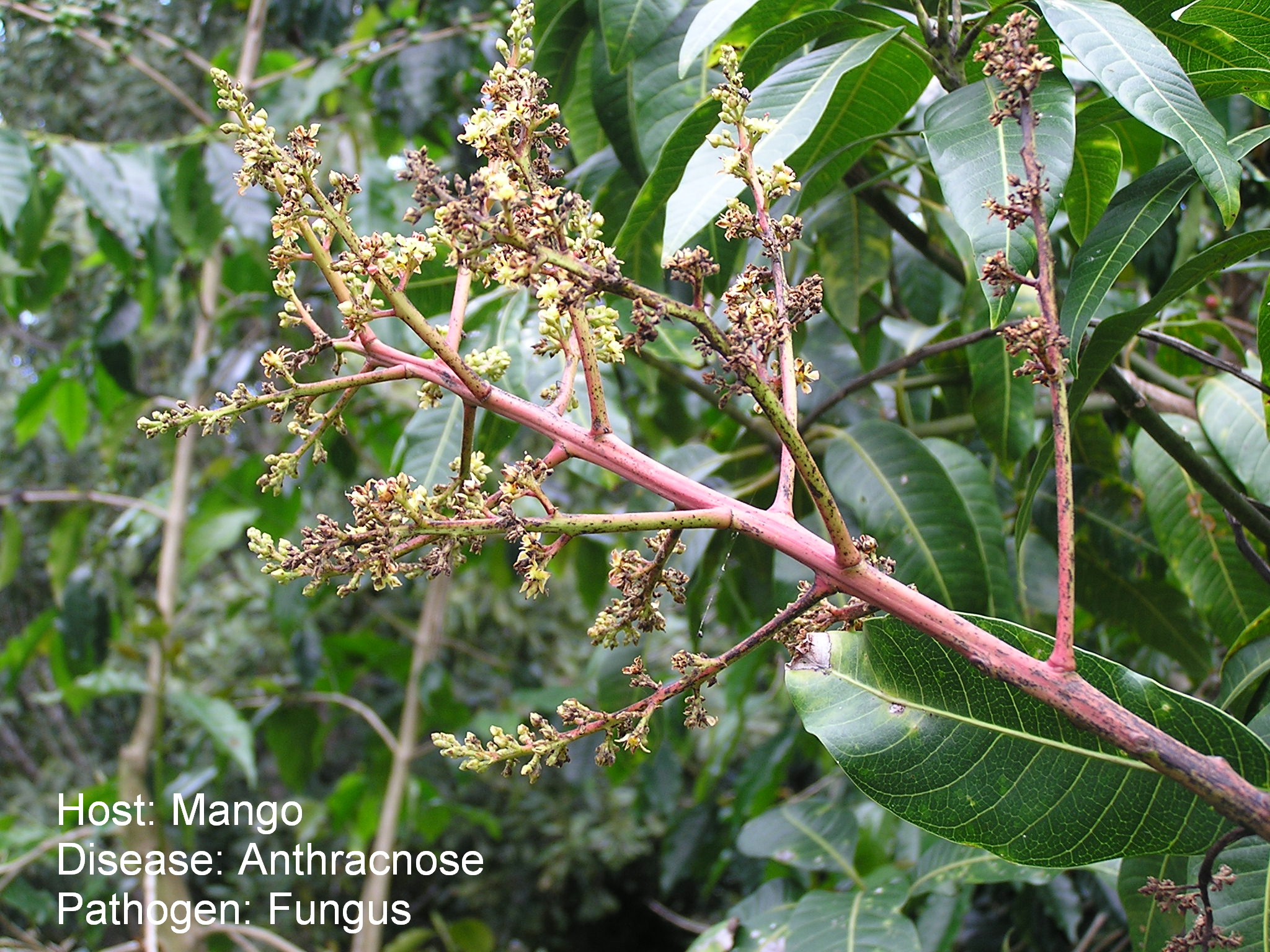
Anthracnose is caused by the fungus Colletotrichum gloeosporioides. The companion CTAHR bulletin, also of 2008, calls it the most important and destructive disease of mango worldwide. On the panicles it first shows as small black or dark-brown spots, which can enlarge, join together and kill the flowers before any fruit is produced, greatly reducing yield; clusters of flowers turn inky black and die. Wet, humid and warm weather favours the disease, and its spores are spread by splashing rain or irrigation water. The fungus survives between seasons on infected branch tips and mature leaves, and infections on green fruit can stay hidden until the fruit ripens, when sunken black spots appear.
The two diseases can be told apart on the panicle. Powdery mildew leaves a whitish-grey haze, and the flowers it kills turn brown and grey; anthracnose leaves black, pin-prick spots, and the flowers it kills turn inky black. Either way, the blossom dies before it can set fruit, which is the loss the Dinajpur growers feared.
Caring for the blossoms, and where to ask
The Prothom Alo advice of 27 January 2026 set out the care for the flowering season in stages. A protective spray is advised one to one and a half months before blossoming, and a second when the panicles are four to six inches long but the flowers have not yet opened, given in the afternoon and wetting the panicles, leaves and stems well. Once the flowers have opened, no insecticide or fungicide should be used at all, the horticulturist wrote, because spraying then can harm the flowers and the beneficial insects that visit them. Further sprays are advised when the young fruit reaches the size of a pea and again at the size of a marble, and the fruit can later be covered with bags.
The same advice listed other points for the flowering season. Branches should not be pruned before or after blossoming; the right time to prune is just after the harvest. Too much nitrogen fertiliser at flowering can make the blossoms drop. Weeds, dry leaves and fallen blossoms under the tree should be cleared, because this lowers the risk of disease and pests. Soil should not be left short of water once fruit has set. And growers should take special care in dense fog, heavy rain or long dry spells. The advice named aphids, thrips, mealybugs and hoppers among the serious pests, and anthracnose and powdery mildew among the fungal diseases to guard against.
The CTAHR bulletins add cultural measures that do not depend on chemicals: pruning to let air move through the canopy, picking up and destroying fallen leaves and debris, removing badly infected panicles, and wider spacing between trees, which slows severe outbreaks. Where sprays are needed against anthracnose, the bulletin says, they should begin when the panicles first appear.
Which products to use, and at what dose, depends on the rules and recommendations in force in Bangladesh. Growers in Dinajpur should take that advice from their upazila agriculture officer or the DAE office. Banglapedia notes that the DAE produces and distributes grafts of elite mango cultivars from its orchards, horticulture centres and nurseries around the country, and that the Bangladesh Agricultural Research Institute (BARI) runs research stations for mango; its Mango Research Station at Nawabganj, set up in 1985, covers about 12.40 hectares and holds over 300 trees of about 65 cultivars.
Mango in Dinajpur: orchards, trade and exports
Banglapedia lists Dinajpur, with Rajshahi and Nawabganj, as one of the districts where most of the superior mango varieties of Bangladesh are grown. Bangladesh has nearly 100 mango cultivars, and the encyclopedia notes that many of the orchards scattered over greater Rajshahi and Dinajpur were old and not well organised.
In July 2022, the deputy director of the DAE in Dinajpur told the Ittefaq that the district had 5,691 hectares of mango orchards, producing 63,170 tonnes of mango. The general secretary of the Dinajpur fruit traders' association told the paper that in other years at least 20 trucks a day carried mangoes from the town's mango market, and at least a hundred trucks a day from different parts of the district, to other parts of the country. In that season, he said, heavy rain, floods elsewhere and the approach of Eid al-Adha had kept outside traders away, and the number had fallen to eight to ten trucks from the town market and at most 50 from the district.
Dinajpur growers have since begun to export. BSS reported on 23 June 2025 that Banana mango from an orchard in Biral upazila had formally begun to be exported, with a first consignment of 100 kilograms shipped to Switzerland on 21 June and three tonnes of Banana, Katimon and BARI-4 mangoes planned for Sweden and Qatar. The grower said mango farmers from the Rajshahi region had leased land in Biral for 10 to 15 years to plant orchards. The DAE's deputy director in Dinajpur said several varieties grown in the district had been exported on a trial basis the year before.
On 7 July 2025 BSS reported that a grower in Hakimpur upazila had exported more than two tonnes of BARI-4 mango to Switzerland and other European countries, the first such export from the upazila, from a one-acre demonstration orchard under the government's PARTNER programme that followed Good Agricultural Practices. An upazila agriculture field officer described fruit bagging as part of that method and said it cut pesticide use by 70 to 80 per cent. The Business Standard reported on 8 July 2025 that mangoes from an orchard at Setabganj in Dinajpur were being sent directly to the United States through an online platform, starting with the Amrapali variety.
These shipments come from a region where the Rajshahi area still dominates. According to agriculture department figures in the same Business Standard report, almost half of Bangladesh's mango output came from four districts of the Rajshahi region; for the 2025 season Chapainawabganj had the highest production target, 458,000 tonnes, followed by Naogaon, where mango was grown on 30,300 hectares with a target of 378,000 tonnes.
Photo: Amar / Wikimedia Commons (CC BY-SA 3.0)
Sources: Jagonews24, Bangladesh Sangbad Sangstha (BSS), Prothom Alo, The Daily Star, Dhaka Tribune, The Business Standard, The Daily Ittefaq, Banglapedia, Wikipedia, University of Hawaii College of Tropical Agriculture and Human Resources (CTAHR), Brazilian Journal of Plant Physiology
Comments
(0)