
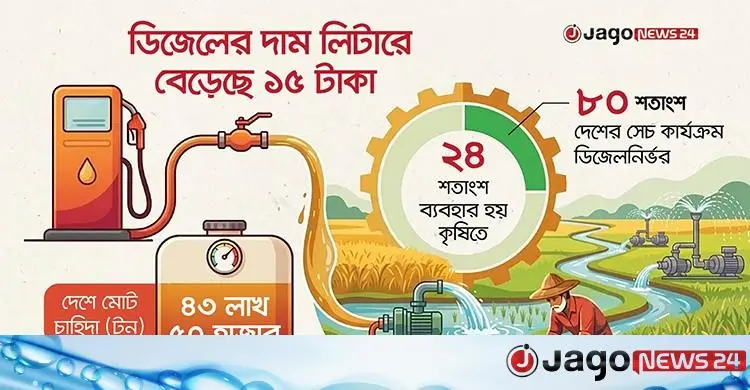
Bangladesh now needs about 43.5 lakh tonnes of diesel a year. About 24 percent of this, or 10.44 lakh tonnes, is used in agriculture. Eighty percent of the country's irrigation depends on diesel, and diesel is needed from land preparation through to bringing the harvest home. With the government raising the price by Tk 15 a litre, farmers' costs will rise by about Tk 1,500 crore.
On Saturday (18 April) the government raised the price of diesel from Tk 100 to Tk 115 a litre. Calculations show this will increase farmers' spending by about Tk 1,566 crore. At the old price, farmers spent Tk 10,440 crore a year on diesel; with the Tk 15 rise, they will now spend Tk 12,006 crore.
Agricultural experts say the price rise could put two kinds of pressure on the farm economy. Higher production costs will make it even harder for farmers to get a fair price for their crops, while higher food prices will increase spending for poor and low-income people. A rise in the price of rice in particular would add to the hardship of the poor and affect other spending, further fuelling inflation.
Boro harvest costs
Boro paddy is now in the fields. The Boro season is in its final stage, so little irrigation will be needed, but the cost of machine harvesting, threshing and transport will rise.
In some areas, however, low rainfall means Boro paddy still needs one or two irrigations. Even before the price rise, many farmers had paid more for irrigation because of the fuel crisis. Overall, production costs keep rising, and farmers in several districts told Jagonews24 they fear they will not recover their costs by selling their crop.
Abdul Matin, a farmer in Sapahar, Naogaon, said: "I have grown Boro on three bighas of my own land this year. Because there was no diesel, irrigation that cost Tk 2,000 a bigha now costs Tk 2,500. Now the diesel price has gone up, so I will have to pay even more. Then harvesting, threshing, everything will cost extra."
He said: "Last year my total cost was about Tk 16,000 a bigha. This year things are bad; it will exceed Tk 20,000 a bigha. I am wondering what the situation will be when it comes to bringing the crop home."
Halim Mia, a farmer in Zianagar village of Dupchanchia upazila, Bogura, said: "Aman paddy is already fetching no price. Now the oil price has gone up, and harvesting and threshing will become very difficult. Last Boro season a shallow machine charged Tk 120 an hour for irrigation; now it is Tk 200. Who knows how much they will ask from tomorrow? One irrigation of a bigha now costs almost Tk 300 extra."
He said: "Last time I harvested with a hired reaper, which charged Tk 800 a bigha, and threshing cost Tk 1,800 a bigha. Now that diesel is dearer, machine rents will surely rise. Altogether, growing paddy will cost about Tk 3,000 more this time."
Diesel shortage in irrigation
When costs rise, the chance of farmers making a profit becomes slim. Growers say Aman paddy prices have already fallen because rice imports from India are continuing, so they are also worried about getting a good price for the coming Boro crop. On top of this, the diesel price rise is, for farmers, "adding insult to injury".
Anwar Faruk, whom the report describes in its main text as a former agriculture secretary and in a highlighted quote as agriculture secretary, told Jagonews24: "Naturally, when the oil price rises, it affects everything. This has certainly raised farmers' costs substantially. Bringing in, threshing and transporting the Boro in the fields economically has been hampered. As a result, rice prices will rise."
The key point now is that farmers' higher costs must be offset by ensuring a fair price for their crops, the report says. Otherwise the next round of production will suffer and the country's food security could be threatened, because if farmers do not get a fair price, they will not produce next time.
Data show that 60 percent of the country's total rice output will come from the Boro now in the fields, all of which depends on irrigation.
According to the Ministry of Agriculture, the country has 754 deep tubewells, 10,39,337 shallow tubewells and 1,84,384 low-lift pumps, most of them diesel-powered. There are also 10,000 combine harvesters, several lakh reapers and 4,96,805 threshing, winnowing and other machines. In all there are about 19 lakh farm machines, 75 percent of them diesel-powered.
Agricultural economist Jahangir Alam Khan said: "Our agriculture depends on diesel-powered irrigation. To keep production normal, diesel supply must be ensured even if the price rises. Incentives or subsidies are urgently needed to offset farmers' higher costs."
Source: Jagonews24. First published in Bengali on The Agro News.
Comments
(0)