
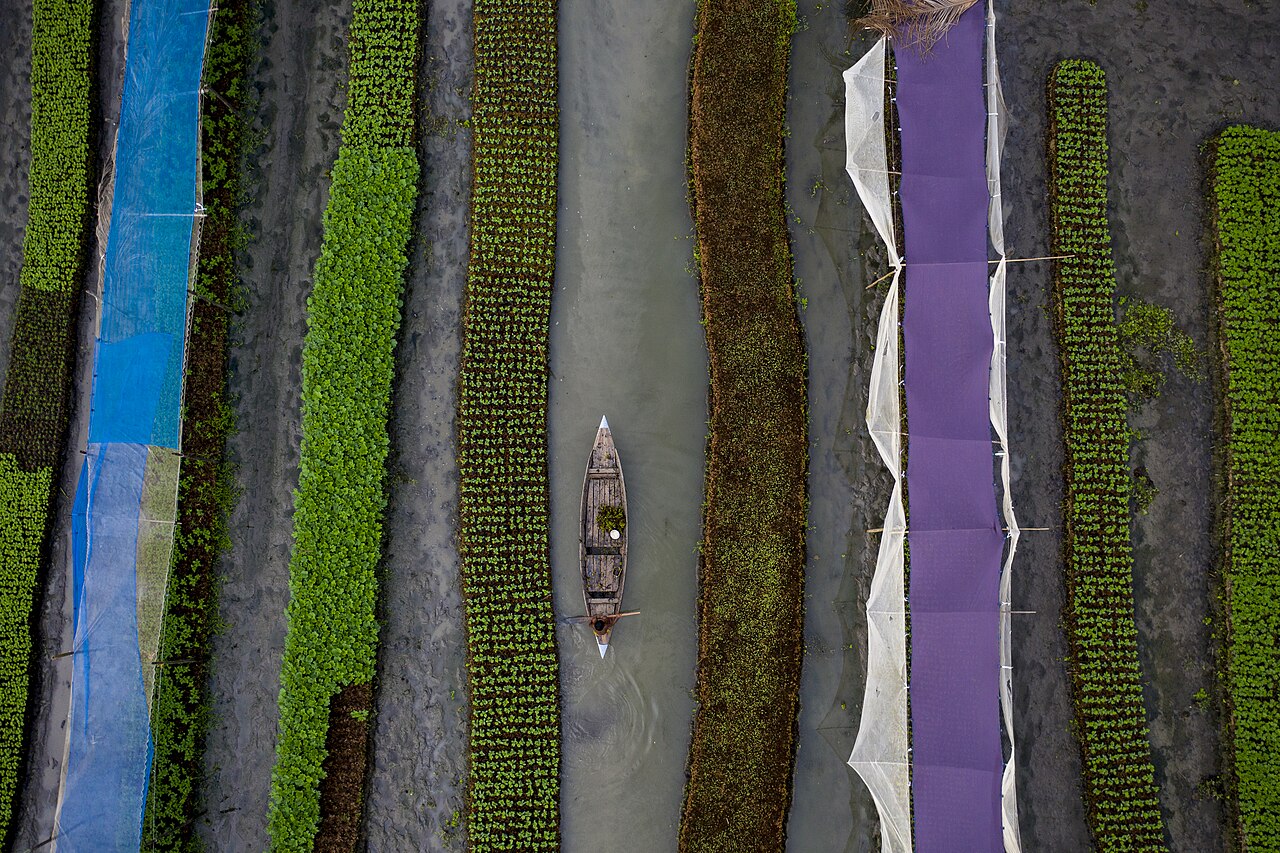
On the dark water of Dhaka's Gulshan-Banani lake, what looks from afar like a heap of plastic rubbish turns out, up close, to be a vegetable garden. Residents of the Korail slum have used discarded plastic bottles to build floating plots on the lake, growing taro, taro stolons, Malabar spinach and red amaranth on the water instead of soil. Dinajpur TV reported the story.
The growers include Sattar, Rubel, Nur, Arifa and Ali from Korail. Rather than occupying the lake, they share out unused space along its edge among themselves.
The method is simple: empty bottles and coconut coir are tied with strong cord onto a bamboo frame to make a sturdy floating platform, a thin layer of soil goes on top, and vegetable seedlings are planted in it. Ornamental plants such as canna have also been planted on the beds, changing the look of the lake.
Local people say the water used to be so polluted that it made their skin itch and the surroundings were filthy; that is much less so now. The chemical-free vegetables help meet residents' nutrition needs. After feeding themselves, the growers give vegetables to neighbours, sometimes for a token price and sometimes free, and when the jackfruit tree by the plots bears fruit, it is shared too.
The plastic bottles that once spoiled the lake are now the base of a crop. People involved say similar waste-management ideas could open new possibilities on other troubled waterbodies in Dhaka; the south's old floating-garden technique has found a new form here, built from city waste.
Photo: Azimronnie / Wikimedia Commons (CC BY-SA 4.0); the picture above is illustrative
Source: Dinajpur TV

Comments
(0)