
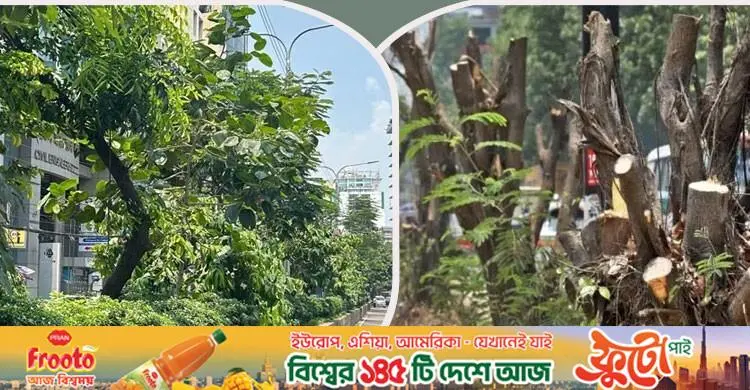
From Notun Bazar to Nadda on Pragati Sarani, rows of green trees line the road divider and footpaths. In a short time they have grown tall. The almond (kathbadam) trees look like umbrellas. Beneath them someone sells tea, someone else sleeps soundly, and working people rest in the shade from the scorching sun. More birds now fly about.
Only about three years ago the footpath was bare, with nowhere to shelter from rain or sun. Cared for by the city corporation, the almond, chhatim and bakul trees have quickly become a refuge for people and animals, and some older trees now shade even the main road.
In this concrete city the trees are also a relief for the eyes. They recall Banaful's famous short story about the neem tree: a tree gives shelter to living things in countless ways and takes very little in return.
While Dhaka North City Corporation (DNCC) has brought a green revolution to selected areas such as parts of Pragati Sarani, Dhaka South City Corporation (DSCC) has created a "barren desert". It is called a desert because, while the whole city burned in extreme heat, the southern corporation not only failed to plant trees but cut down trees in many areas, including parks.
How DNCC greened its roads
Dhaka's temperature keeps rising, and city life becomes unbearable every summer. Three years ago DNCC took several steps, including appointing a heat officer, and announced it would plant four lakh trees to create cooler spaces. Under that programme it planted a variety of trees on footpaths, road dividers and the banks of lakes and canals.
Now most road dividers and footpaths in Dhaka North are green with fruit, flowering and medicinal trees, and canal and lake banks are covered in green. Bees and butterflies gather nectar from the flowers, the air smells of blossom, birds are nesting, and people of every class, including the homeless, shelter beneath the trees.
Residents expressed satisfaction with DNCC's initiative. They said urbanisation had gradually stripped the city of green trees, climate change had altered the seasons, and heatwaves now occur in the monsoon as well as summer. Cities in developed countries have a set number of trees and know how to value them; DNCC still has fewer than needed but has made considerable progress. Being able to shelter under a tree when tired from walking in the hot sun brings real relief, they said, and they demanded enough trees wherever there is still space.
In late May 2023 an intense heatwave hit Dhaka. At an event at Dhaka University's Senate Bhaban on 3 June, then DNCC mayor Atiqul Islam announced that two lakh trees would be planted to increase cool spaces in the capital. Planting then began on footpaths, road dividers and the banks of canals and lakes.
DNCC drew up guidelines on which trees to plant. Chhatim, bakul and almond were to go on roadside footpaths, and krishnachura and sonalu where footpaths were wider. Road dividers were to get thorny henna, rangan, karabi, bougainvillea and dwarf jarul, along with saplings to attract birds, while fruit trees such as mango, jam and jackfruit and medicinal trees were planned for canal banks.
About a month after that announcement, 2,000 flowering, fruit and medicinal trees of various species were planted in rows on both banks of the Lautala canal at Basila in Mohammadpur.
On the right when going from the Mohammadpur embankment to Basila bridge, the Lautala canal is now green along both banks for about half a kilometre, lined with fruit, flowering and medicinal trees. Some kadam trees have grown large, and the calls of mynas, tailorbirds, doves, bulbuls and magpie robins can be heard.
Ali Akram, who lives by the Lautala canal, told Jagonews24: "The part of the canal DNCC has greened used to hold a large truck stand, residential and commercial buildings, garages and shops. DNCC cleared these encroachments and planted trees, creating a beautiful environment. Walking there now feels like the countryside."
The road from the south side of Mohakhali bus stand past Aarong to Police Plaza is known as the Tejgaon-Gulshan Link Road. DNCC renovated it four years ago, building a concrete divider about four feet high and four feet wide with about three and a half feet left open in the middle. Soil was later filled in and thousands of flowering, fruit and medicinal trees were planted; many are now 15 to 20 feet tall and give shade. Trees were also planted on the divider in front of the Agargaon passport office, and on dividers from Mohakhali flyover to Gulshan-1, from in front of Bangladesh Army Stadium in Banani to Jahangir Gate, from Bijoy Sarani to Farmgate, and in various sectors of Uttara.
Thousands of trees were likewise planted on footpaths from Gulshan-1 to Gulshan-2, Gulshan-1 to Mohakhali, in various parts of Mirpur, at Nadda and Notun Bazar on Pragati Sarani and in Uttara's sectors. This has made the roads more attractive and helped control dust and air pollution.
At noon on Wednesday (3 June), with the temperature at 36 degrees Celsius, motorcyclist Mohammad Sohel was sheltering in the shade of an almond tree on the footpath opposite Mohakhali TV Gate. "Before, all you saw on the road was concrete and traffic jams," he said. "Now with trees the place feels much more alive. Most of the trees give shade to pedestrians."
Rasheda Begum, waiting for a bus to Badda Link Road on the footpath opposite BRAC University, also sheltered under an almond tree. "Walking on the footpath on hot days is a little more comfortable now," she said. "I think it will help even more when the trees grow bigger."
Miyawaki forest and future plans
On 18 May DNCC began what it calls the country's largest urban afforestation using the Miyawaki method, on a greenbelt site on the east side of lake no. 11 next to bridge no. 4 in Diabari, Uttara, citing pollution of Dhaka's air, water and soil.
Under the supervision of DNCC's Environment, Climate and Disaster Management Circle, 14,000 trees were planted earlier on phase 1 (chainage 0-150 metres) of the same site between 26 November 2025 and 15 January. Now about 39,400 trees of some 250 species, including native fruit, flowering, medicinal, timber, ornamental, conifer, shrub and bush species, will be planted across about 2.60 acres in phases 2 and 3. Following biophilic design and biomimicry principles, the forest includes mounds, winding paths and a walkway along the lake.
According to the circle, 431,773 trees have been planted across the city in the last three years, including fruit, forest, flowering, medicinal, timber and ornamental trees. A further 55,000 are planned this year: 14,000 have been planted through Miyawaki afforestation and planting of 39,400 is under way, with greening also continuing on dividers and footpaths.
Abul Kashem, superintending engineer of DNCC's Environment, Climate and Disaster Management Circle, told Jagonews24 that DNCC has already sent the ministry an action plan to plant five lakh trees over the next five years. "Through the urban afforestation project DNCC is building long-term green infrastructure aimed at improving air quality, protecting biodiversity and ensuring city dwellers' health," he said. "This forest will play a significant role in controlling pollution in Dhaka and will help counter global warming and the urban heat island effect."
Dhaka South cuts trees
The greening in Dhaka North has had no effect in the DSCC area, which has no significant urban greening initiative. DSCC is made up of 75 wards, a large part of them in Old Dhaka, the most congested part of the city. Apart from North South Road, English Road, Johnson Road and Dholaikhal Road there are no wide roads, people move through narrow lanes, and these lanes have no footpaths.
Elsewhere in Dhaka South, bougainvillea and a few other plants decorate road dividers, but there are no trees on dividers or footpaths that give pedestrians shade or rest their eyes. Ramna Park, Suhrawardy Udyan and Baldha Garden fall within the south city, but countless trees have been felled in Suhrawardy Udyan at various times for various reasons, and some very large trees in Panthakunja Park were cut in the name of a mega project.
In April 2023, as Dhaka's temperature kept rising, DSCC cut down about 2,000 trees on a road divider in Dhanmondi on the orders of then mayor Sheikh Fazle Noor Taposh, in the name of infrastructure development. Local residents protested angrily. Bougainvillea and some other flowering plants were later planted there for beautification, but most died for lack of maintenance.
A recent visit found rangan, kamini and bougainvillea on the divider of Satmasjid Road, but no trees that would shade pedestrians or passengers.
Jigatola resident Aftab Uddin said: "Greening footpaths helps lower the city's temperature and also improves people's peace of mind. But the city corporation is not doing it. On the contrary, three years ago they cut down thousands of trees on Satmasjid Road."
On 15 April, about 1,350 feet of wall along the footpath in front of Dhaka Medical College Hospital was painted with colourful graffiti under a pilot project, showing rural heritage and various flowers, and some potted plants were placed on the footpath.
Rajib Khadem, superintending engineer (Environment, Climate and Disaster Management Circle) at DSCC, told Jagonews24: "Most roads in the south city are narrow and the footpaths are not very wide, so there is little scope to plant trees that will shade pedestrians. However, planting of flowering plants on the dividers of major roads is under way."
Source: Jagonews24. First published in Bengali on The Agro News.


Comments
(0)