
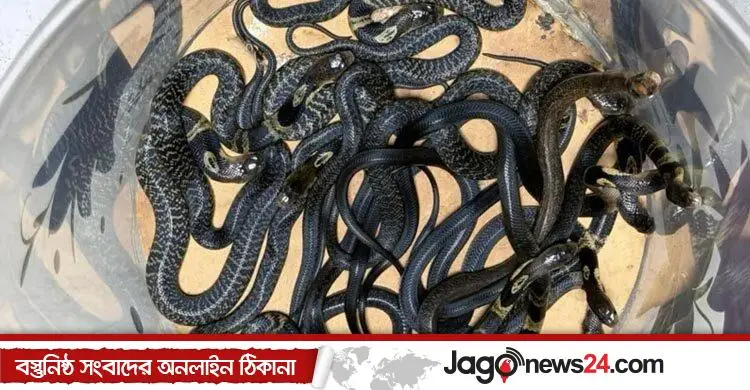
Venomous snakes have been turning up in several parts of Dhaka for months. An organisation called the Bangladesh Animal Welfare Association says it has rescued 351 snakes from crowded areas of the capital in the past four months. The snakes have been found inside homes, in garages and even on the ninth floor of high-rise buildings. They include venomous species such as the spectacled cobra (padma gokhra), Russell's viper, the monocled cobra (khoiya gokhra) and the king cobra (raj keute).
In Bangladesh snakes usually become more of a nuisance in the monsoon. When rainwater floods the holes they live in, they look for dry ground and move to higher places, human settlements and houses. Some researchers are surprised that so many venomous snakes are being found in a city as crowded as Dhaka; others consider it normal.
Researchers divided
Farid Ahsan, a professor of zoology at the University of Chittagong, called it "unusual and worrying". "It is certainly unusual. There can be snakes in Dhaka city if there are bushes. But how there came to be so many is a matter of concern," he said. Some venomous snakes had been found in Dhaka before, he said, but this was the first time so many had been reported.
Md Mizanur Rahman, a research associate at the Venom Research Centre of Chittagong Medical College, believes people have created a housing crisis for snakes by filling in water bodies, canals and wetlands to build homes, and so the snakes are entering people's houses.
Adnan Azad, convener of the Bangladesh Animal Welfare Association, said 351 snakes had been rescued in four months, of which only three were non-venomous.
However, Abdullah As Sadiq, a wildlife inspector with the Forest Department's Wildlife Crime Control Unit, said they had no information about such a surge of snakes in Dhaka. He also said the organisation had not taken permission to carry out the rescues.
Where the snakes were found
The venomous snakes have so far been rescued from Banasree, Aftabnagar, Mohammadpur, Basila, Sector 18 of Uttara, Khilgaon, Kachukhet, Mirpur-2, Niketan, and Uttarkhan and Dakshinkhan in Uttara. The most were found in the RAJUK flat project area in Uttara's Sector 18, with Banasree second. In the past week more snakes have been seen in Khilgaon.
"We found the most snakes at the RAJUK flats in Uttara Sector 18. We rescued snakes from the seventh and ninth floors, and from 11 buildings there," Azad said.
Asked how snakes reached such high floors, Azad said every building where snakes were found in upper flats had climbing plants such as bougainvillea at the gate, with supports for them to climb. The snakes may have climbed up the buildings along those plants.
The spectacled cobra was the most common of the venomous snakes, Azad said: nearly 200 of the 351. Thirty-eight spectacled cobras, male, female (mother) and young, were rescued from a few houses in Khilgaon.
"In one house in Khilgaon we broke up the whole floor of three rooms and found the mother snake. From the same house we rescued two large snakes, seven young and eighteen spectacled cobra eggs. From another house we found 18 young cobras. People whose houses we cleared have told us they have seen large and young snakes again," Azad said.
Professor Farid Ahsan said the spectacled cobra is essentially water-loving and prefers rivers, water bodies, canals and wetlands, though it is also found in bushes and holes near water.
Although the roughly 350 snakes found in Dhaka in four months have frightened many residents, there have been few snakebites.
Habitat loss and breeding season
Asked why so many venomous snakes are suddenly being seen, Mizanur Rahman said the situation had been created by people destroying the snakes' habitat. "What matters is which areas the snakes are being found in. In every one of them people have filled in water bodies, canals and wetlands to build homes. The snake is in its own place; we have moved into its place," he said.
In his view, seeing so many snakes is normal, because Bangladesh used to have few snake rescue organisations and people killed snakes on sight. Now many rescue groups have sprung up, and he believes that is the main reason snakes are in the limelight. The months in which these snakes are being found are also their breeding season, so wherever snakes are rescued, many young and eggs are found as well.
Azad said even more snakes might be found through November, because October and November are the spectacled cobra's breeding season. Numbers had risen because August is the breeding season of the monocled cobra, he said. "That month we rescued 28 snakes from a single house, a mother cobra with 27 young."
Azad also blamed the filling in of water bodies, canals and holes for housing. Five, six or seven years ago there were no residential buildings at Diabari in Uttara, only water bodies, and Aftabnagar was the same, he said. "The snakes lived in those water bodies. People built homes there. So where did the snakes go? Their space gradually shrank, so they moved to the plots behind where no buildings have been built yet, and made their homes in the holes there." When heavy rain falls for three or four days in a row and the holes fill with water, the snakes come out looking for dry ground and enter people's homes, which is why more are being seen now, he said.
What the law says
Under Bangladesh's Wildlife Act 2012, catching or killing wildlife is a punishable offence. Rahman said that under the law, rescued wildlife, including snakes, must be released back into nature, and no individual is allowed to keep a rescued snake. Only the Venom Research Centre has permission to keep snakes for research, he said.
Asked where the snakes rescued in Dhaka are now, Azad said they are released at natural sites far from human settlements, usually forest areas where the snakes find their own environment and do not come into contact with people. He said the group informs the Forest Department of its rescue operations and how many snakes are found, though it is not always possible to report every rescue.
The report was credited to BBC Bangla.
Source: Jagonews24. First published in Bengali on The Agro News.
Comments
(0)