
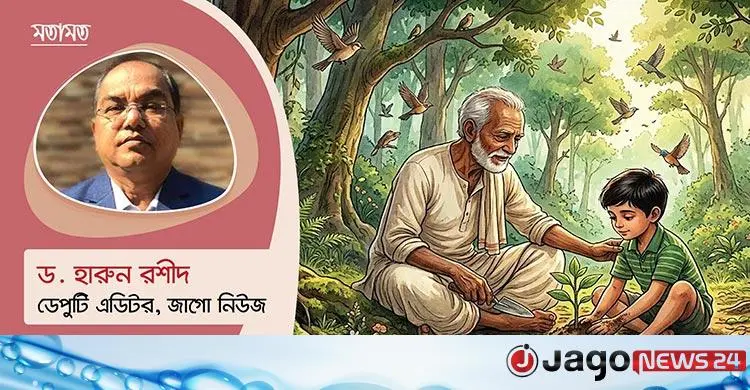
"Have you seen our tree?" a small bird asked its companion as they flew towards the western sky.
The other bird looked down for a while, then said: "The tree is gone. There is a concrete wall there now. People say that is development."
The first bird fell silent. After a while it asked again: "Then what about our nest?"
"There is no room for nests in the plans for development."
Then both birds stayed silent for a long time. Such silence is rare in the human world, but the silence of nature is frightening, because there life disappears before sound does.
This conversation is imaginary, but its pain is real. After every forest cleared, every century-old tree felled and every wetland filled in, thousands of such unheard conversations take place. We hear the sound of the saw but not the sound of a broken nest; we see development being inaugurated but not a bird being driven into exile.
A history of losing forests
The history of civilisation is also a history of losing forests. People cut forests when they first made farmland, when they built cities, and even more during the Industrial Revolution. But in the 21st century the question is no longer about cutting forests; it is whether we are building a world in which no creature other than humans will have the right to live.
The same concern is visible in Bangladesh. Hill forests, sal forests, coastal mangroves, village trees and even old trees in the cities are steadily disappearing, for roads, industrial zones, housing and tourist centres. All of these are needed. But when need is not joined with wisdom, development becomes another name for self-destruction.
We often forget that a forest is not just a collection of trees standing on land. A forest is a shared state of countless lives: birds, bees, butterflies, snakes, foxes and micro-organisms, bound together in an astonishing web of invisible relationships. Cutting a tree does not just mean getting timber; it means destroying a small universe.
Environmental scientists around the world have long warned that the planet is going through a biodiversity crisis. Deforestation, climate change, pollution and unchecked consumerism are pushing many species towards extinction. This extinction is not only of animals; it is also of humanity's future.
Why birds matter
Take birds. They are not just symbols of beauty. They make forests, spread seeds, control insects and pollinate flowers. Nature keeps its balance through them. So when birds decline in an area, it is not just a crisis for one species but a sign that the whole ecosystem is sick.
People who grew up in Bangladesh's villages know that morning once meant birdsong. The magpie robin, myna, bulbul, koel and kingfisher each gave every season its own tune. That music has now grown faint. Children in cities often see birds in picture books but not in real life. This is not only an environmental loss; it is cultural poverty too.
The economics of nature
Humanity's relationship with nature is also an economic one. Forests hold rain, protect soil, keep rivers alive, clean the air and absorb carbon. In this time of climate change, losing forest means inviting future disasters. Yet when we count the gains of development, we almost never count the value of these invisible assets.
Economists now speak of "natural capital". Many countries are including the economic value of environmental resources in their national development plans, because they have understood that growth achieved by destroying nature does not last.
This understanding is even more urgent for Bangladesh, because we live in a land where the impact of climate change is already visible. Temperatures are rising, rainfall patterns are changing, cyclones are growing more intense and rivers are shifting. In this reality, forests are not only an environmental resource but an inseparable part of national security.
Development with nature
No one is saying development should stop. The question is whether development will come by waging war on nature or by making nature a partner.
Many cities around the world have adopted the idea of "green infrastructure". There, felling trees is the last option, not the first. Roads are designed to preserve old trees, special corridors are kept for wildlife to move, and investment in restoring damaged forests is mandatory. Development and nature are partners there, not rivals.
We need that philosophy too. Environmental impact assessment must become a genuine scientific process, not a paper formality. Local communities must be made partners in forest conservation. Planting of native tree species must increase. Wetlands and hills must be seen as living ecosystems, not as empty land for development.
The biggest change, though, must happen in people's minds. We teach our children to do well in exams, win competitions and succeed, but rarely teach them the value of a tree, the need for a bird or the language of a river. A society that does not learn to love nature cannot, in the end, love itself either.
Imagine if one day the birds of that felled forest really came back. They might not put us on trial or ask for compensation. They would only want to know: "Did you really believe your world would be more beautiful without us?"
We may not have an answer to that question. However tall the buildings people put up, a sky without birds can never be a symbol of civilisation. However big the economy grows, a country without forests can never be safe. And however much technology is invented, people still have no technology to bring back a lost ecosystem.
So the conversation of the birds of a felled forest is not mere fancy; it is an early draft of the history of the future. Whether we will be remembered in that history as the killers of forests or as their last guardians is still a decision in our hands.
The Earth is not an inheritance from our ancestors; it is a priceless trust borrowed from our children. If we betray that trust, future generations will not forgive us. And on the day the last bird falls silent, people will understand that it was not the forest that was lost, but the green part of their own hearts.
The writer is a journalist, columnist and deputy editor of Jago News.
Source: Jagonews24. First published in Bengali on The Agro News.
Comments
(0)