
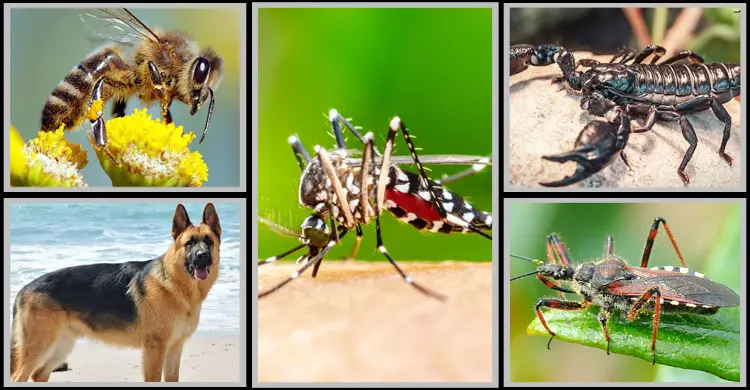
There are snakes of many species in almost every country in the world. In Bangladesh everyone is now alarmed by an outbreak of Russell's viper, whose bites have killed many people in many districts. But Russell's viper is not the only venomous snake in the country; many others live here too.
Yet did you know that there are animals more dangerous than snakes all around you, whose bites can be fatal? Here are a few creatures and insects that look ordinary but can kill.
Mosquito
You can probably see how this tiny insect can cause human deaths. By the number of lives taken, the mosquito beats even ferocious animals. According to the World Health Organization, more than 725,000 people worldwide die prematurely every year from diseases spread by this small creature.
Most of them die of malaria and dengue. The WHO says that in 2022 alone, nearly 250 million people worldwide were infected with mosquito-borne malaria, most of them in Africa, and more than 600,000 of them died.
In 2023, more than five million people in various countries were infected with dengue, and more than 5,000 of them died. Bangladesh has also seen several dengue outbreaks in recent decades. In 2023 the country recorded its highest ever number of dengue cases and deaths: by the official count, more than 300,000 people were infected last year and more than 1,500 died.
Scorpion
This venomous creature, one of the oldest on Earth, kills more than 3,000 people a year worldwide on average. Because its body shape and gait are somewhat like a crab's, in Bangladesh it is also known as "kankrabichha". Scorpions are most often seen in the deserts of the Middle East and North Africa. The venom is usually in the tail; when attacking, a scorpion stings with its tail and injects venom into its prey.
Assassin bug
This insect is found mostly in Central and South America. Looking somewhat like a mosquito or fly, it is also called the "kissing bug" by some. Small though it is, this bloodsucker spreads the germ of Chagas disease, an infectious disease that kills more than 10,000 people every year.
Assassin bugs usually bite sleeping people, and a germ called the protozoan Trypanosoma cruzi then enters the body. In most cases people do not realise they are infected, so the germ slowly spreads through the body and the infected person eventually dies. Apart from bites, Chagas disease can also be caught by eating food contaminated by assassin bugs.
Honey bee
Honey bees are the bees from whose hives honey is collected. Of the world's 20,000 species of bee, only seven are honey bees. They are adept at stinging enemies in self-defence. Although the small amount of venom from their tiny sting is not very harmful, a sting can cause serious problems for someone with an allergy, and too many stings can even kill. How ill a person becomes depends on the number of stings and how much venom enters the body. There is sharp pain at the spot at first; the pain passes quickly, but the skin swells and turns red. Many stings can cause nausea and fever.
Dog
The dog is a trusted companion that guards our homes and keeps thieves away, and there are countless examples of its loyalty. Yet dog bites kill about 59,000 people a year worldwide on average. Besides stray rabid dogs, wild dogs and even pet dogs can bite. If that happens, treatment must be sought quickly; otherwise the person can develop rabies and may eventually die.
According to the WHO, the rabies virus is transmitted to people mainly through dogs. Besides bites, the germ can also enter the human body through wounds, saliva and claw scratches of an infected dog.
Citing the Natural History Museum.
Source: Jagonews24. First published in Bengali on The Agro News.


Comments
(0)