
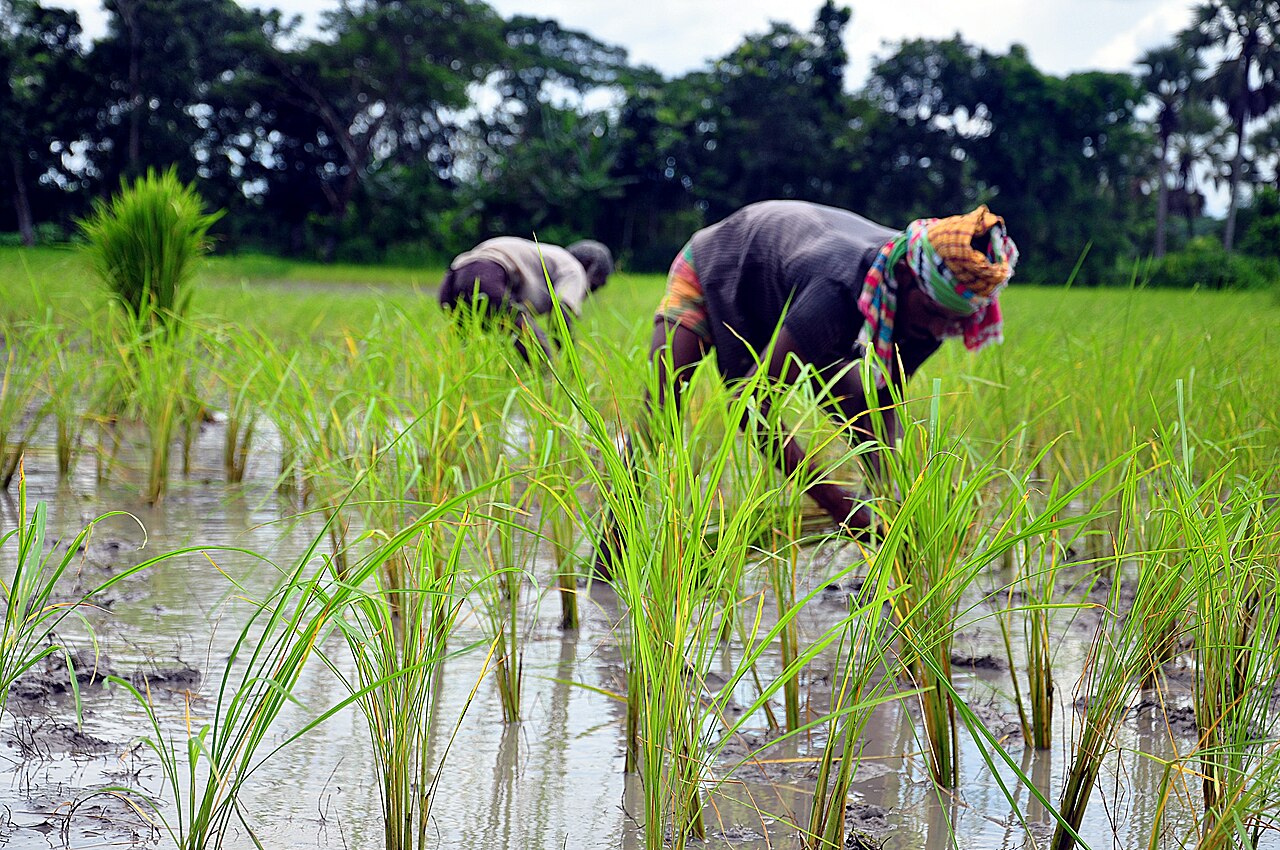
Cyclone Akvan swept across the south on 20 November, bringing four days of continuous rain from 19 to 22 November. Eight days after the cyclone, on 28 November, water had still not drained from farmland in many parts of Pirojpur. According to the Department of Agricultural Extension, crops on 3,467 hectares in the district are at risk: 3,250 hectares of aman rice, 105 hectares of grass pea and 112 hectares of winter vegetables.
On 28 November in Pirojpur Sadar and Zianagar upazilas, aman rice lay flattened in knee-deep water in places, and elsewhere ears of grain floated on the surface. The damage is worst in Pattashi, Indurkani Sadar, Chandipur and Balipara in Zianagar. In Kaibartakhali, Hularhat, Baneshwarpur, Tona, Kumirmara, Gazipur and Sharikatala in Sadar upazila, broken embankments let water into the fields. Low-lying fields in Bhandaria and Mathbaria are also waterlogged, and farmers fear the rice will rot.
Ziauddin Sheikh of Chandipur in Zianagar spent Tk 40,000 planting aman on about two bighas; the rice on about 16 kathas has collapsed into the water, and since it has not ripened he cannot harvest it. Bazlur Rahman Khan, 65, of Baneshwarpur said water came in over and through the embankment; even rice ready for harvest cannot be cut by workers or machines in the mud, and his plans to sow rabi crops after the harvest are now uncertain.
Jamal Howlader of Saidkhali lost much of his winter cauliflower, cabbage, tomato, bottle gourd, red amaranth and spinach. Tajul Islam of Charbaleshwar said the effect has reached the market: vegetable prices have nearly doubled in a few days, with cauliflower at Tk 80 a kilogram and aubergine at Tk 90.
Md Abul Kalam Azad, additional director of the extension department's Barishal region, and other officials have inspected fields in Bhandaria and nearby areas. Soumitra Sarkar, the department's deputy director in Pirojpur, said the district planted 64,344 hectares of aman, 2,250 hectares of grass pea and 2,200 hectares of winter vegetables this year.
He said the rain is pushing back the right time for sowing rabi crops. Sub-assistant agriculture officers are advising farmers on draining their fields, he said, and water on higher ground is slowly soaking away, which is limiting the damage somewhat. The report is by Desh Rupantor's Pirojpur correspondent.
Photo: Asifsaleheen / Wikimedia Commons (CC BY-SA 4.0)
Source: Desh Rupantor

Comments
(0)