
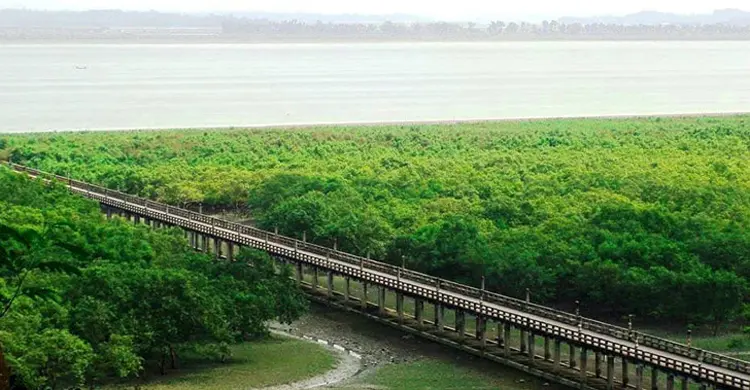
The government has taken up a plan to build a green belt in the tourist city of Cox's Bazar, restore its ecology and develop eco-tourism. Himchhari and Medhakachhapia national parks will get a new look, and trees will be planted in Cox's Bazar Sadar, Ramu, Ukhiya, Teknaf, Chakaria, Kutubdia, Pekua and Maheshkhali. The Forest Department is carrying out the Tk 42 crore 16 lakh 56 thousand project, of which Tk 24 crore 68 lakh 87 thousand will go on afforestation.
Although the project is built around afforestation, a large share of the money will go on infrastructure and vehicles, which the Planning Commission has questioned. There are also Tk 3 crore for allowances and administration, Tk 56 lakh for training and Tk 1 crore 5 lakh for repairs and maintenance.
Cost and time overrun
The work falls under the project for creating a green belt, restoring ecology and developing eco-tourism in Cox's Bazar district (first revision), which the Planning Commission has already revised. The project was to run from July 2019 to June 2024 at a cost of Tk 37 crore 61 lakh 65 thousand. It is now being extended to June 2025, and the total cost is rising to Tk 42 crore 16 lakh 56 thousand, an increase of 12 per cent.
The Forest Department says afforestation will cost Tk 2 crore 33 lakh in Cox's Bazar Sadar, Tk 6 crore 77 lakh in Ramu, Tk 4 crore 19 lakh in Ukhiya, Tk 3 crore 49 lakh in Teknaf, Tk 3 crore 92 lakh in Chakaria, Tk 98 lakh in Kutubdia, Tk 93 lakh in Pekua and Tk 2 crore 3 lakh in Maheshkhali.
Asked about the high infrastructure spending, Bipul Krishna Das, conservator of forests for the Chattogram region and project director, told Jagonews: "The project has infrastructure development as well as afforestation. Besides, I am new to the project. I don't implement the project. I have been working on it for nine to 10 months, and it started in 2019."
On the rise in time and cost, he said: "No work was done for a year because of corona. Also, afforestation rates have gone up. That is why time and cost increased. The project was revised because afforestation rates and maintenance costs rose."
Project aims
The project will create 80 hectares of new jhau (casuarina) plantation, plant 100,000 saplings to fill gaps in existing jhau plantations, plant 10,000 palm trees, create 5 hectares of coastal plantation and 10 kilometres of golpata (nipa palm) plantation. It aims to restore the ecology of 2,750 hectares of natural forest through planting and intensive care, reduce poverty among 2,500 forest-dependent local families and their dependence on the forest, and develop eco-tourism by improving recreation facilities. A key aim is to raise visitor numbers at Himchhari and Medhakachhapia national parks by 10 per cent.
Works at Himchhari
Planned works at Himchhari National Park include a 600 square metre boundary wall, a 50 square metre orchid house, a 50 square metre cactus house, 14 RCC benches of natural design, 10 dustbins designed as animals and birds, and three umbrellas on RCC pillars with round benches beneath. There will also be railings and a platform of stainless steel pipe beside Himchhari waterfall for visitors' safety, a stairway with a boat shed, a 44,000 cubic metre lake, a 2,050 running metre walkway around the lake, toilets with four washrooms, 2,000 square metres of stairs in Himchhari park and two car parks.
The project also includes 500 running metres of road, an approach road and a water supply system.
Source: Jagonews24. First published in Bengali on The Agro News.
Comments
(0)