
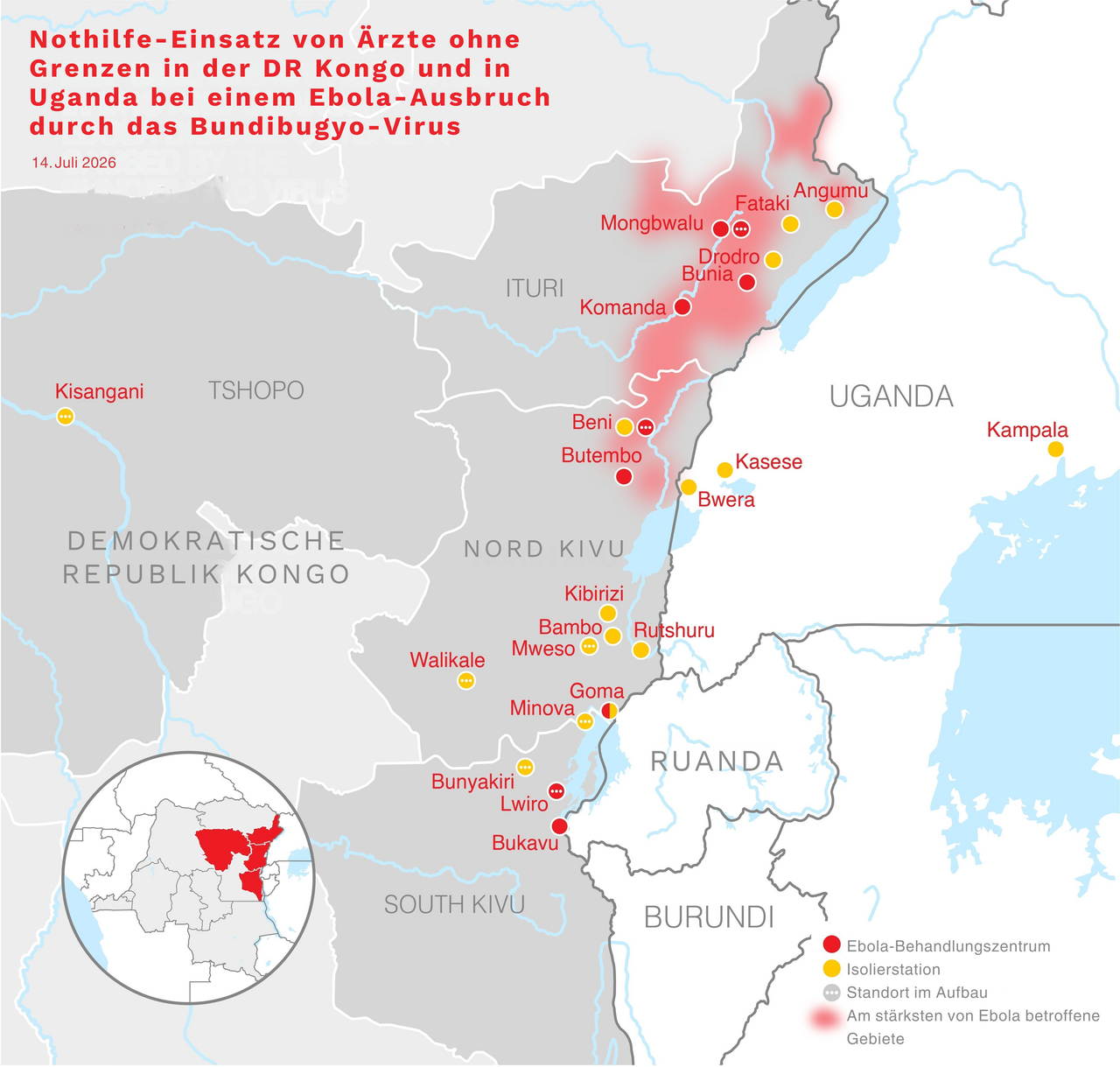
Hundreds of millions of US dollars allocated to fight the Ebola outbreak in the Democratic Republic of Congo are not reaching the people they are meant for, the medical charity Médecins Sans Frontières (MSF) has warned. Its report says the outbreak is still "out of control", yet front-line health workers are not paid regularly, lack training and are short of emergency equipment. In some places ambulances have stopped running because they ran out of fuel.
Since the outbreak was declared in May, more than 11,000 people have been infected and more than 5,400 have died, making it the second deadliest Ebola outbreak on record. Caused by the relatively rare Bundibugyo strain, it has spread beyond Congo to Kenya, Uganda and Nigeria. There is no approved vaccine or treatment for this strain yet, though trials are under way. In Kenya, the last patient left hospital recovered on Wednesday.
A month earlier, the Africa Centres for Disease Control and Prevention (Africa CDC) said that of $962 million given to implementing agencies, $700 million could not be accounted for. Its head, Jean Kaseya, said at the time that it was too early to call it embezzlement, but that it was a major failure of financial transparency and reporting. Congo's health minister, Samuel-Roger Kamba, agreed: only 22 per cent of aid agencies had met the rule to file details of their work with the ministry. "Our demand is clear: there must be 100 per cent transparency," he wrote on X.
MSF says some Ebola "surveillance teams" exist only on paper. Contact tracing, finding and isolating everyone who has been near an infected person, is one of the main ways to stop Ebola, and although it is funded, surveillance is very weak. As a result, two thirds of all deaths are happening outside treatment centres, in the community. The British epidemiologist Neil Ferguson told Reuters that more than half of cases are going undetected, which means the outbreak could last another year.
The charity says urgent areas such as North Kivu and Haut-Uele provinces are badly neglected. Health centres in both lack water, chlorine and basic patient triage, so some have themselves become new sources of infection. "Six months into the outbreak, this situation is simply unacceptable," said MSF president Javid Abdelmoneim. MSF has called on the Congolese government and UN agencies to strengthen monitoring and accountability for the money already released.
Eastern Congo, the centre of the outbreak, has been torn by armed conflict for decades; several affected areas are held by rebels and roads are poor. On Thursday the UN and the Congolese government warned of acute food shortages in the Ebola-hit areas, where about 10 million people need urgent help.
This report is based on a story by the Ajker Patrika desk, drawn from BBC reporting.
Photo: Sophie Müller / Wikimedia Commons (CC BY 4.0)
Source: Ajker Patrika

Comments
(0)