
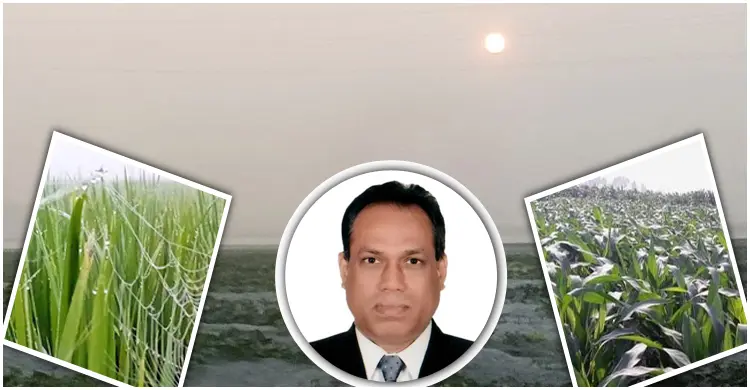
Intense cold and dense fog are ruining boro seedbeds and damaging farmers' fields of beans, bottle gourd, bitter gourd, sweet pumpkin, potatoes and other vegetables. At this point in the season, the fields hold winter crops such as potato, tomato, aubergine, chilli, mustard and beans. In some places boro seedbeds are still in the ground, while elsewhere boro seedlings have been transplanted.
Farmers and field-level agriculturists fear that the ongoing cold wave will cause cold injury to boro seedbeds and transplanted rice and bring late blight to potatoes. This kind of weather helps wheat, but if rain falls the fungal blast disease could spread. Temperatures in various parts of the country have already fallen to 7-8 degrees Celsius, so farmers' worries over boro seedbeds and potatoes keep rising. Transplanted boro is not thought to be at risk, but some concern remains over the seedbeds.
Wheat encouraged again
In the past few years the government discouraged wheat farming in some areas because of blast disease, but the situation is different this time. Having overcome that setback, the Ministry of Agriculture has taken steps to expand wheat cultivation this season.
Boro seedbeds are being ruined by intense cold and dense fog, and spraying various fungicides is not doing much good. According to the Meteorological Department, a cold wave is sweeping the country and may continue. Temperatures in the north, known as the country's granary, have started to plunge. There are fears that dying seedbeds could cause a shortage of boro seedlings. Farmers say they are spraying fungicide on the seedbeds and covering them with polythene against the fog. The cold also causes problems for boro seedbeds.
Blight in potato fields
When fog increases in winter, potato blight appears. "Potato plants cannot stand the cold," as a farmer put it, "so when fog falls we worry." Blight appears in tomato fields as well. After several days of dense fog and bitter cold, potato farmers in Bogura and Joypurhat are anxious. On bigha after bigha, potato leaves are curling and leaves and stems have started to rot. Farmers are applying fungicide every four days. A month and a half to two months after planting, stems and leaves are being attacked and the plants are dying. The agriculture department says pesticide must be sprayed at least once a week to protect the crop from this rot, known as late blight or "morok".
People involved say the cold has intensified in the Rangpur region in recent days. With fog covering much of the day, fungus has attacked the fields. In places seedlings are turning yellow and drying up, and in many seedbeds seedling burn and scorch have appeared. Seedlings 10-15 days old in the field are turning white or reddish and dying.
The agriculture directorate concerned, however, says the cold has not reached the point of destroying seedbeds completely. In its view, "The cold has not yet become intense enough to destroy seedbeds completely. Seedbeds that have been affected will recover as soon as the temperature rises a little."
Why boro matters
Agriculture specialists say boro makes up the lion's share of the country's rice production, and its yield is comparatively higher. While aus and aman yield 2.55 and 2.50 tonnes a hectare respectively, boro yields more than 4 tonnes. A fall in boro output would have a strongly negative effect on the whole year's production, so officials of the Bangladesh Rice Research Institute (BRRI) are urging that the issue be taken very seriously.
Chief scientific officers of the plant pathology division said extra steps were essential during a cold wave, or it would affect overall boro production. To protect seedbeds from the cold wave, they advised keeping tube-well water standing in them, covering them with polythene if possible, shaking off dew when it falls, and applying fungicide and 280 grams of urea per decimal.
Production targets
The Ministry of Agriculture has set a target to raise potato production this season over last year. Meanwhile, as the use of maize in poultry feed and other supplementary feeds has grown in recent times, its cultivation is also increasing.
Last year boro production, including hybrid, high-yielding and local varieties, was 3.65 tonnes a hectare; this year the DAE is working to reach 4.24 tonnes. The government wants to lift wheat yield from 3.64 tonnes a hectare last year to 3.65 tonnes this season. The DAE is also working towards a maize yield of 10.36 tonnes a hectare, while the potato target has been set at 24.27 tonnes a hectare, up from 23.50 tonnes last year.
Source: Jagonews24. First published in Bengali on The Agro News.
Comments
(0)