
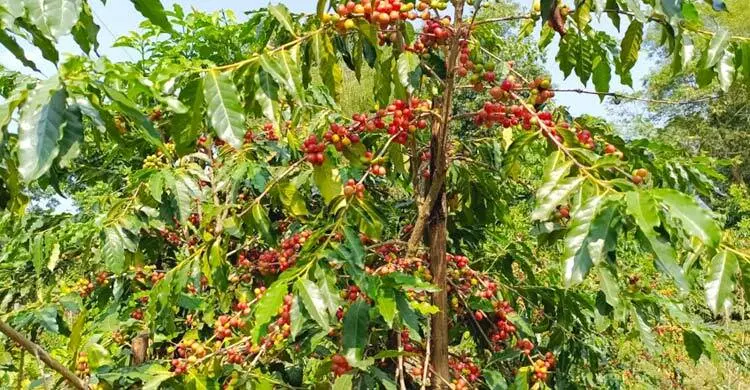
Md Chhanowar Hossain (50) of Tangail gave up teaching and has earned a name as a successful farmer. After bananas, pineapples, maize, papaya, dragon fruit, guava and various vegetables, he has now succeeded with coffee too. He produces about one tonne of coffee a year on average.
His orchard grows at least 10 kinds of fruit including coffee. Chhanowar is now a model farmer for local people in producing safe fruit, and many come to the village to see his coffee garden and seek farming advice. Beyond being a model farmer, he has received state recognition as a successful farmer, the Bangabandhu Krishi Swarnapadak (Bangabandhu Agriculture Gold Medal).
He has also shown the bright prospects of coffee, like pineapple, banana and papaya, on the high red soil of Madhupur Garh in the district. Following this, the agriculture department has started work to add coffee as a new crop in the region. Madhupur upazila agriculture officer Shakura Namni said the department has already taken steps under the Cashew Nut and Coffee Research, Development and Extension project, including training farmers, distributing coffee seedlings and boosting production.
From teacher to farmer
Md Chhanowar Hossain is the son of Jamal Hossain of Mahishmara village in Madhupur upazila, Tangail. He passed his SSC from Chapri High School in Madhupur in 1988, his HSC from Kalihati College in 1990 and his degree from Madhupur College in 1992. From 1993 to 1998 he was an English teacher at Rengahajiganj High School in Sylhet, and for the next two years he was headmaster of Garobazar Sunamganj Public School in Ghatail in the district. He then left teaching and started farming in his village.
How coffee is grown and processed
Coffee seedlings look much like debdaru (mast tree) seedlings. Ripe coffee cherries are bright red, some like raw turmeric yellow, while unripe ones are green. Each mature plant starts flowering between March and mid-April. Besides coffee, Chhanowar Hossain's orchard is full of 280 dragon fruit pillars, 19 Saudi date palms, 500 papaya, 1,000 malta, 500 lemon, pineapple, medicinal plants, banana and pomelo trees. He now farms about 15 acres.
Flowers turn into berries between May and June, and the berries mature from mid-August to September. The reddened coffee fruit is collected and first washed well in clean water, then soaked in water for a long time. Once it softens a little, the outer skin is removed, and the beans are dried in the sun. To make it ready for market and for drinking, it is ground into powder by machine. Seedlings can also be raised from coffee seed. With a good crop and favourable weather, 750 to 1,000 kg a hectare and 5 kg a plant a year can be obtained, and once they start bearing, the plants give coffee for 20 to 30 years.
Coffee spreading in Madhupur
The Madhupur upazila agriculture office said 120 farmers in Madhupur have so far started growing coffee on 35 hectares under the Cashew Nut and Coffee Research, Development and Extension project. To expand cultivation, in the 2021-22 fiscal year the project trained farmers and in the first phase distributed 7,500 coffee seedlings among 53 farmers. Most recently, in the 2023-24 fiscal year, seven demonstrations were set up and 135 seedlings given to each, 945 in all. The agriculture department has distributed about 8,500 coffee seedlings so far.
Although there are 60 species of coffee in the world, commercial cultivation of arabica and robusta has begun in the area. With suitable weather and climate, special work on growing high-quality, aromatic coffee is under way in the Madhupur hill area. The agriculture department also said the weather and soil of Bangladesh's hill region and Tangail's Madhupur Garh are well suited to robusta coffee.
Coffee farmer Chhanowar Hossain told Jago News: "In 2017 I collected 200 seedlings from Raikhali in Rangamati district and started the first coffee cultivation in the upazila. I have been able to sell coffee since two years after starting. I now have coffee on about 50 decimals of land. My garden has arabica and robusta coffee plants. Every year I can sell about one tonne of coffee on average. I also raise seedlings from coffee seed."
"At present 500 coffee plants in my garden are bearing," he said. "Over the past seven years the coffee garden has cost me about Tk 3 lakh, but I have already earned almost double that. I hope to earn like this for 20 years."
Chhanowar said he sells his green coffee through a cosmetics company at Tk 2,000 a kg. His coffee has 18 kinds of taste and aroma. The beans must be ground by machine to make them ready for market and drinking, and processing is the hard part, so he has bought a coffee processing machine. "My dream now is to turn coffee into a big industry," he said.
Coffee is being grown successfully in Madhupur and a few other places in the country, both as a hobby and commercially, and it shows great potential. Chhanowar believes a coffee revolution is possible by harnessing farmers' interest.
Officials see bright prospects
Madhupur upazila agriculture officer Shakura Namni told Jago News: "Arabica and robusta coffee are grown in the upazila. Farmer Chhanowar Hossain started growing coffee in 2017, and the agriculture department has since trained farmers and distributed seedlings through the Cashew Nut and Coffee Research, Development and Extension project."
"There are now 120 coffee farmers in the upazila, cultivating 35 hectares," she said. "Farmer Chhanowar Hossain sells coffee on his own initiative, but commercial processing has not started. In the 2023-24 fiscal year, seven demonstrations were set up for seven farmers and 135 seedlings each, 945 in all, were provided."
Md Kabir Hossain, deputy director of the Department of Agricultural Extension (DAE) in Tangail, told Jago News: "The fertility of Madhupur's soil suits coffee. Flood water does not easily reach the area, and there is not much drought either. Together, the rainfall and soil structure give the red soil of the Garh area bright prospects for coffee."
Source: Jagonews24. First published in Bengali on The Agro News.
Comments
(0)