
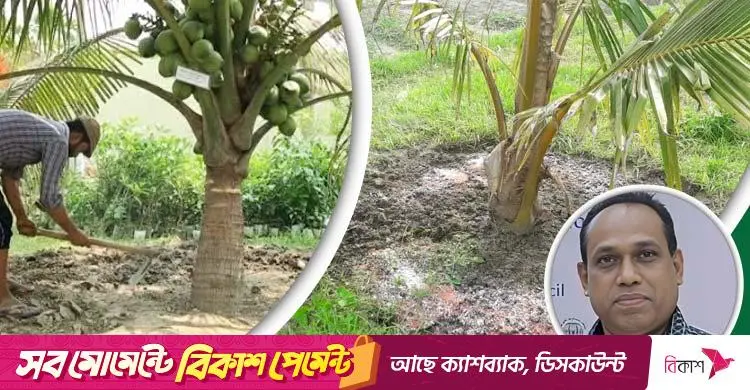
Coconut is an important plantation cash crop in the coastal and southern areas of Bangladesh. Its fruit, leaves, trunk and other parts can be used in many ways and are economically profitable. Coconut is not only a source of food and oil but is also used in construction, religious rites and medicine. Coconut growing is most common in the Khulna, Barishal, Patuakhali, Bhola, Chattogram and Cox's Bazar regions.
Recently, climate change, rising soil salinity, the steady loss of farmland and unregulated cultivation have caused some problems in coconut production. But production can be improved considerably with modern farming methods, the right choice of variety, fertiliser, irrigation and disease management. Scientific, modern fertiliser practices are therefore needed, which will benefit farmers financially and contribute to the national economy.
Applying fertiliser correctly to coconut trees raises yields considerably and keeps the trees healthy. The rules for fertilising coconut trees are set out below.
When and how much
- Timing: it is best to apply fertiliser twice a year, in June-July (the start of the monsoon) and November-December (the start of winter).
- Annual dose per mature tree: urea 500g, TSP 325g, MoP 650g and cow dung manure 15-20kg.
- Method: dig a ring-shaped trench 15-20cm deep at a distance of 1 to 1.5 metres around the base of the tree. Spread the fertiliser in the soil, then cover it with soil and water lightly, especially in the dry season.
- Trees aged three to five years should be given half the dose. Keep the ground under the tree free of weeds, and make sure there is proper drainage.
Why balanced feeding matters
Applying fertiliser regularly and in the right amounts is very important for the healthy growth of coconut trees, higher yields and long-term productivity. The timing and quantity may vary with soil type, the age of the tree and the environment. In general, however, applying a balanced mix of organic and chemical fertiliser twice a year (before the season and at the end of the monsoon) supplies the tree with the nutrients it needs.
Applying fertiliser regularly in pits or in a ring around the tree makes it easier for the tree to take up. Yields rise further when fertiliser management is combined with irrigation and weed control. Following the correct method and applying balanced fertiliser to coconut trees can therefore ensure sustainable production in the long term.
Source: Jagonews24. First published in Bengali on The Agro News.

Comments
(0)