
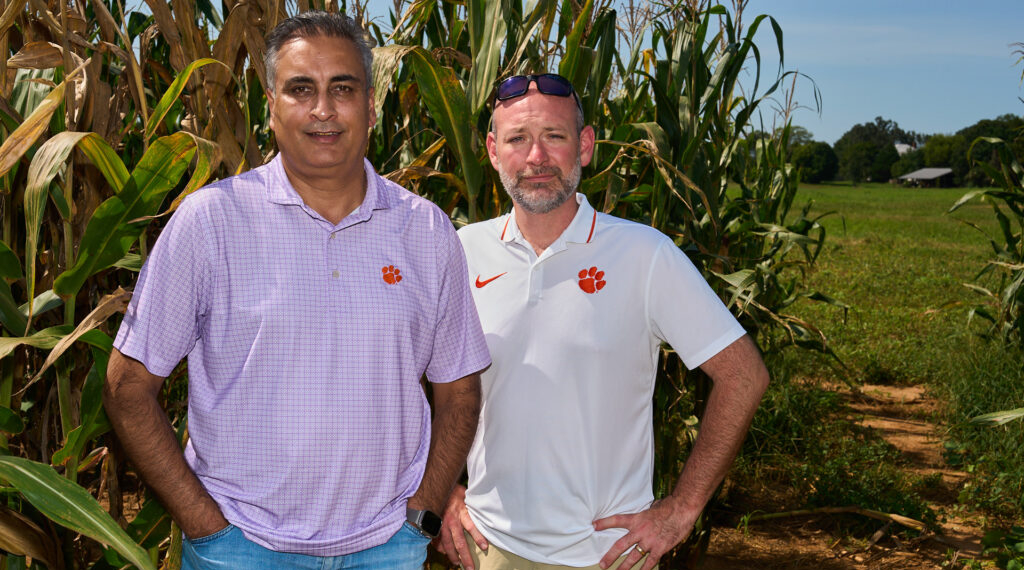
Clemson University is to lead the genetics side of a new national research project that aims to breed corn plants less likely to bend or break before harvest. The work sits inside a four-year, $6 million National Science Foundation grant that brings together plant geneticists, engineers, statisticians and artificial-intelligence researchers from Clemson, the University of Nebraska Medical Center and the University of Idaho, which leads the project.
Clemson's share is $2 million. Rajandeep Sekhon, associate professor in the Department of Genetics and Biochemistry, is the university's principal investigator and will direct the systems-genetics and maize-biology work, focusing on how genetic variation shapes the biological and structural traits that decide whether a stalk stays upright.
Stalk lodging is a costly problem. A peer-reviewed study by Clemson researchers and collaborators put global maize yield losses from lodging at more than $6 billion a year. When mature plants go down in high wind or under other stress they become more vulnerable to pests and disease and often cannot be harvested at all, cutting both the size and the quality of the crop.
The team plans to work backwards from the standing plant to its DNA. Researchers will grow about 1,000 maize inbred lines in South Carolina field trials, compare lines with strong and weak lodging histories, and measure stalk strength, stiffness, diameter, rind thickness and cell characteristics, tracking how stalk chemistry changes as the plants develop. "It's almost like reverse engineering the strong plant versus the weak plant back to the DNA, so we can identify the genetic and biological factors that allow a plant to remain standing," Sekhon said.
Because lodging is not governed by a single gene, the project leans on statistics. Chris McMahan, a professor in Clemson's School of Mathematical and Statistical Sciences, will build the statistical and machine-learning models that combine the project's many data sources and, with the Nebraska group, decide which genetic markers deserve the closest attention. Clemson colleagues Nishanth Tharayil and Trevor Rife bring plant metabolomics, cell-wall chemistry and high-throughput phenotyping to the effort.
The University of Idaho team will develop automated sensing systems, including technology that could eventually ride on plot combines, so that mechanical data can be collected on far more plants during harvest than manual testing allows. The researchers say the same DNA-to-performance approach could later be applied to other crops and traits.
The stated goal is roughly 500 validated alleles that breeders can use to select for stronger, lodging-resistant corn. "Ultimately, that could mean fewer losses in the field, more reliable harvests for farmers and more resilient food production," Sekhon said. The report was released by Clemson University.
Source: Morning Ag Clips

Comments
(0)