
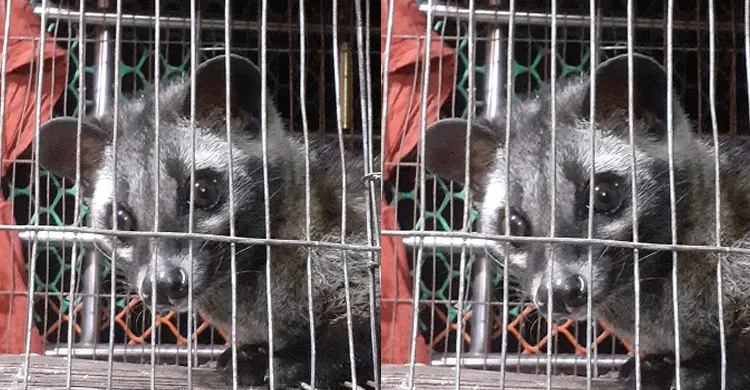
An Asian palm civet, an endangered wild animal known locally as gandhagokul, became trapped on the third floor of a residential building in Boalkhali, Chattogram, after coming in search of food. It was trapped at around 9pm on Saturday (18 February) in the home of Nigar Sima Tuli at Mirpara in the municipal sadar. By the time this report was written that night, no one from the forest department had come to rescue it.
Nigar Sima Tuli said: "For the past week this animal has been climbing up the building's cornice and getting into the flat to steal food. Even though I noticed the theft, I kept feeding it. It eats things like biscuits and chicken. At around 9pm on Saturday it came in and could not get out again. I then informed the forest department people. They said they would come and take it."
"The animal is giving off a kind of smell," she said. "Thinking of its safety, I did not let it out among people. I will hand the civet over to the forest department."
Azam Khan, a forest department employee, said: "On Saturday a civet got trapped after entering a house in search of food. It will be rescued and released into the forest."
About the gandhagokul
The animal's English name is Asian palm civet and its scientific name is Paradoxurus hermaphroditus. It is also known locally as Eshio talkhatash, bhondor, lenja, sairel or gachkhatash. The civet is one of the wild animals that most often come into human settlements. It comes out at night in search of food, which is mostly when people see it.
The civet is currently considered an unprotected animal, and its numbers are falling as old trees and forests disappear. The International Union for Conservation of Nature (IUCN) has placed it on the list of the world's endangered animals.
Under Schedule 1 of Bangladesh's Wildlife (Conservation and Security) Act 2012, the civet is a protected species.
Source: Jagonews24. First published in Bengali on The Agro News.

Comments
(0)