
Citrus fruit, including lemons, oranges and malta, is an extremely important fruit worldwide. It ranks second among the world's fruits in production but first in international trade. Bangladesh's climate is very well suited to citrus, especially elachi lebu, kagzi lebu, pomelo (jambura), oranges and malta. Annual citrus production in the country is about 40,000 tonnes. Lemons are an essential fruit in daily life, adding flavour to food and making refreshing sherbet.
A bacterial disease
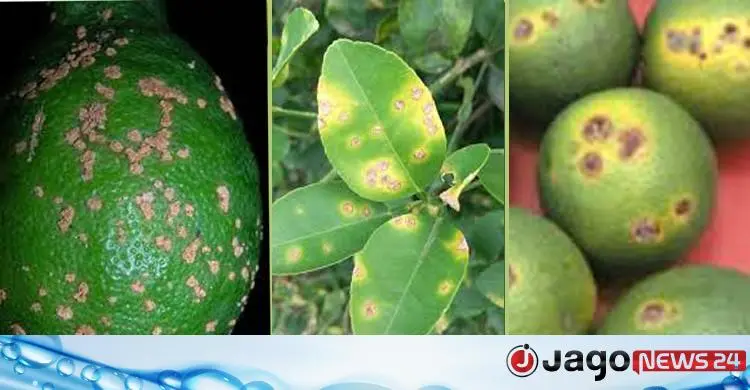
One of the most harmful and serious diseases of lemons is canker, a bacterial disease. The pathogen can survive in the soil for 8–10 days, but it is quickly destroyed by light or sunshine. It attacks every part of the tree above the ground: leaves, fruit and stems. The bacteria usually enter through wounds and leaf pores (stomata), so when strong winds in the rainy season wound the trees, the risk of infection rises.
Symptoms
Canker affects the branches, fruit, leaves, fruit stalks and shoot tips. At first small yellow spots appear on the affected parts. Later the spots merge and become thick and large. These blister-like spots have a yellow halo around them, seen mostly on the leaves. Sometimes the fruit skin cracks, and the upper leaves of the tree drop.
The disease leaves raised brown blister spots on leaves, fruit and stems, on both the upper and lower sides of the leaves. The spots start yellow and gradually turn brown. Old leaves are infected and fall, while new leaves grow poorly and become deformed. If the attack is severe, the tree dies.
Causes
Attack by the citrus leaf miner brings on the disease. It is seen more during storms and rain because it is a waterborne bacterial infection, so it is more common in the monsoon. It also occurs in excessively cold and wet conditions, where water stands in the field, and where the trees lack nutrients.
Organic management
- When setting up an orchard, keep the correct spacing between seedlings. If necessary, leave a little more space between plants and between rows so that stormy winds do not wound the trees.
- Collect disease-free lemon seedlings from healthy, vigorous mother trees and plant those.
- Inspect the lemon field regularly for leaf miners and take control measures as soon as an attack appears.
- Collect and burn diseased leaves, branches and fruit.
- Tend the orchard while the leaves are dry.
- Prune lemon trees before the monsoon and burn the prunings, then apply Bordeaux mixture at the correct dose.
- Uproot dead trees infected with canker and burn them quickly.
Chemical management
Mix copper oxychloride or copper at 1.5 g per litre of water and spray three times at four-day intervals. Because the disease is more common during storms and rain, spray every 15 days throughout the rainy period. Spray when the first symptoms appear; the spray can also be used as a preventive.
Precautions
It is best to spray in the morning or afternoon, when the sun is weaker. Do not overuse the chemical, and spray again if it rains. Wear gloves and a mask while spraying, and wash your hands and face well afterwards. Spraying should usually be stopped 7–10 days beforehand. Store the chemical in a dry, cool place out of the reach of children.
Source: Jagonews24. First published in Bengali on The Agro News.

Comments
(0)